
The First Jewish Philosopher and Torah Commentator

A 16th-century illustration of Philo Judaeus
Yedidya “Philo Judaeus” HaKohen (c. 20 BCE – 50 CE) was born to a wealthy Jewish family of kohanim in Alexandria, Egypt, which was then part of the Roman Empire and had one of the largest Jewish communities in the world. His father had earned Roman citizenship from Julius Caesar, and his nephew was a Roman prefect and military commander. Philo received an extensive education in Judaism, as well as the wisdom of Rome, Greece, and Egypt. He became a well-known philosopher and scholar, and a leader of Alexandria’s Jewish community. Around 37 CE, he led a diplomatic mission to the emperor Caligula to seek the end of the oppression of Jews in Alexandria and to reaffirm Jewish civil rights. He also convinced Caligula not to put a statue of himself in Jerusalem’s Holy Temple, for that would surely instigate a war, and explained why the Jews could not accept him as a deity or worship him in any way. Philo is most famous for his written works, producing what may very well be the first commentary on the Torah. He also wrote several texts to explain Judaism to the non-Jewish world, and a number of detailed works about the Roman Empire—now a gold mine for historians. He was also the first to synthesize Greek wisdom with Jewish wisdom (and in this regard, predated the great Maimonides by more than a millennium), and demonstrated how many fundamentals of Greek philosophy had already been laid out in the Torah long before. Philo advocated for a democratic government with the Torah serving as the constitution. Because of his numerous easy-to-understand Greek explanations for the Torah, Philo’s works ironically became more popular among Christians, and mostly forgotten in Jewish tradition. Nonetheless, he was a noted defender of Judaism at a difficult time of persecution, an important scholar and advocate on behalf of the Jewish people, and an inspiring philosopher and political figure. Interestingly, he is the first to mention the custom of staying up all night on Shavuot to learn Torah and recite holy hymns, in his description of a group of Jews associated with the Essenes and the Dead Sea Scrolls.
Shavuot Begins Saturday Night! Chag Sameach!
The Mystery and Mysticism of the Essenes
Video: Why NBA Legend Amar’e Stoudemire Learns Torah
Words of the Week
The best data we have are exactly what I would have predicted, had I nothing to go on but the Five Books of Moses and the Bible as a whole.
– Arno Penzias, Nobel Prize-winning discoverer of the Big Bang
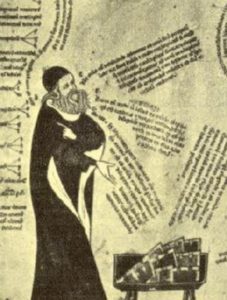 Avraham bar Chiya (c. 1070-1145) was born in Barcelona to a Sephardic Jewish family. It appears that his family was persecuted by its Christian rulers, so they fled to the neighbouring Arab kingdom of Zaragoza. Bar Chiya came from a long line of rabbis, and was also extensively trained in science, math, and astronomy. Famed for his wisdom, he became the court astronomer of Al-Musta’in II. Eventually, he was appointed minister of police and given the title sahib al-shurtah, “city governor”. This is why he was known in the Jewish community as HaNasi, “the prince” or “the president”. Al-Musta’in II was unable to defend his domain from the Christians, who soon took over. Bar Chiya moved to southern France for a while and lived in Narbonne and Provence. There he composed some of the most important scientific texts of the Medieval era. He translated a number of Arabic works into Latin, opening their study for Europeans, and played a key role in introducing the Hindu numerals we use today (by way of Arabia) to Europe, and thus to the rest of the world. Bar Chiya also synthesized ancient Greek wisdom with contemporary Arabic knowledge, and published new discoveries in number theory, arithmetic, geometry, optics, astronomy, and music theory. His Treatise on Measurement and Calculation inspired later greats like Plato of Tivoli and the world-famous Fibonacci. Meanwhile, Bar Chiya also served as the chief rabbi of the Jewish communities he presided over, and composed two important Jewish commentaries and texts. He is credited with being the first person to write a scientific book in Hebrew, and played an instrumental role in the development of the Hebrew language. His disciples included both Jews and non-Jews, among them the great