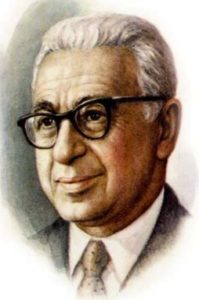
 Matvei Isaakovich Blanter (1903-1990) was born in the Russian Empire in a small Ukrainian town. He studied music and became a master pianist and violinist. In the 1920s, Blanter became popular for his dance and jazz songs. After the rise of Stalin, he was “recruited” to write propaganda pieces and composed some of the Soviet Union’s greatest hits. In 1938, he wrote the music for the internationally-acclaimed song “Katyusha”, by far the most well-known Russian tune in the world. (Click here to listen.) It was so popular that it lent its name to one of Russia’s most famous military weapons: the Katyusha rocket. A recent poll found that it is still the 13th most listened to song in Russia. Also in 1938, Blanter wrote “The Football March”, which would be played before every Russian soccer game – and still is today! All in all, Blanter composed over 200 songs. He was awarded the Stalin Prize and the People’s Artist of the USSR. In the last days of World War II, Stalin sent Blanter to Berlin to compose a victory symphony. He wound up with the Russian general right when a German delegation came to sue for a peace treaty. Blanter was quickly shoved into a tiny closet while the generals negotiated. Running out of air, he passed out and fell out of the closet, embarrassing everyone in the room. Some say this is the origin of the expression to “come out of the closet”.
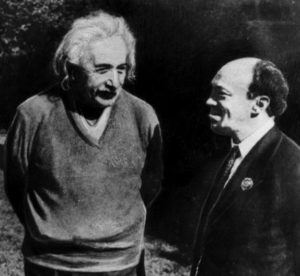
Mikhoels with Albert Einstein, during his 1943 fundraising tour
Blanter’s uncle was Shlomo Mikhoels (1890-1948). Born in Latvia to a religious Jewish family, he studied law in St. Petersburg before joining a Jewish theatre group. In 1920, Mikhoels co-founded the first Jewish acting studio in Moscow, putting on plays in Yiddish. Lenin soon turned it into the official State Jewish Theatre. By 1928, Mikhoels had become the theatre’s director, as well as its most famous actor. People came from around the world to see his legendary performances. One New York Times reviewer wrote that Mikhoels had put on “one of the most stirring performances of my theatre-going career.” His 1935 role as King Lear (in Yiddish) drew another critic to write: “I do not recall a performance that stirred me as profoundly, to the core, as Mikhoels’ performance of Lear.” Mikhoels had become one of the world’s best Shakespearean actors. He also played Rabbi Alter in Mazel-Tov, and Tevye in the Russian version of Fiddler on the Roof, among many other roles. In 1942, Mikhoels was made chairman of the Jewish Anti-Fascist Committee, and sent around the world to draw support from his fellow Jews for the Soviet war effort against the Nazis. This made him the first official Soviet representative to make such a trip, and he successfully raised millions. However, after the war ended Stalin became increasingly paranoid, and soon began another round of his purges, particularly of Jewish intellectuals. In 1948, he ordered Mikhoels assassinated, and made it look like a car accident. Nonetheless, Mikhoels was given a state funeral. Today, he is recognized as an important artist and pioneer of Russian theatre, and one of Moscow’s main cultural centres is named after him.
Words of the Week
He who has many friends has no friends.
– Aristotle
 Ezer Weizman (1924-2005), the nephew of Israel’s first president, Chaim Weizmann, was born in Tel Aviv and raised in Haifa. In his youth, he joined the Haifa Aviation Club and was flying planes by age 16. At 18, in the midst of World War II, he enlisted in the British Royal Air Force and served in Africa and India. After the war, Weizman lived in London and studied aeronautics. It was there that he joined the Zionist paramilitary group, Irgun. Weizman returned to Israel to fight in the Independence War. He was one of Israel’s very first fighter pilots, co-founded its air force, and participated in the first air force mission. He continued working for the army after the war, and in 1958 became the commander of the Israeli Air Force. He modernized the IAF, personally trained its pilots, and transformed it into the powerful and feared juggernaut that it is today. In 1967, Weizman was the IDF’s chief of military operations, and helped persuade the Israeli government to launch a preemptive strike against its aggressors. He directed the surprise attack on Arab air forces on the first day of the Six-Day War, totally destroying their air power and thus securing Israel’s lightning victory. (It has been said that the Six-Day War was won by the Israeli air force in the first six hours!) In 1969, Weizman – now a major general and deputy chief of staff – retired from the military and joined the Gahal political party (the precursor of Likud). He served as a Minister of Transportation and later as Defense Minister. He oversaw the development of Israel’s Lavi fighter jet, and the critical 1978 campaign in Lebanon (Operation Litani). Meanwhile, Weizman also became an important peace negotiator. He spoke Arabic fluently, and grew close to Egyptian president Anwar Sadat, who went so far as to call Weizman his “younger brother”. Not surprisingly, Weizman played a key role in Israel’s 1979 peace treaty with Egypt. He later founded his own party, Yachad, and sat on the Knesset between 1984 and 1992, serving as Minister for Arab Affairs and Minister of Science and Technology. A year after leaving the Knesset, Weizman was elected Israel’s seventh president. By this point, he had built a reputation as a dove, and worked hard to promote peace. He was credited with making the office of president more relevant in Israeli society, and was praised for his warmth and concern for all of Israel’s citizens, including Arabs and Druze. After being reelected to a second term, Weizman resigned as president in 2000, and passed away five years later. He has been voted the 9th greatest Israeli of all time.
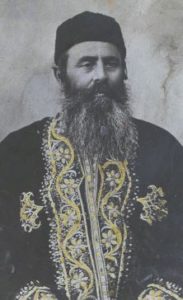 Shlomo ben Yakov Moussaieff (1852-1922) was born in the emirate of Bukhara (present-day Uzbekistan). Both a renowned rabbi and a wealthy businessman, he made aliyah to the Holy Land in 1888 – bringing with him forty cases of gold – and was one of the founders of Jerusalem’s famous Bukharian Quarter. Moussaieff built four synagogues, and homes for 25 poor families. Meanwhile, he published a prayer book and disseminated it widely, making it his mission to inspire more Jews to pray regularly. He also continued his business ventures, particularly in real estate, tea, silk, and gemstones. Moussaieff was an avid collector of rare manuscripts, and amassed an impressive library with 225 ancient texts, including prized manuscripts of Maimonides and the mystical teachings of the Arizal. Until his last days, Moussaieff was committed to the development of Israel, and stated in his will that only those of his seven children that remain in Israel would receive any inheritance.
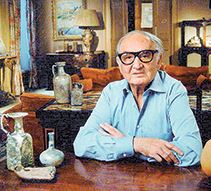 His grandson, also Shlomo Moussaieff (1923-2015), though better known as Sam, would become even more famous. One of twelve children raised in Jerusalem, Sam Moussaieff ran away from home as a teen to avoid his strict father. Living in a synagogue, he worked for a carpenter and sold ancient coins he would find in Jerusalem’s caves and tombs. Once arrested by Arab policemen, he ended up in a Muslim school for nearly a year, becoming proficient in Arabic and the Koran. At 17, Moussaieff enlisted in the British Army to fight the Nazis. After World War II, he fought for Israel’s independence and was captured by the Jordanians, who imprisoned him for a year. Moussaieff returned to Jerusalem and joined the family jewellery business. He soon opened his own antiquities shop in Jaffa, at times getting in trouble for smuggling goods. In 1963, Moussaieff was offered to have his record cleared of legal issues, as well as the rights to an exclusive shop in London’s Hilton Hotel, in exchange for handwritten letters from Maimonides which he owned. Moussaieff accepted and moved to London. His shop soon specialized in jewellery, and he became the dealer of choice for wealthy barons from Arab oil states thanks to his pristine Arabic. Moussaieff became world-renowned for his extremely rare and special gems. He owned the most precious stone in the world: a red diamond valued at $20 million. In 2011, he was ranked among the richest Londoners, with an estimated worth of some $350 million. Moussaieff amassed a personal collection of over 60,000 ancient artifacts, including millennia-old seals from Jerusalem’s First Temple, and reportedly even items associated with the forefather Abraham! His stated goal was to collect indisputable evidence proving the accuracy of the Torah. Moussaieff was given an honourary degree by Bar Ilan University (to whom he donated many artifacts, including his grandfather’s ancient manuscripts) which established the Dr. Shlomo Moussaieff Center for Kabbala Research. Interestingly, Moussaieff once purchased an ancient Torah scroll for $1 million from the Allenby family – who had the Torah because the elder Shlomo Moussaieff gave it as a gift to General Allenby during World War I!