Category Archives: Extraordinary Individuals

Unique Jews In a Category of Their Own

Jew of the Week: Helena of Adiabene

The Jewish Queen of Armenia 
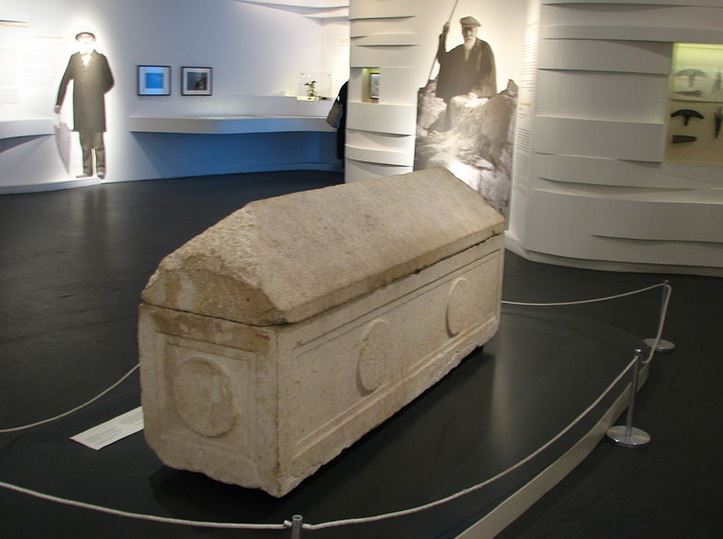
The Sarcophagus of Helena in the Israel Museum

The Sarcophagus of Helena in the Israel Museum

Helena of Adiabene (d. 56 CE) was the Queen of the Persian-Armenian kingdom of Adiabene, a vassal of the Parthian Empire. Essentially nothing is known of her early life. Around 30 CE, after the death of her husband, King Monobaz, she took an interest in Judaism, a little-known religion in her kingdom. After learning with a Jewish merchant named Chananiah, Helena decided to convert. Meanwhile, her son, King Izates, encountered Rabbi Eleazar of Galilee in his royal court and similarly began exploring the wonders of the Torah. Soon, both Helena and Izates, as well as her other son Monobaz II, officially converted to Judaism. In 46-47 CE, Helena traveled to Israel. Witnessing the ongoing famine, she was able to import grain from Egypt and figs from Cyprus to quell the hunger and save countless lives. Helena also commissioned several gifts for the Holy Temple in Jerusalem, including a special candlestick that would indicate the appropriate time to recite Shema Israel, a golden plate engraved with Torah passages, and golden handles for all Temple vessels. The palatial sukkah she had built in her homeland was reported to be over 40 feet high! Towards the end of her life, Queen Helena moved to Jerusalem and had a mausoleum built for herself where she was eventually interred. In the 19th century, her grave was discovered by French archaeologists. Meanwhile, her Jerusalem palace was discovered by Israeli archaeologists in 2007. Among the incredible finds in the palace was a proper mikveh. Ancient historians like Josephus wrote of Helena, and her story is even described in detail in the Talmud. The latter records that Helena was a devout Jewess, spending at least 7 years of her life as a nazirite, a special status of holiness in Judaism that may be loosely compared to a monk or nun. After Helena’s death, her children continued to support the Jewish people, even sending troops to assist Jewish rebels in fighting the Romans during the Great Revolt (66-70 CE), which ended with the destruction of the Second Temple. Ultimately, the Romans invaded Adiabene, too, in 115 CE. Within a few short centuries, the kingdom was all but forgotten.

Words of the Week

Disasters go out through the mouth and disease comes in through it. You must be constantly circumspect about what goes in and out of your mouth.
Kaibara Ekiken (author of Samurai manual ‘Yojokun‘)

Jew of the Week: Shula Cohen

Shula Cohen, "the Pearl"

Shula Cohen, “the Pearl”

Shulamit Cohen (b. 1917) was born in Argentina and raised in Jerusalem with her twelve brothers and sisters. Her father was from a wealthy Egyptian-Jewish merchant family, and her mother was the daughter of a prominent rabbi in Jerusalem. In 1936, the family experienced severe financial strain, and Shulamit’s father arranged her to marry Joseph Kishak-Cohen, a wealthy businessman from Beirut. Shula moved to Lebanon, and had five kids by the time she was 24. One day in 1947, she overheard people discussing military activities against Israel. Shula recorded the information in a letter to the Haganah, which was fighting for a Jewish state in Israel, addressing it to her brother in Jerusalem. Five weeks later, an agent of the Haganah’s secret service contacted her. For the next 14 years, Shula worked as an Israeli spy in Lebanon. Her work consisted of two major goals. The first was to gather intelligence about Arab military activities, which she was able to do by getting herself into Lebanon’s high society, including the home of the prime minister, who considered her like one of his own daughters. The second was to help smuggle Jewish families fleeing persecution in the Arab world, particularly from Syria. Over the years, she helped countless families find safe passage to Israel. Shula communicated with the secret service using invisible ink, under the code name “Pearl”. She was first caught for smuggling in 1952. Pregnant at the time, Shula was taken to jail just three weeks after giving birth, and spent 36 days in confinement. She continued her clandestine activities for another 9 years before things got too dangerous and she moved to Rome for three months. Upon her return in 1961, she was immediately arrested for espionage. The trial went on for several months during which she was brutally tortured. She was initially sentenced to death by hanging, but the verdict was softened because she was a mother of seven. Her sentence was reduced to 20 years of hard labour. During the Six-Day War in 1967, Israel captured Lebanese citizens, and used them in a prisoner exchange for Shula and a captured Israeli pilot. Shula has lived in Israel ever since, and still volunteers at schools and IDF bases, despite her advanced age. Two of her sons have high-ranking roles in the Israeli government. A book about her story has been published, called Shula: Code Name The Pearl.

UPDATE: Sadly, Shula Cohen passed away in May of 2017.

Words of the Week

Success is the ability to go from one failure to another with no loss of enthusiasm.
– Winston Churchill

Jew of the Week: Moe Berg

Baseball Player, Lawyer… and Secret Agent 

Moe Berg

Moe Berg

Morris Berg (1902-1972) was born in New York to Russian-Jewish immigrants. He began playing baseball at age 7, and by 16 was on Newark’s baseball “dream team”. He studied first at New York University, then Princeton, and graduated with a degree in languages, learning to speak seven of them. By his senior year, he was captain of Princeton’s baseball team. A day after his last game with Princeton, Berg signed a contract with the Brooklyn Robins. In the off-season, he headed to Paris and continued his studies at the world-famous Sorbonne (University of Paris). There, he began a personal routine of reading as many as 10 newspapers every single day. Berg was never very good at baseball, and was often traded and loaned between many different teams. Always a scholar first, in 1926 he told the Chicago White Sox that he is skipping spring training because he was enrolled in law school at Columbia University. He earned his law degree in 1930, and then split his time between baseball in the summer and working at a prestigious Wall Street law firm in the winter.

In 1932, Berg toured Asia, visiting Japan, China, Siam, India, and Egypt. A couple of years later, he returned to Japan with a video camera, later traveling to the Philippines, Korea, and Russia, before returning to play with the Red Sox for 5 seasons, then coaching the team for 2 more. After the attack on Pearl Harbor, Berg joined the war effort and eventually became a spy. He shared his video footage of Japan, which was instrumental in planning American raids during the war. After serving in South America and the Caribbean, Berg was parachuted into Yugoslavia to assist resistance groups fighting the Nazis. His next mission was to travel across Europe and convince scientists working for the Nazis (particularly on their nuclear bomb project), to come work for the U.S. instead. In 1951, he requested that the CIA station him in Israel. Instead, they sent him to Europe to spy on Soviet nuclear work. In 1954, the CIA let him go and for the rest of his life Berg lived with his siblings, having never married. His wishes were to be cremated, and his ashes were scattered in Jerusalem. Berg was inducted into the Jewish Sports Hall of Fame, and Baseball’s Shrine of the Eternals. He was awarded the Medal of Freedom, and his baseball card is on display at CIA headquarters. Berg was described as “the most scholarly professional athlete”, and the “strangest man ever to play baseball.”

Words of the Week

If you begin a good deed, finish it, for a mitzvah is credited to the one who concludes the task.
– Talmud, Sotah 13b