Father of Modern Physics
 Albert Einstein (1879-1955) was born in Germany, lived in Italy, and received his higher education in Switzerland. In 1905, Einstein exploded onto the science scene with 4 revolutionary papers on the subjects of the photoelectric effect, Brownian motion, special relativity, and mass/energy equivalence. By 1919 his research and theories were world-famous, with The Times reporting “Revolution in Science – New Theory of the Universe – Newtonian Ideas Overthrown”. He won the Nobel Prize two years later, for the photoelectric effect (not relativity!) In 1922, Einstein travelled the world, with a 12-day stop in Israel, during which he said “I consider this the greatest day of my life.” In 1933, he moved permanently to the US due to the Nazi rise to power. The Nazis raided his house, publicly burned his writings, and even put a bounty on his head worth $5000! Of them, he said, “I must confess that the degree of their brutality and cowardice came as something of a surprise.” Fearing the Nazis would develop an atomic bomb, Einstein penned a letter to President Roosevelt persuading him to start a nuclear weapon research program. Einstein would later call this the greatest mistake of his life – but a necessary one.
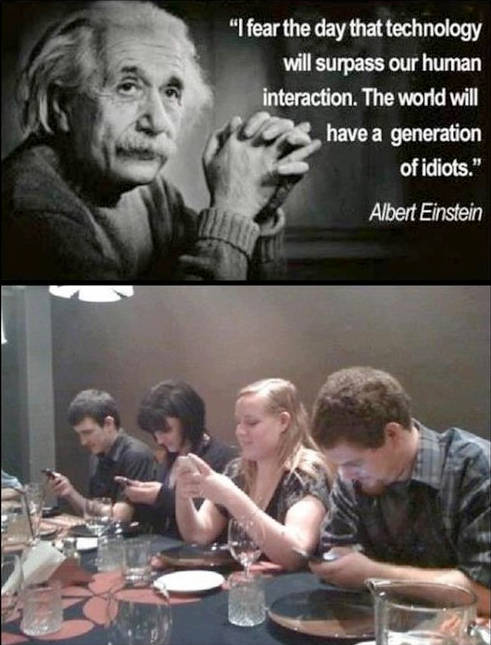
Einstein Predicts the Future…?
He spent the rest of his life researching, teaching and writing, based primarily at Princeton. He was a member of the NAACP and fought for civil rights in America. Becoming a vegetarian, Einstein believed mankind as a whole would benefit greatly by adopting such a diet. Three years before his death he was offered to be President of Israel, but was “saddened and ashamed” to decline, humbly admitting he would have no idea how to run a country. Einstein passed away while working on a speech for Israel’s 7th Independence Day. His brain was preserved to be studied, the rest of his body cremated and scattered. Receiving countless awards, Einstein would publish over 300 scientific works, and an additional 150 non-scientific ones. He revolutionized the fields of thermodynamics, light, quantum physics, energy, relativity, cosmology, statistics, motion and momentum, magnetization, refrigeration and a host of others. He was also a musician. So great is his legacy, that “Einstein” has become synonymous with “genius”.
Words of the Week
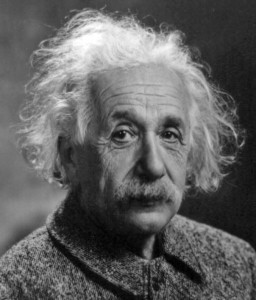
Einstein in 1947
Gems from Albert Einstein:
No problem can be solved from the same level of consciousness that created it.
Education is what remains after one has forgotten what one has learned in school.
Great spirits have always encountered violent opposition from mediocre minds.
The world is a dangerous place to live; not because of the people who are evil, but because of the people who don’t do anything about it.