Tag Archives: German Jews

Jew of the Week: Gershom Scholem

Gerhard Scholem (1897-1982) was born to a secular Jewish family in Berlin. At a young age he showed a great interest in religion, but his father was staunchly anti-Orthodox and opposed it. After his mother intervened, Scholem was allowed to study Judaism with an Orthodox rabbi. In university, he studied mathematics, philosophy, and Hebrew, and met other greats like Martin Buber and Hayim Bialik. He later received an additional degree in Semitic languages. During his studies, he discovered Kabbalah and the infinite depths of Jewish mysticism. He ended up writing his doctoral thesis on the oldest known Kabbalistic text, Sefer ha-Bahir. In 1923 Scholem moved to Israel and changed his name to Gershom. He worked as a librarian and spent his time in study. In 1933 he became the first Professor of Mysticism at the Hebrew University of Jerusalem, teaching a unique view of Kabbalah from a scientific and historical perspective. He stayed at this post for over 30 years, while writing over 40 world-famous texts (in addition to over 700 articles) and winning a handful of prestigious awards, including the Israel Prize. He is credited with being a major force in opening the study of Kabbalah to the masses, both Jews and Gentiles. Despite studying Judaism through a scholarly approach, he maintained that Hebrew is a divine language, alone capable of revealing hidden truths.

Words of the Week

There are two things that are no cause for worry: that which can be fixed, and that which cannot be fixed. That which can be fixed, can be fixed, so what’s there to worry about? And that which cannot be fixed, cannot be fixed anyways so what’s there to worry about?!
– Rabbi Michel of Zelotchov

Jew of the Week: Albert Einstein

Father of Modern Physics

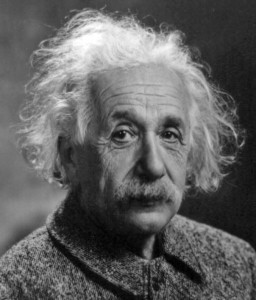
Albert Einstein (1879-1955) was born in Germany, lived in Italy, and received his higher education in Switzerland. In 1905, Einstein exploded onto the science scene with 4 revolutionary papers on the subjects of the photoelectric effect, Brownian motion, special relativity, and mass/energy equivalence. By 1919 his research and theories were world-famous, with The Times reporting “Revolution in Science – New Theory of the Universe – Newtonian Ideas Overthrown”. He won the Nobel Prize two years later, for the photoelectric effect (not relativity!) In 1922, Einstein travelled the world, with a 12-day stop in Israel, during which he said “I consider this the greatest day of my life.” In 1933, he moved permanently to the US due to the Nazi rise to power. The Nazis raided his house, publicly burned his writings, and even put a bounty on his head worth $5000! Of them, he said, “I must confess that the degree of their brutality and cowardice came as something of a surprise.” Fearing the Nazis would develop an atomic bomb, Einstein penned a letter to President Roosevelt persuading him to start a nuclear weapon research program. Einstein would later call this the greatest mistake of his life – but a necessary one.

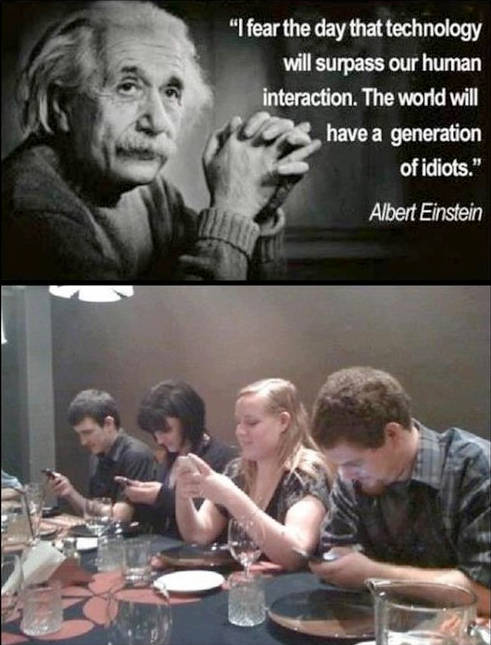
Einstein Predicts the Future...?

Einstein Predicts the Future…?

He spent the rest of his life researching, teaching and writing, based primarily at Princeton. He was a member of the NAACP and fought for civil rights in America. Becoming a vegetarian, Einstein believed mankind as a whole would benefit greatly by adopting such a diet. Three years before his death he was offered to be President of Israel, but was “saddened and ashamed” to decline, humbly admitting he would have no idea how to run a country. Einstein passed away while working on a speech for Israel’s 7th Independence Day. His brain was preserved to be studied, the rest of his body cremated and scattered. Receiving countless awards, Einstein would publish over 300 scientific works, and an additional 150 non-scientific ones. He revolutionized the fields of thermodynamics, light, quantum physics, energy, relativity, cosmology, statistics, motion and momentum, magnetization, refrigeration and a host of others. He was also a musician. So great is his legacy, that “Einstein” has become synonymous with “genius”.

Words of the Week

Einstein in 1947

Einstein in 1947

Gems from Albert Einstein:

No problem can be solved from the same level of consciousness that created it.

Education is what remains after one has forgotten what one has learned in school.

Great spirits have always encountered violent opposition from mediocre minds.

The world is a dangerous place to live; not because of the people who are evil, but because of the people who don’t do anything about it.

Jew of the Week: Joseph Seligman

America’s Financier

Seligman

Joseph Seligman

Born in Baiersdorf, Germany, Joseph Seligman (1819-1880) showed a creative entrepreneurial spirit from an early age. As a youth he would earn money by exchanging foreign coins for travellers while working at his family’s goods shop. At 17, Seligman decided to go out on his own, boarding a steamer for America. In Pennsylvania he worked as a cashier for a salary of $400 a year. From his earnings, Seligman started a small business delivering goods to rural farmers, saving them from having to travel to the city. His first $500 in savings was used to ferry over two of his brothers from Germany. After building a successful clothing business, the brothers went into banking, opening branches across Europe and America. Their wealth continued to skyrocket, so much so that during the Civil War Joseph Seligman disposed $200 million in bond loans to allow the war effort to continue. Historians have called this “scarcely less important than the Battle of Gettysburg”. Seligman was later offered the position of Secretary of the Treasury, but turned it down. He would go on to invest heavily in the development of the United States (as well as Russia and Peru), pumping money into railroads, bridges, shipbuilding, steel, oil and mining, even bicycles and communication lines. Together with the Vanderbilt family, Seligman financed much of New York’s public utilities. In one of the country’s most controversial events of the time, Seligman’s family was denied residence at the Grand Union Hotel by Henry Hilton, on the grounds that Jews were not welcome. Of this H.W. Beecher wrote “When I heard of the unnecessary offense that has been cast upon Mr. Seligman, I felt no other person could have been singled out that would have brought home to me the injustice more sensibly than he.”

Words of the Week

Time must be guarded… Every bit of time, every day that passes, is not just a day but a life’s concern.
Rabbi Menachem Mendel Schneerson, The Lubavitcher Rebbe (Hayom Yom, Cheshvan 17)