Two Israeli Presidents
 Reuven Rivlin (b. 1939) was born in Jerusalem to a family descended from the great Vilna Gaon, that made aliyah in 1809. His father was a Hebrew University professor who first translated the Koran into Hebrew. Not surprisingly, Rivlin speaks Arabic fluently. That made him a key asset during those years when he served in the IDF Intelligence Corps. In the Six-Day War, Rivlin fought with the Jerusalem Brigade. He later studied law at Hebrew University, and served on Jerusalem’s City Council. In 1988, he was elected chairman of Likud and took his first seat in the Knesset. In 2003, he became Knesset Speaker, a position he held until 2014, when he was elected Israel’s tenth president. In that election, he had the support of Arab MKs, despite the fact that he has always been very right-wing, heavily criticized the withdrawal from Gaza, declared that “West Bank settlements are as Israeli as Tel Aviv”, and continues to push for a one-state solution. Nonetheless, he has been praised for building bridges in Israel, and being an eloquent spokesperson on the state’s behalf. Rivlin is a vegetarian and a big supporter of the Beitar Jerusalem soccer team, which he once managed decades ago. Earlier this month, his term as Israel’s president came to an end, and he has been replaced by (former Jew of the Week) Isaac Herzog.
 Schneur Zalman Rubashov (1889-1974) was born in the Belorussian town of Mir, near Minsk, to a deeply religious Chabad family, and was named after Chabad’s founder, Rabbi Schneur Zalman of Liadi. From a young age, he was drawn to Zionism and was also a member of Jewish self-defence organizations in Eastern Europe. He regularly wrote articles for a number of Yiddish publications. After being released from the Russian army in 1924, he made aliyah and settled in Tel-Aviv, changing his last name to “Shazar” (an acronym of his full name). There he worked for the Histadrut (Israel’s national trade union) and also as a journalist. In 1947, Shazar was part of the Jewish delegation to the UN during the critical Partition Plan vote. He was elected to the first Knesset in 1949 and became the new state’s Minister of Education. In 1963, Shazar was elected Israel’s third president. He wrote a goodwill message that was taken by the Apollo 11 crew to the moon, where it still rests. On it he wrote: “From the President of Israel in Jerusalem with hope for ‘abundance of peace so long as the moon endures’ (Psalms 72:7).” Shazar was a devoted member of the “Chein Circle” for Hasidic study in Jerusalem, often hosting the group in his presidential residence. He became a student of Rabbi Adin Steinsaltz, and later helped him produce his renowned translation and commentary of the Talmud. Shazar kept a regular correspondence with the Lubavitcher Rebbe, and often visited him in Brooklyn. He co-founded Kfar Chabad in Israel. Shazar passed away shortly after completing his second term as Israel’s president. Today, his portrait appears on the Israeli 200 shekel note.
Words of the Week
I have no doubt, and my positions are known, that the status of Judaism according to halachah is what has kept us going for 3,800 years.
– Reuven Rivlin
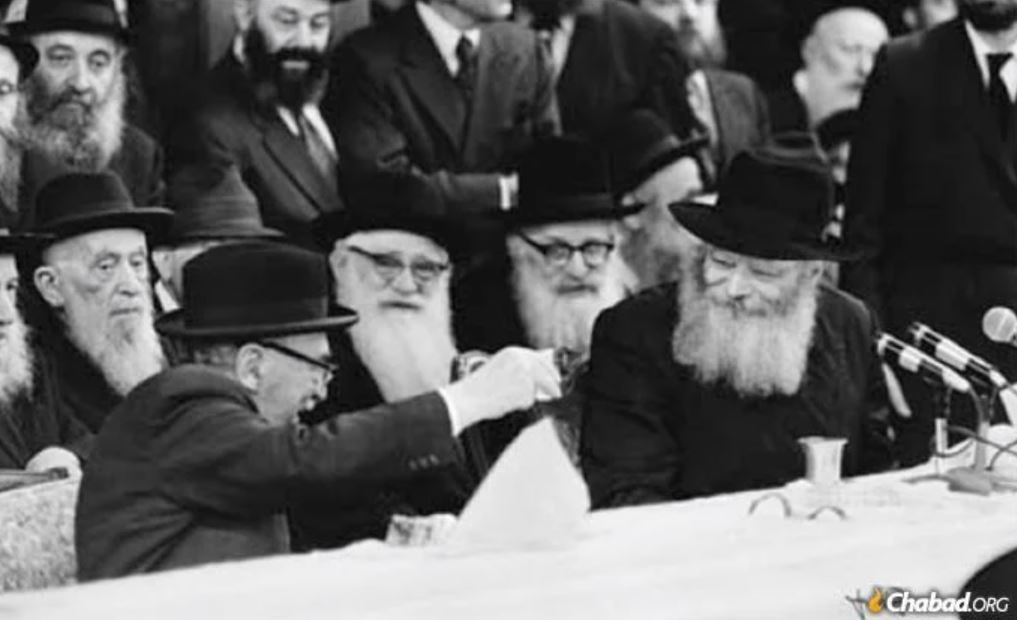
President Shazar toasts the Lubavitcher Rebbe at Chabad headquarters (770 Eastern Parkway, Brooklyn)
 Yitzhak Yezernitsky (1915-2012) was born in what is now Belarus and spent his youth in Poland. As a young man, he joined Betar, the Zionist organization founded by
  Lawrence Harvey Zeiger (1933-2021) was born in Brooklyn to Orthodox Jewish immigrants from Belarus. His father died when he was just a child, leaving the family impoverished. Young Larry was fascinated by radio and always wished to become a broadcaster. In Miami, he found a job cleaning at a radio station and, when the station’s broadcaster suddenly left the show, Larry was given a chance to take his place. The manager said “Zeiger” was not a good stage name, so Larry quickly chose “King” (based on an ad he had just seen for King’s Wholesale Liquor store). He got the job to radio DJ for three hours every morning, earning $50 a week. King soon started doing interviews, too, and would occasionally have a celebrity who was in town to do a show. He was then hired as a commentator for the NFL’s Miami Dolphins. It was in 1978 when The Larry King Show aired its first episode (on radio). It would be broadcast live every weekday at midnight, starting with a one-hour interview and followed by several hours of discussion. By 1985, King was a household name and was hired by CNN to star in a television version of his interview show. CNN’s Larry King Live went on to set a Guinness World Record as the “longest-running TV show hosted by the same person on the same network”. Many iconic moments took place in his studio, including the Perot-Gore debate of 1993 (which became CNN’s most-watched segment ever), and the joint interview of