Jew of the Week: Max Azria

BCBG Max Azria 

Max Azria (Credit: David Shankbone)

Max Azria (b. 1949) was born in Tunisia to a traditional Jewish family, the youngest of six children. He grew up in France, where he was first drawn to the fashion industry. He spent eleven years working in French fashion before moving to Los Angeles and opening his first boutique, called Jess. After eight very successful years, Azria launched BCBG Max Azria in 1989. (The name comes from the French slang bon chic bon genre, “good style, good attitude”.) Known for its affordable designer fashion, the brand became extremely popular. It made headlines at New York Fashion Week in 1996, and put Azria on the prestigious Council of Fashion Designers of America in 1998. That same year, he bought a French company, Hervé Léger, making history by being the first American designer to buy out a French one. Azira launched an exclusive celebrity line called Max Azria Atelier in 2004, and a youth store called BCBGeneration in 2008. Celebrities are particularly fond of his designs, and among his biggest fans are Angelina Jolie, Miley Cyrus, Britney Spears, Halle Berry, and Beyoncé. Azria has also designed clothing for TV shows, including Friends and Seinfeld. In all, he owns twenty different brands and has nearly 600 stores around the world. Unfortunately, many of these locations will soon be closing, as BCBG filed for bankruptcy yesterday. Nonetheless, Azria has been hailed as “one of the most important and influential designers in the world”. Aside from fashion, he is the spokesperson for ‘Concept: Cure’, a charity that supports breast cancer research. His brother Serge, daughter Joyce, and wife Lubov are all successful fashion designers as well. The latter recently spoke of the large Shabbat meals that the couple hosts at their home: “Sometimes there’s only five people, sometimes a hundred.”

Words of the Week

My relationship to the Jewish people has become my strongest human bond, ever since I became fully aware of our precarious situation among the nations of the world.
– Albert Einstein

Jew of the Week: Aletta Jacobs

A Great Pioneer for Women’s Rights

Aletta Jacobs

Aletta Henriëtte Jacobs (1854-1929) was born in a small village in the Netherlands, the eighth of twelve children. Growing up, she often accompanied her doctor father to work and developed a passion for medicine. Unfortunately, medical school (as well as high school) was barred to women at the time. Undeterred, Jacobs studied on her own, and passed the exam to become a pharmacist. This made her quite famous, and in 1871 the Dutch Prime Minister personally granted her permission to attend the University of Groningen. Jacobs was the university’s first female student, and eight years later became the first female physician in the Netherlands. During a brief period of study in London, Jacobs joined a group of suffrage activists and became a noted feminist. She discovered the need for effective contraceptives for women, and back in Amsterdam, starting to work on a new type of diaphragm. Many credit her as a co-inventor of the device. Jacobs opened her own medical clinic, focused on serving the poor. She fought tirelessly to alleviate the terrible living conditions of Amsterdam’s impoverished neighbourhoods, campaigned for public housing, worker’s rights, and for an end to prostitution. By 1903, Jacobs left the field of medicine and devoted herself full time to women’s rights. She traveled around the world to speak about women’s issues, and inspired many along the way. She also wrote regularly for a Dutch newspaper. During World War I, she was a staunch peace activist, meeting with European leaders to stop the conflict. She even met with US President Woodrow Wilson in 1915 to try to convince him to mediate an end to the fighting. In 1919, Jacobs saw the fruits of her labour when the Netherlands finally granted women the right to vote. She continued her important work until the last days of her life. Jacobs is included in the official ‘Canon of Dutch History’, which is taught in all primary and secondary schools in the Netherlands.

Words of the Week

I will insist that the Hebrews have done more to civilize men than any other nation… They have given religion to three quarters of the globe and have influenced the affairs of mankind, more and more happily than any other nation, ancient or modern.
John Adams, 2nd President of the United States, in a letter to F.A Van der Kemp, 1809

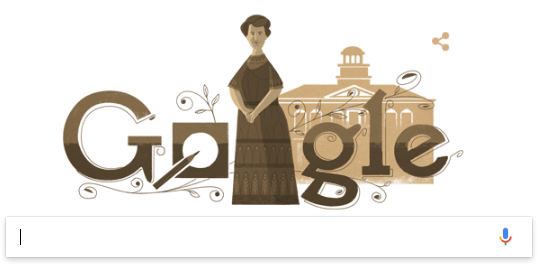
On February 9th (her birthday), Aletta Jacobs was featured in a Google Doodle

Jew of the Week: Hermann Schapira

Founder of the Jewish National Fund

Zvi Hermann Hirsch Schapira (1840-1898) was born to a religious Russian-Jewish family in a small Lithuanian village. He studied to become a rabbi and at age 24 was appointed to his first post. However, he soon decided to pursue his passion for the sciences and ended up studying at a Berlin academy. Three years later, he settled in Odessa and worked for several years as a merchant. In 1878, Schapira moved to Heidelburg and spent another four years studying math and physics, during which time he earned his doctorate. He became a math professor at the University of Heidelburg, and published several important papers. Throughout this time, he continued studying Jewish literature, and contributed to three Hebrew periodicals. By 1884, Shapira was a vocal Zionist, and suggested the establishment of a Jewish National Fund which would buy land in Israel and help settle Jews there. He formally proposed the idea to the First Zionist Congress in 1897, where he also suggested the establishment of a Hebrew University in Jerusalem. Tragically, Schapira died the following year from pneumonia. The Jewish National Fund would finally be launched three years later, and it would take another two decades before the Hebrew University would open its doors. The JNF would go on to become one of the most important organizations in Israel’s history, and instrumental in the nascent state’s success. It purchased over 50% of Israel’s landmass, developed over 250,000 acres of its land, planted some 260 million trees, built nearly 200 dams and reservoirs, and established over 1000 parks. The JNF also played a key role in the founding of Tel Aviv in 1909, and in running Israel’s first postal service. It still owns about 13% of Israel’s land, and in the past decade alone, helped Israel expand its water capacity by 7%. The JNF is perhaps most famous for its Tu b’Shevat tree-planting drive, which over a million Jews participate in every year.

Happy Tu b’Shevat!

Words of the Week

When God created the first man, He showed him all the trees of the Garden of Eden, and said to him: “See My works, how beautiful and praiseworthy they are. And everything that I created, I created it for you. Be careful not to spoil or destroy My world, for if you do, there will be nobody after you to repair it.”
– Midrash (Kohelet Rabbah 7:13)