Tag Archives: Torah

Jew of the Week: Semei Kakungulu

The Jewish Warrior-King of Africa

Semei Kakungulu

Semei Kakungulu, founder of the Jewish Abayudaya tribe of Uganda

Semei Kakungulu (1869-1928) was born into the African tribe of Baganda. As a young man he was converted to Christianity by a missionary. Meanwhile, he grew to become a skilled warrior, as well as an influential politician. The British supported him, essentially turning him into the unofficial king of the Busoga region, which he conquered for the Empire along with other territories. However, the British did not want to confer any titles on him, fearing he would become too powerful. This strained the relationship, and soon Kakungulu also abandoned Protestant Christianity, further driving a wedge between him and the British. Having begun to study the Bible on his own, Kakungulu recognized that Christians had misinterpreted and manipulated it, for example changing the day of the Sabbath to Sunday despite the fact that the text explicitly says it must be Saturday. According to lore, Kakungulu isolated himself in a room with the Bible, and emerged some time later with the book torn in half, concluding that only the first half (the Old Testament) must be true. In 1919, he circumcised himself and his son, urging his followers to do the same. He started a new community focused on following the laws of the Torah. Starting in 1925, the growing community encountered a number of Orthodox Jews from Europe who were working and traveling in the area. One of them, a man named Joseph, taught the community (now known as the Abayudaya) proper Jewish rituals and prayers, the Hebrew language, and even showed them how to slaughter and prepare kosher meat. Soon after, the community dropped any remaining aspects of their former Christian faith, and properly converted to Judaism. Kakangulu wrote a Jewish manual for Africans, and was able to inspire as many as 8000 followers in his time, building a network of some 36 synagogues in the region. His descendants continue to thrive in today’s Uganda. Click here to read more about them.

Words of the Week

In those days it shall come to pass, that ten people, of all the nations of the world, shall grab onto the clothing of a Jew, and say: “We will go with you, for we have heard that God is with you.”
Zechariah 8:23, as quoted by Kakungulu in response to a Christian missionary.

Jew of the Week: Helena of Adiabene

The Jewish Queen of Armenia 

The Sarcophagus of Helena in the Israel Museum

The Sarcophagus of Helena in the Israel Museum

Helena of Adiabene (d. 56 CE) was the Queen of the Persian-Armenian kingdom of Adiabene, a vassal of the Parthian Empire. Essentially nothing is known of her early life. Around 30 CE, after the death of her husband, King Monobaz, she took an interest in Judaism, a little-known religion in her kingdom. After learning with a Jewish merchant named Chananiah, Helena decided to convert. Meanwhile, her son, King Izates, encountered Rabbi Eleazar of Galilee in his royal court and similarly began exploring the wonders of the Torah. Soon, both Helena and Izates, as well as her other son Monobaz II, officially converted to Judaism. In 46-47 CE, Helena traveled to Israel. Witnessing the ongoing famine, she was able to import grain from Egypt and figs from Cyprus to quell the hunger and save countless lives. Helena also commissioned several gifts for the Holy Temple in Jerusalem, including a special candlestick that would indicate the appropriate time to recite Shema Israel, a golden plate engraved with Torah passages, and golden handles for all Temple vessels. The palatial sukkah she had built in her homeland was reported to be over 40 feet high! Towards the end of her life, Queen Helena moved to Jerusalem and had a mausoleum built for herself where she was eventually interred. In the 19th century, her grave was discovered by French archaeologists. Meanwhile, her Jerusalem palace was discovered by Israeli archaeologists in 2007. Among the incredible finds in the palace was a proper mikveh. Ancient historians like Josephus wrote of Helena, and her story is even described in detail in the Talmud. The latter records that Helena was a devout Jewess, spending at least 7 years of her life as a nazirite, a special status of holiness in Judaism that may be loosely compared to a monk or nun. After Helena’s death, her children continued to support the Jewish people, even sending troops to assist Jewish rebels in fighting the Romans during the Great Revolt (66-70 CE), which ended with the destruction of the Second Temple. Ultimately, the Romans invaded Adiabene, too, in 115 CE. Within a few short centuries, the kingdom was all but forgotten.

Words of the Week

Disasters go out through the mouth and disease comes in through it. You must be constantly circumspect about what goes in and out of your mouth.
Kaibara Ekiken (author of Samurai manual ‘Yojokun‘)

Jew of the Week: Saadia Gaon

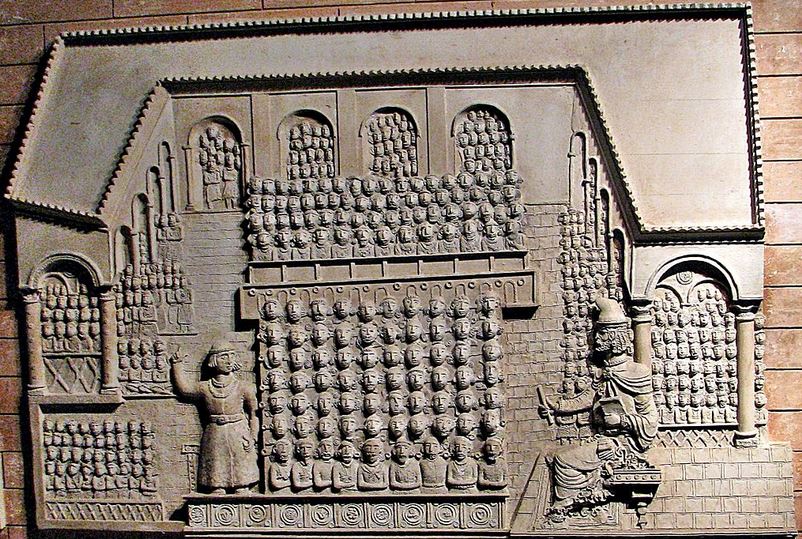
Depiction of the Sura Academy

Depiction of the Sura Academy

Sa’adiah ben Yosef (c. 882-942) was born in Fayum, Egypt. His family moved to Israel while he was still very young, and he began his Torah studies at the famous academy of Tiberias. By the time he was 20, he completed his first work, Agron, possibly the first official Hebrew dictionary. Sa’adiah went on to write over two dozen significant texts in both Hebrew and Arabic, including Emunot v’Deot, thought to be the first Jewish work that blended Jewish teachings with science and Greek philosophy. He also translated the entire Torah into Arabic, and wrote a deep commentary on top of it, together with many other books of the Bible. At the time, the vast majority of Jews in the world lived in Arabic lands, so this translation served a monumental role in helping spread Jewish learning. Sa’adiah also authored a number of legal treatises, and translated the mystical Sefer Yetzirah into Arabic, adding his own commentaries that weaved together both esoteric and scientific explanations. Sa’adiah is credited with being a key force in Judeo-Arabic culture, and inspiring a “renaissance” in Jewish-Arabic literature. Meanwhile, he played an instrumental role in defending traditional Judaism in the face of the rising Karaite sect, a cause he fought for until his last days (at times risking his life). For his great wisdom and tireless work on behalf of the Jewish community, Sa’adiah was appointed “Gaon” in 928. The title Gaon (literally “genius”) was given to the head of the Sura Academy, then the leading body of Jewish scholarship in the world. Sa’adiah Gaon died in Baghdad at the age of 60, having inspired a new generation of Torah scholars. Two hundred years later, the great Maimonides wrote: “Were it not for Rav Sa’adiah Gaon, the Torah would have almost disappeared from the Jewish people, for it was he who shed light on that which was obscure, strengthened that which had been weakened, and spread the Torah far and wide, by word of mouth and in writing.”

Words of the Week

The birds and many of the land animals forbidden [to eat] by the Torah are predators, while the permitted animals are not. We are commanded not to eat those animals possessive of a cruel nature, so that we should not absorb these qualities into ourselves.
– Nachmanides (the Ramban)