Great Arabic Poets
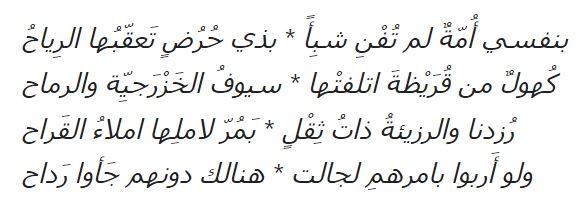
The single surviving poem of Sarah of Yemen
Sarah (fl. 6th-7th century) was born to the Jewish Banu Qurayza clan of the Arabian Peninsula, in the pre-Islamic era when much of the peninsula was inhabited by Jews. Her family originally hailed from what is today Yemen. They lived in Yathrib, the flourishing oasis of the Banu Qurayza Jews. In 622, Muhammad entered the city, and in 627 he annihilated the Banu Qurayza tribe (and renamed the city “Medina”, making it the first capital of the Islamic empire). Sarah was a poet, and one of her poems describing the devastation of Yathrib has survived. It was first printed in a 10th-century anthology of Arabic poems called Kitab al-Aghani. She wrote: “By my life, there is a people not long in Du Hurud; obliterated by the wind. Men of Qurayza destroyed by Khazraji swords and lances; We have lost, and our loss is so grave…” According to legend, she fought in the battle against Muhammad and was killed. (In a little-known quirk of history, Muhammad actually took two of the Jewish captives for himself as wives, and one of them is even considered a “mother of Islam”!) Incredibly, Sarah of Yemen may be history’s oldest and first known Arabic poet.
Another famous Jewish-Arab poet was Qasmuna bint Ismail (fl. 11th-12th century), who lived in Andalusia (today’s Spain). She was the child of a wealthy and well-educated Jew, who made sure his daughter was literate and taught her the art of poetry. Qasmuna is the only Sephardic Jewish female poet whose work has survived. Three of her poems were published in a 15th century anthology. In one of her poems she wrote: “Always grazing, here in this garden; I’m dark-eyed just like you, and lonely; We both live far from friends, forsaken; patiently bearing our fate’s decree.” In another she describes reaching the age of marriage and the struggle of finding the right partner: “I see an orchard, Where the time has come; For harvesting, But I do not see; A gardener reaching out a hand, Towards its fruits; Youth goes, vanishing; I wait alone, For somebody I do not wish to name.” She has also been referred to as “Qasmuna the Jewess” and “Xemone”.
Back When Palestinians Insisted There’s No Such Thing as Palestine
Words of the Week
In Judaism the word for “education” (chinukh) is the same as for “consecration”. Is your child being consecrated for a life of beneficence for Israel and humanity?
– Rabbi Dr. J.H. Hertz, former Chief Rabbi of Britain
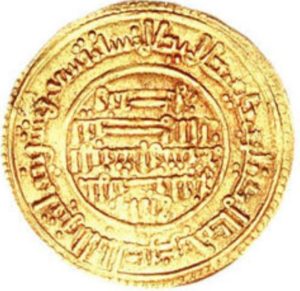
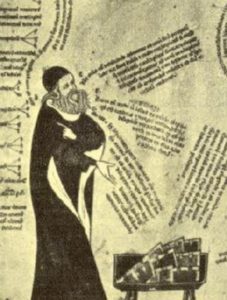 Avraham bar Chiya (c. 1070-1145) was born in Barcelona to a Sephardic Jewish family. It appears that his family was persecuted by its Christian rulers, so they fled to the neighbouring Arab kingdom of Zaragoza. Bar Chiya came from a long line of rabbis, and was also extensively trained in science, math, and astronomy. Famed for his wisdom, he became the court astronomer of Al-Musta’in II. Eventually, he was appointed minister of police and given the title sahib al-shurtah, “city governor”. This is why he was known in the Jewish community as HaNasi, “the prince” or “the president”. Al-Musta’in II was unable to defend his domain from the Christians, who soon took over. Bar Chiya moved to southern France for a while and lived in Narbonne and Provence. There he composed some of the most important scientific texts of the Medieval era. He translated a number of Arabic works into Latin, opening their study for Europeans, and played a key role in introducing the Hindu numerals we use today (by way of Arabia) to Europe, and thus to the rest of the world. Bar Chiya also synthesized ancient Greek wisdom with contemporary Arabic knowledge, and published new discoveries in number theory, arithmetic, geometry, optics, astronomy, and music theory. His Treatise on Measurement and Calculation inspired later greats like Plato of Tivoli and the world-famous Fibonacci. Meanwhile, Bar Chiya also served as the chief rabbi of the Jewish communities he presided over, and composed two important Jewish commentaries and texts. He is credited with being the first person to write a scientific book in Hebrew, and played an instrumental role in the development of the Hebrew language. His disciples included both Jews and non-Jews, among them the great