Tag Archives: Sephardic Jews

Jew of the Week: Rabbi Zecharia Barashi

World’s Oldest Jew

Rabbi Barashi (Credit: Lazar Berman)

Zecharia Barashi (1900-2017) was born in Kurdistan, the last of ten children in an observant Jewish family. His father was a rabbi who traveled from village to village, serving the needs of small Jewish communities in Iraq. Unfortunately, this job did not come with a salary, and the poor family made a meager living by sowing clothes and selling nuts and dates. Several years of harsh poverty, disease, and the difficulties of the First World War left six of the ten children dead. Barashi himself nearly died when he was 11 years old. He would follow in his father’s footsteps and become a rabbi as well. Inspired by Zionism, Barashi struggled to move the family to Israel. In 1936, he finally got a chance by working as a Hebrew interpreter for the Jewish Agency. After a long and arduous journey, the family settled in Jerusalem. Throughout World War II and Israel’s ensuing War of Independence, Barashi supported the war effort by digging trenches, and paving roads and runways. In 1950, the Jews of Iraq and Kurdistan made a mass aliyah to Israel, and Barashi soon became their spiritual leader. He would go on to earn the esteemed title of Chacham, “Sage”. He also published four important books on Judaism. He was in the midst of writing his fifth book when, at the age of 111, his eyesight became too poor. Deeply respected as one of Israel’s greatest rabbis, Barashi was known for his incredible memory, humility, and great sense of humour. Sadly, he passed away earlier this week. Until that moment, he was the world’s oldest living Jew. He was also Israel’s oldest living resident, having spent over 80 years in Jerusalem. Although he outlived two of his own children and his beloved wife, he is survived by five more children, 29 grandchildren, 72 great-grandchildren, and 24 great-great-grandchildren. His advice for a long life: “Always be happy, never jealous. Stay active. And never overeat, always leave the table a little hungry.”

Words of the Week

“My brain is the key that sets my mind free.”
Harry Houdini

Rabbi Barashi with Shimon Peres (Credit: Mark Neyman/Flash90)

Jew of the Week: Max Azria

BCBG Max Azria 

Max Azria (Credit: David Shankbone)

Max Azria (b. 1949) was born in Tunisia to a traditional Jewish family, the youngest of six children. He grew up in France, where he was first drawn to the fashion industry. He spent eleven years working in French fashion before moving to Los Angeles and opening his first boutique, called Jess. After eight very successful years, Azria launched BCBG Max Azria in 1989. (The name comes from the French slang bon chic bon genre, “good style, good attitude”.) Known for its affordable designer fashion, the brand became extremely popular. It made headlines at New York Fashion Week in 1996, and put Azria on the prestigious Council of Fashion Designers of America in 1998. That same year, he bought a French company, Hervé Léger, making history by being the first American designer to buy out a French one. Azira launched an exclusive celebrity line called Max Azria Atelier in 2004, and a youth store called BCBGeneration in 2008. Celebrities are particularly fond of his designs, and among his biggest fans are Angelina Jolie, Miley Cyrus, Britney Spears, Halle Berry, and Beyoncé. Azria has also designed clothing for TV shows, including Friends and Seinfeld. In all, he owns twenty different brands and has nearly 600 stores around the world. Unfortunately, many of these locations will soon be closing, as BCBG filed for bankruptcy yesterday. Nonetheless, Azria has been hailed as “one of the most important and influential designers in the world”. Aside from fashion, he is the spokesperson for ‘Concept: Cure’, a charity that supports breast cancer research. His brother Serge, daughter Joyce, and wife Lubov are all successful fashion designers as well. The latter recently spoke of the large Shabbat meals that the couple hosts at their home: “Sometimes there’s only five people, sometimes a hundred.”

Words of the Week

My relationship to the Jewish people has become my strongest human bond, ever since I became fully aware of our precarious situation among the nations of the world.
– Albert Einstein

Jew of the Week: Mirra Alfassa

Alfassa and her symbol

Alfassa and her symbol

Blanche Rachel Mirra Alfassa (1878-1973) was born in Paris to a Turkish-Jewish father and Egyptian-Jewish mother. Growing up in a wealthy Sephardic home, she was exposed to a great deal of spiritual teachings, art, and her father’s vast library – which she had read entirely by age 14. After studying art at the prestigious Académie Julian, she found success as a painter and artist, collaborating with such greats as Matisse, Rodin, and Zola. After ten years of this, Alfassa wished to pursue her spiritual inclinations and found her way to a Polish Jew in Algeria who led a Kabbalah-based mystical circle. In 1908, she established her own mystical circle in Paris, fusing together esoteric Jewish teachings with those of Buddhism and Hinduism. In 1914, she moved to Pondicherry, India – then a French colony – where her second husband was seeking election to the senate. There, Alfassa met a yogi named Sri Aurobindo and became his devoted follower. For the next six years (four of which were spent in Japan), she and her husband published a regular journal of Aurobindo’s teachings. Eventually, the couple divorced, and Alfassa moved to Aurobindo’s house. Aurobindo soon recognized Alfassa as his spiritual equal, and titled her “the Mother” – an incarnation of the cosmic “Divine Mother” of the universe. Alfassa and Aurobindo started teaching together and attracted many followers. The house soon transformed into an ashram. By 1937, their ashram had grown so much that Alfassa commissioned the construction of a new community. This community would draw many, including the daughter of US President Woodrow Wilson, who stayed there for the rest of her life. During World War II, while many in India supported Nazi Germany (in order to overthrow their British rulers), Aurobindo and Alfassa worked hard to support the Allied Forces, and donated much of their funds for the war effort. In 1943, Alfassa founded a new school, which later became the Sri Aurobindo International Centre of Education. After Aurobindo’s death in 1950, Alfassa became the sole leader of the movement, and a prominent holy figure in India. In 1956, she established another ashram and school in Delhi, and did the same in Gujarat in 1967. Meanwhile, a popular 13-volume book of her life and teachings was published (now expanded to 17 volumes).

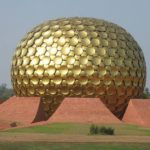
Matrimandir

Perhaps her greatest legacy is Auroville, a city-state she founded in 1968 near Pondicherry. Auroville was meant to be a model community for the whole world, where all people regardless of background could live in total harmony, spirituality, and peace. Delegates from 124 nations attended the inauguration ceremony. Today, Auroville has over 2500 permanent residents from some 50 countries. A self-sustaining community, it has its own institutions, including farms, schools, and restaurants (one of which is an Israeli cafe – closed on Shabbat, of course). The city’s centrepiece is the beautiful Matrimandir, the solar-powered “Mother Temple”, designed in the form of a famous golden vision once seen by Alfassa, who is still known affectionately as “the Mother”.

Words of the Week

The most important thing for an individual is to unify himself around his divine centre; in that way he becomes a true individual, master of himself and his destiny. Otherwise, he is a plaything of forces that toss him about like a piece of cork on a river…
– Mirra Alfassa, “the Mother”

Alfassa and Sri Aurobindo

Alfassa and Sri Aurobindo