Great Arabic Poets
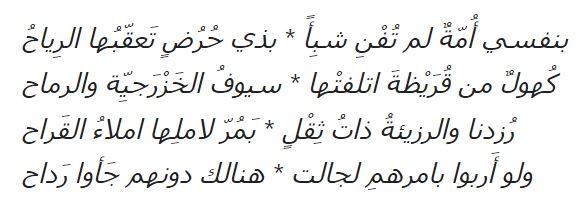
The single surviving poem of Sarah of Yemen
Sarah (fl. 6th-7th century) was born to the Jewish Banu Qurayza clan of the Arabian Peninsula, in the pre-Islamic era when much of the peninsula was inhabited by Jews. Her family originally hailed from what is today Yemen. They lived in Yathrib, the flourishing oasis of the Banu Qurayza Jews. In 622, Muhammad entered the city, and in 627 he annihilated the Banu Qurayza tribe (and renamed the city “Medina”, making it the first capital of the Islamic empire). Sarah was a poet, and one of her poems describing the devastation of Yathrib has survived. It was first printed in a 10th-century anthology of Arabic poems called Kitab al-Aghani. She wrote: “By my life, there is a people not long in Du Hurud; obliterated by the wind. Men of Qurayza destroyed by Khazraji swords and lances; We have lost, and our loss is so grave…” According to legend, she fought in the battle against Muhammad and was killed. (In a little-known quirk of history, Muhammad actually took two of the Jewish captives for himself as wives, and one of them is even considered a “mother of Islam”!) Incredibly, Sarah of Yemen may be history’s oldest and first known Arabic poet.
Another famous Jewish-Arab poet was Qasmuna bint Ismail (fl. 11th-12th century), who lived in Andalusia (today’s Spain). She was the child of a wealthy and well-educated Jew, who made sure his daughter was literate and taught her the art of poetry. Qasmuna is the only Sephardic Jewish female poet whose work has survived. Three of her poems were published in a 15th century anthology. In one of her poems she wrote: “Always grazing, here in this garden; I’m dark-eyed just like you, and lonely; We both live far from friends, forsaken; patiently bearing our fate’s decree.” In another she describes reaching the age of marriage and the struggle of finding the right partner: “I see an orchard, Where the time has come; For harvesting, But I do not see; A gardener reaching out a hand, Towards its fruits; Youth goes, vanishing; I wait alone, For somebody I do not wish to name.” She has also been referred to as “Qasmuna the Jewess” and “Xemone”.
Back When Palestinians Insisted There’s No Such Thing as Palestine
Words of the Week
In Judaism the word for “education” (chinukh) is the same as for “consecration”. Is your child being consecrated for a life of beneficence for Israel and humanity?
– Rabbi Dr. J.H. Hertz, former Chief Rabbi of Britain
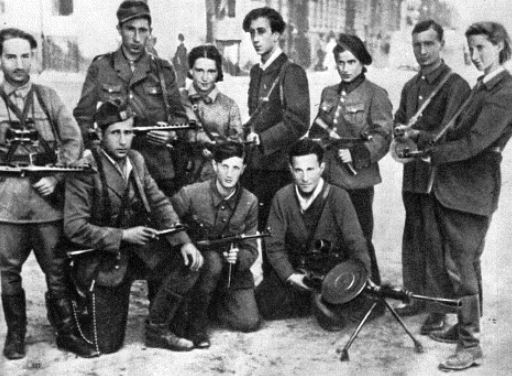
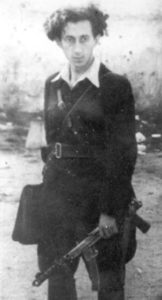 Abel “Abba” Kovner (1918-1987) was born in what is today Belarus and grew up in Vilnius (then part of Poland). As a young man, he was a member of HaShomer HaTzair, the Zionist youth movement. When the Nazis invaded Vilnius in 1941, Kovner escaped to a convent, but soon returned to the Vilna Ghetto to organize a Jewish resistance. At the start of 1942, Kovner secretly published a manifesto inside the Ghetto to inspire the Jews to fight back, writing that it was better to die than “go like lambs to the slaughter”. Along with several other young men, Kovner formed the United Partisan Organization, possibly the first armed underground Jewish group in Nazi Europe. Before they could launch their first large-scale attack, the Vilna Ghetto was liquidated in 1943, forcing the group to flee to the surrounding forests. From there, they launched a guerrilla warfare campaign against the Nazis. The small group began calling themselves “the Avengers” (HaNokmim) and were successful enough to draw the attention of the Red Army. They would go on to coordinate with the Soviets to crush the Nazis in Eastern Europe. Once the fate of the Nazis was sealed towards the end of 1944, Kovner was among the founders of a new group, called Bricha (“Escape”), which worked to get Jewish refugees out of Europe and to the Holy Land. Over the next couple of years, they would successfully move 250,000 Holocaust survivors to Israel. Having seen first-hand the horrific devastation inflicted by the Nazis, Kovner yearned for revenge. He started yet another group, called Nakam (“Vengeance”), seeking to punish Germany for the Holocaust. “Plan B” was to poison the water supply in Allied prisoner-of-war camps where Nazi SS soldiers were kept. The far more controversial and shocking “Plan A” was to poison the water supplies of several major German cities in order to kill 6 million Germans, one for each Jew lost in the Holocaust. Thankfully, Plan A was soon abandoned, though Kovner was still arrested by the British and held in a Cairo prison for several months. He did aim to accomplish Plan B, and Nakam members infiltrated a POW camp bakery in April 1946, coating the loaves of bread with arsenic. Over two thousands German soldiers fell ill, though no deaths were reported. In December 1947, Kovner joined the Haganah and fought in Israel’s Independence War as a captain of the Givati Brigade. Following this, he lived out the remainder of his life in a kibbutz, working tirelessly to strengthen the nascent state. He also helped to design several Holocaust museums, and testified at the Eichmann trial. More famously, Kovner wrote a series of poetry books (in Hebrew and Yiddish) describing the struggles he faced during the Holocaust and in Israel’s early years. This made him one of the country’s most celebrated poets and writers. For this, he won the Israeli Prize for Literature in 1970. A heavy smoker, Kovner succumbed to tracheal cancer before his 70th birthday.