Tag Archives: Mizrahi Jews

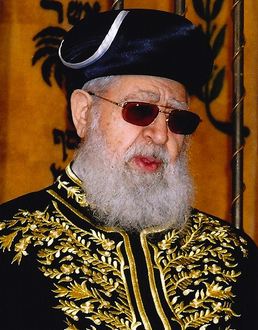
Jew of the Week: Rav Ovadia Yosef

Rav Ovadia Yosef

Rav Ovadia Yosef

Abdullah Ovadia Yousseff (1920-2013) was born in Baghdad, Iraq and immigrated with his family to Jerusalem at the age of 4. He was quickly recognized as a young prodigy with a photographic memory and a profound depth of understanding, and ordained as a rabbi at age 20. Shortly after, Rav Ovadia moved to Cairo, Egypt where he headed a yeshiva and Jewish court until his return to Israel upon the State’s independence. In 1952 he published the first of several great works, which propelled him into the spotlight. He then founded an advanced yeshiva for gifted students. By 1973, Rav Ovadia was appointed Israel’s Sephardic Chief Rabbi. He served in this post until 1984 when he founded the Shas political party – today the 4th largest in the Knesset – and served as its spiritual guide until his last days. A scholar above all else, he pored through thousands of works. Once, he tumbled off a ladder while reaching for a book, breaking his back. As no one was there to help him, he grabbed the nearest text and studied it for 3 hours until someone found him. Possessing a great love for the Jewish people, Rav Ovadia always strove to make life simpler for the Jews, earning a reputation for being very lenient when it came to Jewish law. He was heavily engaged in kiruv – bringing secular Jews back to their heritage and into the spiritual fold. He especially focused his efforts on Mizrahi and Sephardic Jews (who often suffered discrimination and a lower socio-economic status in Israel) and is thus credited with restoring Jewish and national pride among this demographic. Many stories highlight his love and service to the people. Once, he suffered a heart attack and was rushed to hospital for life-saving surgery. He had the surgery delayed for several hours as he was in the middle of writing a letter to a woman in distress, and feared that if he died there would be no one to help her. Sadly, Rav Ovadia passed away on Monday. Nearly a million people attended his funeral in Jerusalem – the largest funeral in Israel’s history. Many have hailed his passing as the end of an era in the country’s history.

Words of the Week

The righteous promise little and do a lot; the wicked promise much and don’t do even a little.
– Talmud, Bava Metzia 87a
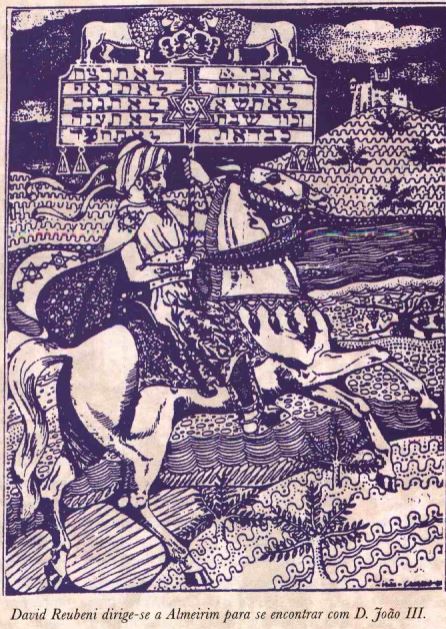
Jew of the Week: David Reubeni

David Reubeni was born around 1490 in a place called Chabor – the location of which is disputed to this day, though the best evidence points towards Afghanistan, where certain Pashtun tribes still practice Jewish customs (despite being officially Muslim) and speak of a folk hero named Daoud Roubani. In 1522, Reubeni left on a long journey around the world, going to India, Africa, throughout the Ottoman Empire and Europe. Along the way he claimed to be a messenger from the distant Jewish Kingdom of Chabor. His wisdom, piety, and military genius were evident to all who met him, including the Pope and a host of other rulers and dignitaries. To these leaders he proposed a plan to conquer Israel from the Ottomans through a Jewish-Christian alliance. The plan gained a lot of steam, and even appeared to be manifesting at one point. Pope Clement VII supported it, and King Juan III of Portugal promised eight ships and 4000 cannons. However, the messianic fervour that resulted inspired some Jews to rebel against the Inquisition, causing the loss of key allies. Meanwhile, skeptical Jews joined anti-Semities and opponents in preventing what they felt was another “false messiah”, though Reubeni never claimed to be one. It was Emperor Charles V of Spain who eventually had Reubeni and his key supporters arrested. They were assigned to the Inquisition and never heard from again. Reubeni’s cause and time of death are unknown, though his diary survives in Oxford (a second copy was destroyed by the Nazis). His story is as fascinating as it is mysterious: a man with an unknown beginning and an unknown end, hailing from a lost Jewish kingdom, who nearly succeeding in reestablishing a Jewish state in Israel four centuries before the Zionist movement.

Words of the Week

A person must seek out a spiritual livelihood with all the intensity of his strength, just as he seeks a material livelihood.
– The Lubavitcher Rebbe (Hayom Yom, Cheshvan 14)

Jew of the Week: Marcus Samuel

Oil & Seashells

Marcus Samuel, Oil Baron

Marcus Samuel (1853-1927) was born in London to a wealthy Iraqi-Jewish family originally from the Netherlands. On a trip to the Black Sea in 1890, he saw the potential in oil (still a novel resource at the time). Samuel ordered the construction of 8 tankers that met the highest safety standards, receiving permission to transport oil to Asia across the newly-built Suez Canal. Thus was born Shell Oil, taking the name of the Samuel family business, which began meagerly just a few decades earlier by selling painted seashells. Using one of his tankers, Samuel once saved the stranded ship HMS Victorious, a feat for which he was knighted. Previously, Sir Samuel had served as the Sheriff of London, and even its Mayor! For his role in fueling the Allies in World War I, he was made 1st Baron of Bearsted, and later 1st Viscount of Bearsted. Lord Samuel was known for his incredible devotion to his wife and four children. So much so, in fact, that he died less than 24 hours after the passing of his beloved wife. At death, he left his large estate to be transformed into a public park, an orphanage and a nursing home. Today, his company is known as Royal Dutch Shell, after having merged in 1907 with the Royal Dutch oil company in order to compete with Rockefeller’s Standard Oil. Shell is currently the 5th largest company in the world, with a yearly revenue of over $360 billion.

Today is Tu B’Shvat!

Words of the Week

If you live as though there will always be a tomorrow, then you’ll never make much of today.
– Rabbi Noah Weinberg