The First Yiddish Novel and Hebrew Dictionary
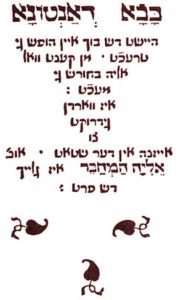
Cover Page of a 1541 Edition of ‘Bovo-Bukh’
Eliyahu “Bachur” haLevi (1469-1549) was born near Nuremberg, the youngest of nine children. When the Jews were expelled from the region, his family settled in Venice. Throughout these years, Eliyahu spent most of his time in the study of Torah, Kabbalah (Jewish mysticism), and Hebrew grammar. In 1504, he settled in Padua and took on a job as a teacher of Jewish studies. He wrote a textbook of Hebrew grammar for his students, and the book quickly spread far and wide. It became especially popular among Christian scholars, many of whom were then trying to learn Hebrew in order to understand the Bible in its original language. Meanwhile, inspired by other Renaissance authors, Eliyahu wrote a romance novel in Yiddish, the Bovo-Bukh, history’s first Yiddish novel. Hugely popular, it has been continuously published until this day, going through some 40 editions over the past five centuries. It was also translated to other languages, including German and Russian. The book’s title is the origin of the well-known Yiddish phrase, bube mayse, an “old wives’ tale”. Eliyahu wrote two satires in Italian as well. By the time he resettled in Rome in 1514, he was quite famous, and became close with Cardinal Egidio da Viterbo. The two made a deal in which Eliyahu and his family could live in the Cardinal’s palace, in exchange for Eliyahu teaching him Hebrew and Jewish mysticism. (At that time, Jewish mysticism was very popular in Europe, and had many famous non-Jewish students, too, including Michelangelo and Pico della Mirandola.) Eliyahu lived with the Cardinal for the next 13 years. During this time, he composed several more textbooks on the Hebrew language, including one of the first Hebrew dictionaries. He also translated various Jewish texts, mainly Kabbalistic ones, into Latin. Rome was sacked in 1527, so Eliyahu had to relocate again. King Francis I offered him to become a professor of Hebrew at the University of Paris, but Eliyahu declined because at that time Jews were banned from living in Paris and he refused to live in a city where his brethren were not welcome. Eliyahu would return to Venice and passed away there. Today is his yahrzeit. Former British Prime Minister David Cameron is one of his descendants.
Words of the Week
To have a second language is to have a second soul.
– Charlemagne
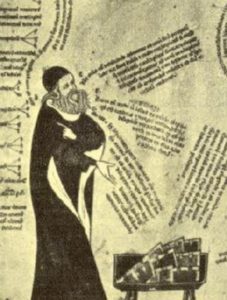 Avraham bar Chiya (c. 1070-1145) was born in Barcelona to a Sephardic Jewish family. It appears that his family was persecuted by its Christian rulers, so they fled to the neighbouring Arab kingdom of Zaragoza. Bar Chiya came from a long line of rabbis, and was also extensively trained in science, math, and astronomy. Famed for his wisdom, he became the court astronomer of Al-Musta’in II. Eventually, he was appointed minister of police and given the title sahib al-shurtah, “city governor”. This is why he was known in the Jewish community as HaNasi, “the prince” or “the president”. Al-Musta’in II was unable to defend his domain from the Christians, who soon took over. Bar Chiya moved to southern France for a while and lived in Narbonne and Provence. There he composed some of the most important scientific texts of the Medieval era. He translated a number of Arabic works into Latin, opening their study for Europeans, and played a key role in introducing the Hindu numerals we use today (by way of Arabia) to Europe, and thus to the rest of the world. Bar Chiya also synthesized ancient Greek wisdom with contemporary Arabic knowledge, and published new discoveries in number theory, arithmetic, geometry, optics, astronomy, and music theory. His Treatise on Measurement and Calculation inspired later greats like Plato of Tivoli and the world-famous Fibonacci. Meanwhile, Bar Chiya also served as the chief rabbi of the Jewish communities he presided over, and composed two important Jewish commentaries and texts. He is credited with being the first person to write a scientific book in Hebrew, and played an instrumental role in the development of the Hebrew language. His disciples included both Jews and non-Jews, among them the great