Tag Archives: Jerusalem

Jew of the Week: Leonard Cohen

Leonard Cohen (Credit: CBC)

Leonard Cohen (Credit: CBC)

Leonard Norman Eliezer Cohen (1934-2016) was born in Montreal, the grandson of a Lithuanian rabbi and a Polish immigrant who founded the Canadian Jewish Congress. Cohen grew up very close to his Jewish community, and attended Montreal’s Jewish Herzliah High School, where he was first inspired to take up poetry by a teacher. While studying at McGill University, he published his first set of award-winning poems. His second book of poetry found even more success, and was seen as an important work in Canadian literature, with one critic calling Cohen “the best young poet in English Canada.” Cohen moved to a small island off the coast of Greece and wrote prolifically, publishing several more books of poetry and novels. One of his later books – a Literary Award winner – was inspired by the Hebrew Bible and consisted of 50 poems that Cohen called “prayers”. Meanwhile, Cohen started recording music in the 1960s as poetry did not bring the income he hoped for. His first album was a big hit in the US and UK. It was his seventh album that had his most famous song, “Hallelujah”, which Cohen went through some 80 drafts writing, and “banging his head on the floor”. The song was inspired by various Biblical scenes, including the stories of Samson and Delilah, and King David and Batsheva. It would be covered by over 200 artists in dozens of languages, and become the subject of a whole book and BBC documentary. In 1994, Cohen entered a period of five years of seclusion during which time he was ordained a Zen Buddhist monk. However, he never abandoned his Jewish roots, and said, “I’m not looking for a new religion. I’m quite happy with the old one, with Judaism.” Cohen was known to keep Shabbat throughout his career, even while on tour. In his 2009 concert in Tel-Aviv, Cohen spoke Hebrew and ended the concert with Birkat Cohanim, the priestly blessing. During the Yom Kippur War, Cohen went to Israel to volunteer at a kibbutz before going to the front lines himself to entertain Israeli soldiers, saying he will “stop Egypt’s bullets”. In his 1972 Jerusalem concert he was so emotional that he had to walk off stage at one point. The crowd started singing to bring him back and a teary-eyed Cohen felt like “the entire audience turned into one Jew”. All in all, Cohen produced 15 albums (the last of which was released just three weeks ago), 13 poetry books, and two novels. He won a plethora of awards – including multiple Junos and Grammys, the Order of Canada, and induction into the Rock and Roll Hall of Fame – and inspired countless musicians, poets, and artists. He has been hailed as one of the most influential songwriters and greatest musicians of all time. Sadly, Cohen passed away earlier this week.

Words of the Week

There is a crack in everything. That’s how the light gets in.
– Leonard Cohen
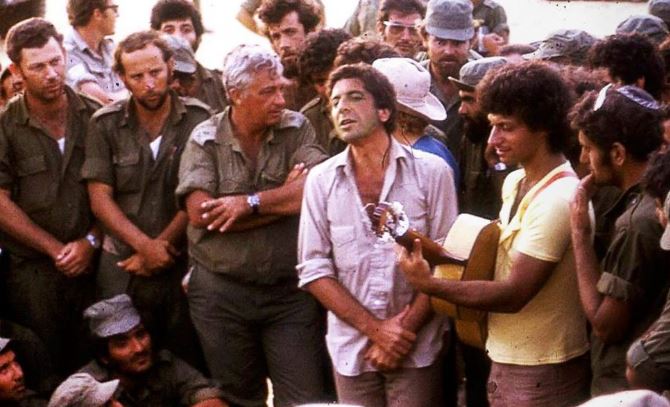
Leonard Cohen performing for the IDF, with Ariel Sharon looking on.

Leonard Cohen performing for the IDF, with Ariel Sharon looking on.

Jew of the Week: Dalia Itzik

Dalia Itzik, Israel's First Female President (הצלם אלכס קולומויסקי וידיעות אחרונות)

Dalia Itzik, Israel’s First Female President (הצלם אלכס קולומויסקי וידיעות אחרונות)

Dalia Itzik (b. 1952) was born to an Iraqi-Jewish family in Jerusalem. She studied literature and history at the Hebrew University before becoming a teacher. At the young age of 21, Itzik was a co-founder of Jerusalem’s Katznelson School, where she taught for 17 years. In 1984, she became the chairwoman of Jerusalem’s Teachers Union. Due to her vast experience in education, Itzik was elected to the city council in 1989 and took over its education portfolio. From there, she rose to the position of Jerusalem’s deputy mayor. In 1992, she ran for the Knesset as a member of the Labor Party and won a seat. She would go on to serve in Israel’s parliament for nearly twelve years, and during that time filled the roles of Minister of Industry and Trade, Minister of the Environment, and Minister of Communications. She sat on the Finance Committee and the Education and Culture Committee, among others. In 2006, she became Israel’s first female Speaker of the Knesset, and shortly after, Israel’s deputy president. The following year, President Moshe Katzav took a leave of absence, making Itzik Israel’s first female president (though only in an interim position). Since leaving politics in 2013, Itzik has served on the board of Hadassah International – one of the largest women’s organizations in the world – and as the chairwoman of From the Depths, an organization which strives to preserve the memory of the Holocaust. She was also nominated for Israel’s presidency in 2014.

Words of the Week

Fundamental to our faith is the belief that every event in a person’s life is by Divine Providence. So expressions such as “If only I had…” or “If only I hadn’t…” smack of heresy.
Rabbi Sholom DovBer of Lubavitch (1860-1920)

Jew of the Week: Rabbi Yehuda Glick

Yehuda Glick (Credit: Amitay Salomon)

Yehuda Glick (Credit: Amitay Salomon)

Yehuda Joshua Glick (b. 1965) was born in Brooklyn to an Orthodox Jewish family which made aliyah to Israel when he was nine years old. After completing his rabbinical studies, Glick began working for the Israeli Ministry of Immigrant Absorption. In 2005, after some ten years, he quit the job to protest Israeli withdrawal from Gaza. He then served as executive director of The Temple Institute, an organization working to rebuild the Holy Temple in Jerusalem through peaceful means. Glick is most famous for his activism with regards to permitting Jews to ascend the Temple Mount. This area is the holiest site in the world for the Jewish people, yet entrance to it is severely limited for Jews, and prayer there is currently forbidden to all but Muslims. As chairman of the Temple Mount Heritage Foundation and leader of the HaLiba group, Glick has worked tirelessly to end this racist policy, and to open the Temple Mount for visitation and prayer to people of all faiths. He envisions rebuilding a temple – “a house of prayer for all nations” – next to the Dome of the Rock. For leading prayer groups to the Temple Mount, Glick has been arrested multiple times. In 2013, he went on a hunger strike to protest a ban that forbid him to go to the Temple Mount. After twelve days without food, Glick was permitted to return to the Mount. In 2014, after giving a speech at a Jerusalem conference, an Arab man approached Glick and shot him four times in the chest before driving off on a motorcycle. Glick underwent multiple surgeries, and was unable to communicate or breathe on his own for a couple of weeks. Amazingly, he survived the assassination attempt. Shortly after, he joined the Likud political party, and was placed 33rd on its list. The party won 30 seats, making Glick third in line to become a parliamentarian. Over the past year, three Likud MKs resigned, including Moshe Ya’alon earlier this month. This opened the door for Glick to enter Knesset, which he did two days ago. His calls for peace, prayer, and human rights are truly universal, as he has stood by not only Orthodox Jews, but also Christian groups and Reform Jews (including the Women of the Wall) who aim to pray freely at Jerusalem’s holy sites. He has also spoken frequently about ending the plight of the Palestinians, and bridging gaps between Jews and Muslims. In addition to his own six kids, Glick is the legal guardian of six more children, and two foster children. He has been compared to Gandhi, and described as “earthly, wise, thoughtful, nonviolent, and compassionate.” Last year, he was awarded the Moskowitz Prize for Zionism by the Jewish National Fund.

Words of the Week

If your dreams don’t scare you, they are not big enough.
– Ellen Johnson Sirleaf