
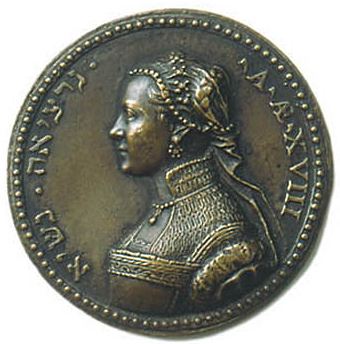
Commemorative Medal of Dona Gracia Mendes
Hanna ‘Gracia’ Nasi (1510-1569) was born in Lisbon, Portugal to a family of conversos – aka Marranos, Jews who were forcibly converted to Christianity – and named Beatriz de Luna Miquez. She married Francisco Mendes Benveniste, a wealthy spice trader and banker. When she was only 28, Gracia’s husband passed away, leaving the business to her and his brother. Gracia thus joined her brother-in-law in Antwerp (then part of the Spanish Netherlands). From there, she organized an escape network for Jews to flee Spain and Portugal from the Inquisition, smuggling them in spice ships, providing them with money and documents to make their way to the Ottoman Empire where Jews were still welcome. This saved the lives of countless Jews, who nicknamed her ‘Our Angel’. Shortly after, her brother-in-law died as well, leaving Gracia alone at the helm of the massive Mendes financial empire, dealing with the likes of European kings, the Sultan of Turkey, and several Popes. At the time, she was possibly the most powerful woman in the world. After a series of political intrigues, which included an unjust imprisonment and several attempts to seize her wealth, Gracia settled in Istanbul, where she was now free to return to her religion. She built and financed dozens of synagogues and yeshivas across the Ottoman Empire. In 1558, the Sultan granted her a lease for the desolate town of Tiberias in Israel. Gracia began rebuilding the town, allowing Jewish refugees to settle there, with the vision of reestablishing a Jewish homeland in Israel. Many historians consider this the earliest modern Zionist attempt. Today, Donna Gracia has become a feminist icon, and is celebrated as a hero around the world. Both Philadelphia and New York City host a ‘Dona Gracia Day’, and the Turkish government has sponsored exhibits in her honour. There is a museum exploring her life in Tiberias, and the ‘La Senora’ synagogue of Istanbul, named after her, still stands to this day. Dona Gracia is the aunt of past Jew of the Week Joseph Nasi
Words of the Week
One of the greatest tragedies of intellectual human experience is that we study Bible stories when we are 55 in the same manner as we studied them when we were 5.
– Rabbi Yaakov Kamenetsky
 Manoel Dias Soeiro (1604-1657) was born in Madeira, an island off of Portugal, where his parents fled from the Portuguese Inquisition. They soon moved to the Netherlands, where Soeiro grew up and became a respected rabbi and author, known by his Hebrew name Menashe ben Israel. In Holland, he established the first Hebrew printing press at the young age of 22, and his writings (in five languages!) would gain great fame, not only in the Jewish community, but among the greatest scholars and philosophers of the age, including Vieira, de Groot, and Huet. A portrait of Soeiro was even painted by Rembrandt! A great kabbalist, Soeiro wrote and published one of the earliest Jewish treatises on reincarnation, called Nishmat Hayim. Among his students was the infamous Baruch (Benedict) Spinoza. In 1638, Soeiro moved to Brazil. At the time, there was a popular notion that the natives were actually the Lost Tribes of Israel. This inspired Soeiro to take up the role of helping Jewish causes around the world. His first stop was England, where virtually no Jews lived since they were expelled in 1290. Soeiro worked hard to open the doors to their return, and in December 1655, the re-admittance of Jews to England was granted. Sadly, Menashe could not continue his work. Upon return to the Netherlands, his son passed away. Unable to contain the grief, Soeiro passed away himself in the midst of the funeral.