Tag Archives: Polish Jews

Jew of the Week: André Citroën

The Man Who Made the Citroën Car and Helped Win World War I
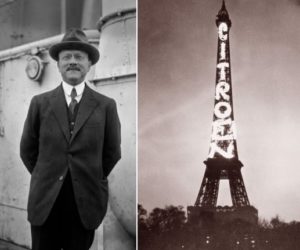
As a child, André Citroën was inspired by the Eiffel Tower. He lived to see his name displayed on it. This early “billboard” marketing technique is still a Guinness World Record for largest advertising sign.

André-Gustave Citroën (1878-1935) was born in Paris to a Dutch-Jewish father and Polish-Jewish mother. The last name “Citroën” comes from his grandfather, who sold fruit for a living in the Netherlands and was known as Limoenman, so his son made the family last name Citroen, which means “lemon”. As a child, Citroën was inspired by the Eiffel Tower and by the works of Jules Verne and dreamed of becoming an engineer. After graduating with an engineering degree, Citroën went on a trip to Poland to see his mother’s birthplace. There, he saw a carpenter working with a gear that had a “fish bone” structure. Citroën realized that such gears could be used in automobiles to make them quieter and more efficient. He bought the patent from the carpenter, then tweaked the designs until he came up with the automotive double helical gear. The Mors auto company successfully integrated these gears to make better cars, and by 1906 Citroën was the company’s director. With the outbreak of World War I, factories were being converted to produce weapons, and Citroën soon became world-renowned for increasing factory productivity. He took charge of fellow car-maker Renault’s large plant, now having its 35,000 employees making armaments. Citroën’s work played a key role in ensuring the Allies were well-armed and helping them win the war. Following the war, Citroën founded his own Citroën automobile company in 1919. Within just a dozen years, it became the world’s fourth largest car manufacturer. The company was most famous for its executive Traction Avant model, which pioneered a number of revolutionary features including independent suspensions on all four wheels and front-wheel drive. Investing so much money into research and development ultimately drove the company to bankruptcy and it was bought out by its tire maker Michelin. Citroën died the following year from cancer. He was buried in Paris’ famous Montparnasse Cemetery, with a traditional Jewish ceremony presided by Paris’ chief rabbi. A number of streets and parks in the city are named after him, and in 1998 Citroën was inducted into the Automotive Hall of Fame. Meanwhile, his company retained his original vision, and continued to pioneer many new technologies (like modern disc brakes, self-leveling suspensions, and swiveling headlights), becoming one of the most iconic car brands in the world.

Should You Wear a Red String On Your Wrist?

Words of the Week

If someone says,“I have worked hard, and I have not been successful,” don’t believe him. If someone says,“I have not worked hard and I have been successful,” don’t believe him. If someone says,“I have worked hard and I have been successful,” believe him!
– Talmud (Megillah 6b)
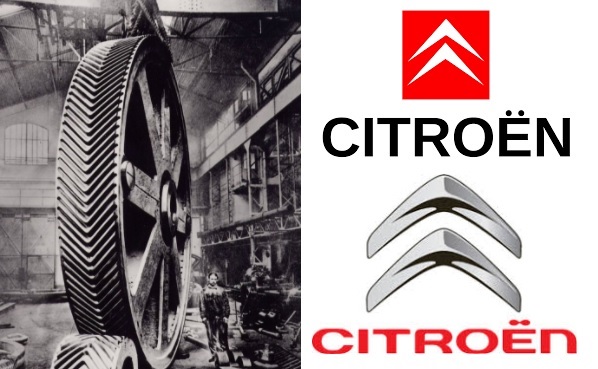
The double helical gear inspired the Citroën logo.
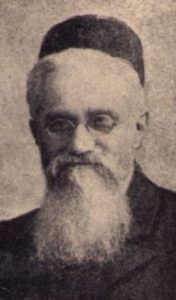
Jew of the Week: Rabbi Ze’ev Yavetz

Planting Trees on Tu b’Shevat

Rabbi Ze’ev Yavetz

Ze’ev Wolf Yavetz (1847-1924) was born in what is now Kolno, Poland (then part of the Russian Empire) to a wealthy Orthodox Jewish family. A noted scholar from a young age, he became a distinguished historian, linguist, writer, and teacher. When he was 40, Rabbi Yavetz made aliyah to the Holy Land with his family and joined the Yehud moshava, where he worked in a vineyard. Shortly after, he was hired by Baron Edmond de Rothschild to head the new Rothschild-funded school in Zikhron Ya’akov. (Zikhron Ya’akov was one of the first modern Jewish settlements in Israel, founded by Edmond de Rothschild in 1882, and named after his father Ya’akov “James” Rothschild.) In 1890, when the holiday of Tu b’Shevat came around, Rabbi Yavetz wanted to do something meaningful with his students in honour of the Jewish “new year for trees”. So, he took his class on a tree-planting trip. This turned into a yearly tradition, and was soon adopted by neighbouring schools and villages. Eventually, the Jewish National Fund adopted the custom, too, and to this day over a million Jews participate in the JNF’s Tu b’Shevat tree-planting drive each year. In all, the JNF has planted over 260 million trees in Israel, making it the only country in the world to have increased its tree population in the last century. Meanwhile, Rabbi Yavetz joined the Hebrew Language Committee (famously founded by Eliezer Ben-Yehuda) and helped to develop the modern Hebrew tongue. He coined a number of modern Hebrew words, including tarbut and kvish. Unlike other Zionists, Rabbi Yavetz never abandoned his faith, and worked hard to ensure Jews in Israel observe Torah law, and live like their ancestors. For this reason, he was a co-founder of the Mizrachi religious Zionist movement. (The more well-known Bnei Akiva organization is the youth arm of Mizrachi.) Mizrachi would go on to establish Israel’s Ministry of Religious Affairs, ensure that Israeli government kitchens keep kashrut, and that public services rest on Shabbat. Mizrachi also had a political party, which had many names over the years, and is now known as HaBayit HaYehudi (“The Jewish Home”). Rabbi Yavetz spent the last years of his life in London, where he wrote a monumental 14-volume history of the Jewish people called Toldot Israel. Today, a school in Zikhron Ya’akov is named after him, as is the village of Kfar Yavetz.

Happy Tu b’Shevat!

Words of the Week

… from the most inhospitable soil, surrounded on every side by barrenness and the most miserable form of cultivation, I was driven into a fertile and thriving country estate where the scanty soil gave place to good crops and cultivation, and then vineyards and finally to the most beautiful, luxurious orange groves, all created in 20 or 30 years by the exertions of the Jewish community who live there.
– Winston Churchillreporting to Parliament after visiting Rishon LeZion in 1921

Jews of the Week: Rose and Reuben Mattus

Rose and Reuben Mattus

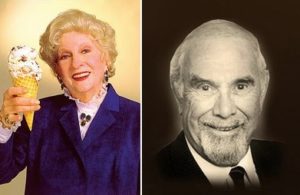
Reuben Mattus (1912-1994) was born in Poland during World War I, which took his father’s life. He and his mother moved to New York when he was still a child. To make a living, the two worked at an ice cream parlour run by Mattus’ uncle, where ten-year old Reuben would squeeze lemons. By the time he finished high school, the family business was making chocolate ice cream bars and ice cream sandwiches, and sold them from a horse-drawn carriage. They opened up an ice cream factory in Brooklyn, where a young Rose Vesel (1916-2006) was hired to be a bookkeeper. Rose also immigrated with her Polish-Jewish family to New York as a five-year old. She first met Reuben on the streets of Brooklyn, and the two finally married in 1936. Two decades later, the couple decided to open up a new ice cream company. This ice cream would be richer and thicker, made with natural ingredients and butterfat as opposed to the artificial ingredients commonly used by other ice cream makers at the time. Since foreign-sounding names typically market better, Reuben came up with the Danish-sounding “Häagen-Dazs”, and put a map of Denmark on the logo. He did this as a tribute to Denmark, a country which strove to protect its Jews during the Holocaust. (The name “Häagen-Dazs” doesn’t actually mean anything in Danish!) While Reuben developed the recipes, Rose would sell the ice cream – initially by giving out free samples at supermarkets and universities, then catering to upscale restaurants. By 1973, Häagen-Dazs was the only ice cream being sold across the US, and opened its first official store just three years later. The Mattus’ sold the company for $70 million in 1983, but stayed on as consultants. Today, Häagen-Dazs is among the best-known ice cream brands in the world, and continues to operate ice cream shops all over the globe. (It still uses natural flavours and avoids using emulsifiers and artificial stabilizers like guar gum and carrageenan.) Reuben and Rose Mattus have been called the “Emperors of Ice Cream”, much like their fellow Jewish compatriots Baskin & Robbins and Ben & Jerry. Aside from ice cream, the Mattus’ were noted philanthropists, and strong supporters of Israel. They founded a school in Herzliya which still bears their name, and funded the construction of multiple settlements. They also financially supported the controversial Rabbi Meir Kahane, founder of the Jewish Defense League (JDL), as well as the Likud party. Rose Mattus sat on the board of the Zionist Organizations of America, and was reportedly a good friend of both Ariel Sharon and Benjamin Netanyahu. In 2004, she published a book detailing the incredible story of Häagen-Dazs.

Words of the Week

It is better to have an Israel that everyone hates, than an Auschwitz that everyone loves.
– Rabbi Meir Kahane