Tag Archives: Nobel Prize

Jew of the Week: Fritz Haber

Fritz Haber

Fritz Haber

Fritz Haber (1868-1934) was born to a traditional Jewish-German family in what is today Poland. He studied chemistry in Berlin, receiving his doctorate in 1891 and then going to apply his expertise in his father’s successful dyes and pharmaceuticals business. The two didn’t work well together, though, and Haber returned to academia. (In order to obtain a higher position at a time when Jews were barred from such posts, Haber nominally converted to Christianity.) His research in organic chemistry, electrochemistry, dye technology, gasses, and textiles brought him a great deal of recognition. In 1898 he was made an associate professor, and by 1906 a full professor at Karlsruhe University, among the most prestigious schools in Germany. It was there that Haber made his biggest breakthrough. Together with Carl Bosch, he invented a process that would quickly and cheaply produce ammonia (the key component of fertilizer) from abundant atmospheric nitrogen. Until then, ammonia had to be mined from very limited reserves. Today, over 100 million tons of ammonia is made annually using the “Haber Process”, helping to feed half of the world’s population. Haber won the 1918 Nobel Prize for this work. Unfortunately, Haber also applied his know-how to less honourable endeavours. Aside from the fact that ammonia is a central ingredient of explosives, too, and the Haber Process helped to arm the German military, Haber headed the Ministry of War’s Chemistry Section during World War I, developing gasses for chemical warfare (as well as the gas masks to protect from them). To be fair, many of the world’s top chemists during this time period worked on chemical warfare to assist in their nation’s war effort. As Haber himself said, “During peace time a scientist belongs to the World, but during war time he belongs to his country.” His wife did not agree, and committed suicide after failing to convince him to abandon his project. After the war, Haber started a company that produced pesticides. Incredibly, their most famous product was Zyklon B, later used in the gas chambers of the Holocaust. Haber fled Germany when the Nazis came to power. He accepted a position in what would later be the Weizmann Institute in Israel, but passed away on the journey there. Few people have at once been able to cause both so much harm and so much good. While half of the world’s food production today depends on the Haber process, so do much of its explosives, and Haber is often called “the father of chemical warfare”. Haber’s work simultaneously brought death to millions of people, and life to millions more.

Words of the Week

When God desired to create man, Truth said: “He should not be created, for he is full of lies.” Kindness said: “He should be created, for he is full of kindness.”
– Midrash Rabbah, Bereshit 8:5
Jew of the Week: Elie Wiesel

Messenger to Mankind

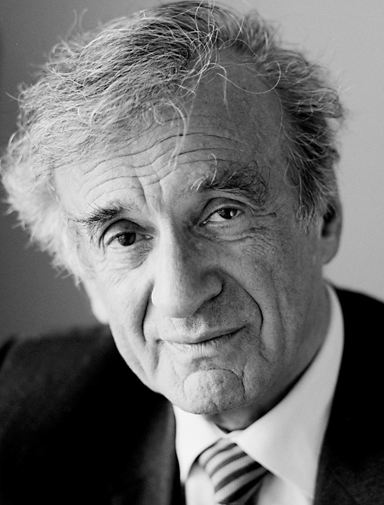
Elie Wiesel

Elie Wiesel

Eliezer Wiesel (b. 1928) was born in Romania in a home that regularly spoke Hungarian, German, Romanian, and Yiddish. During the Holocaust he suffered in multiple labour and concentration camps, including Buchenwald and Auschwitz, and lost both parents and a younger sister. After the war, he resettled in Paris, studied at the Sarbonne, and worked as a journalist. In 1949, Wiesel became the Paris correspondent (later the international correspondent) for Yediot Ahronot. Though originally not wanting to write at all about the horrors of the Holocaust, he was convinced by a friend and published Night in 1958 – a shortened French version of his 900-page memoir in Yiddish. Though it took a while to hit the mainstream, the book now sells hundreds of thousands of copies every year and has been translated into 30 languages. Wiesel has subsequently authored many more publications, and has become an internationally-renowned speaker. In 1986, he won the Nobel Peace Prize for his efforts against racism, violence, and genocide, and was called a “messenger to mankind”. He has also won the Presidential Medal of Freedom, the Congressional Gold Medal, and was knighted, among many other awards. He has even been nominated as President of Israel, but did not wish to take up the post. Wiesel has taught at Boston and Columbia Universities, the City University of New York, and served as a visiting scholar at Yale. He has spent a great deal of his life as a political activist for international causes. He stood strongly against apartheid South Africa and raised support for intervention during the Bosnian genocide, and more recently in Darfur. He has assisted the plight of Kurds, Native Americans, Argentinian Desaparecidos, as well as Soviet and Ethiopian Jewry. Wiesel remains a vocal supporter of Israel, and Jerusalem as its undivided capital. For the past 58 years, he has lived in the US and to this day has authored 57 books.

UPDATE: Sadly, Elie Wiesel passed away on July 2, 2016.

Words of the Week

For me, the Jew that I am, Jerusalem is above politics. It is mentioned more than six hundred times in Scripture – and not a single time in the Koran.
– Elie Wiesel

Jew of the Week: Albert Einstein

Father of Modern Physics

Albert Einstein (1879-1955) was born in Germany, lived in Italy, and received his higher education in Switzerland. In 1905, Einstein exploded onto the science scene with 4 revolutionary papers on the subjects of the photoelectric effect, Brownian motion, special relativity, and mass/energy equivalence. By 1919 his research and theories were world-famous, with The Times reporting “Revolution in Science – New Theory of the Universe – Newtonian Ideas Overthrown”. He won the Nobel Prize two years later, for the photoelectric effect (not relativity!) In 1922, Einstein travelled the world, with a 12-day stop in Israel, during which he said “I consider this the greatest day of my life.” In 1933, he moved permanently to the US due to the Nazi rise to power. The Nazis raided his house, publicly burned his writings, and even put a bounty on his head worth $5000! Of them, he said, “I must confess that the degree of their brutality and cowardice came as something of a surprise.” Fearing the Nazis would develop an atomic bomb, Einstein penned a letter to President Roosevelt persuading him to start a nuclear weapon research program. Einstein would later call this the greatest mistake of his life – but a necessary one.

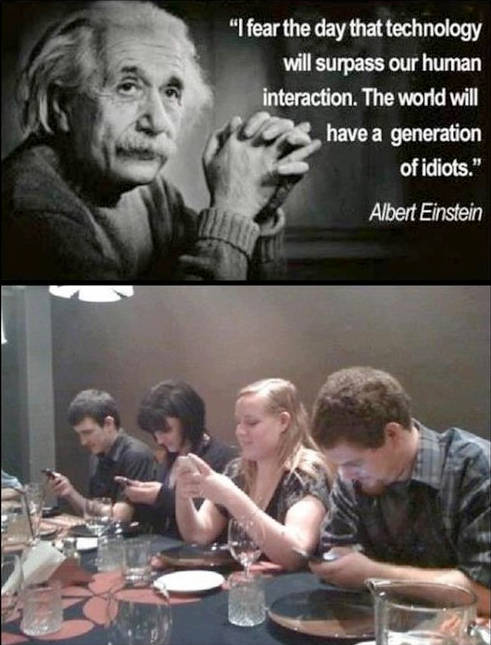
Einstein Predicts the Future...?

Einstein Predicts the Future…?

He spent the rest of his life researching, teaching and writing, based primarily at Princeton. He was a member of the NAACP and fought for civil rights in America. Becoming a vegetarian, Einstein believed mankind as a whole would benefit greatly by adopting such a diet. Three years before his death he was offered to be President of Israel, but was “saddened and ashamed” to decline, humbly admitting he would have no idea how to run a country. Einstein passed away while working on a speech for Israel’s 7th Independence Day. His brain was preserved to be studied, the rest of his body cremated and scattered. Receiving countless awards, Einstein would publish over 300 scientific works, and an additional 150 non-scientific ones. He revolutionized the fields of thermodynamics, light, quantum physics, energy, relativity, cosmology, statistics, motion and momentum, magnetization, refrigeration and a host of others. He was also a musician. So great is his legacy, that “Einstein” has become synonymous with “genius”.

Words of the Week

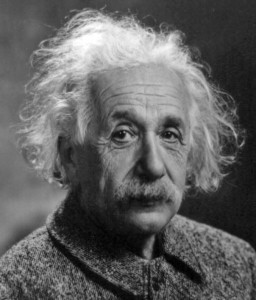
Einstein in 1947

Einstein in 1947

Gems from Albert Einstein:

No problem can be solved from the same level of consciousness that created it.

Education is what remains after one has forgotten what one has learned in school.

Great spirits have always encountered violent opposition from mediocre minds.

The world is a dangerous place to live; not because of the people who are evil, but because of the people who don’t do anything about it.