Second Israeli in Space
 Eytan Meir Stibbe (b. 1958) was born in Haifa to Jewish parents who had made aliyah from the Netherlands. He grew up partly in the United States. Stibbe joined the Israeli Air Force and became an F-16 fighter pilot. He served under the command of Ilan Ramon, who would go on to become Israel’s first astronaut. Stibbe served with distinction, and once tied a record by shooting down four enemy aircraft in a single battle over Lebanon in 1982. In another mission, he downed a total of five Syrian aircraft! Stibbe was awarded the Distinguished Service Medal, and went on to teach at the IAF Flight Academy. Altogether, he served with the Israeli Air Force for some 43 years. Meanwhile, in 1984 he joined Israel Aircraft Industries to help modify and improve Israel’s own Lavi fighter jet. The following year, he co-founded Elar, a new Israeli military tech developer. When he left the company in 2011 and sold all of his shares, he had become a millionaire. Stibbe then turned his attention to his new Vital Capital Fund, which invests specifically in projects designed to alleviate poverty and clean up the environment. The Fund has helped bring sanitation, electricity, and healthcare to millions of people around the world, and has won numerous awards for its philanthropic work. Stibbe has always dreamed of following his mentor Ilan Ramon to space. He purchased a $55 million ticket on board a SpaceX craft, in collaboration with Axiom Space, which took off on April 8th for a ten-day mission. This is the first ever privately-funded human mission to space, and Stibbe is now only the second Israeli ever to go to space. He is not only a passenger, but also doing important scientific work, carrying out a total of 35 experiments, including on space radiation, optics, and quantum communications. Because of several delays, the Rakia mission (from the Biblical Hebrew word for outer space) ended up overlapping with Passover. And so, Stibbe took with him a Pesach seder kit prepared by Chabad, with shmurah matzah and four mini-cartons of grape juice (wine is prohibited on the ISS!) The return trip has also been delayed due to poor weather, and is expected to finally return to Earth this Sunday.
Passover: Fighting for Freedom
Words of the Week
Moses spoke not about freedom but about education. He fixed his vision not on the immediate but on the distant future, and not on adults but children. In so doing he was making a fundamental point: It may be hard to escape from tyranny but it is harder still to build and sustain a free society. In the long run there is only one way of doing so – to defend a country you need an army, but to defend a civilization you need education.
– Rabbi Jonathan Sacks
 Anatoliy Davidovich Daron (1926-2020) was born in Odessa, Ukraine. An avid pianist, he initially wished to become a musician. At age 12, he read a book about space and was inspired to become a rocket scientist, with the hopes of one day flying to Mars. That same year, World War II broke out and the family fled to Russia’s Stavropol region. A few years later, the Nazi invasion came to his town just as he was graduating high school—he got his diploma, written by the principal on a scrap piece of paper, while everyone was fleeing! Doron went on to study rocketry in Moscow, and soon joined OKB-456, the Soviet state institution tasked with missile and rocket development, under the leadership of Valentin Glushko. There, Daron worked on the USSR’s first intercontinental ballistic missiles (ICBMs). When the anti-Semitic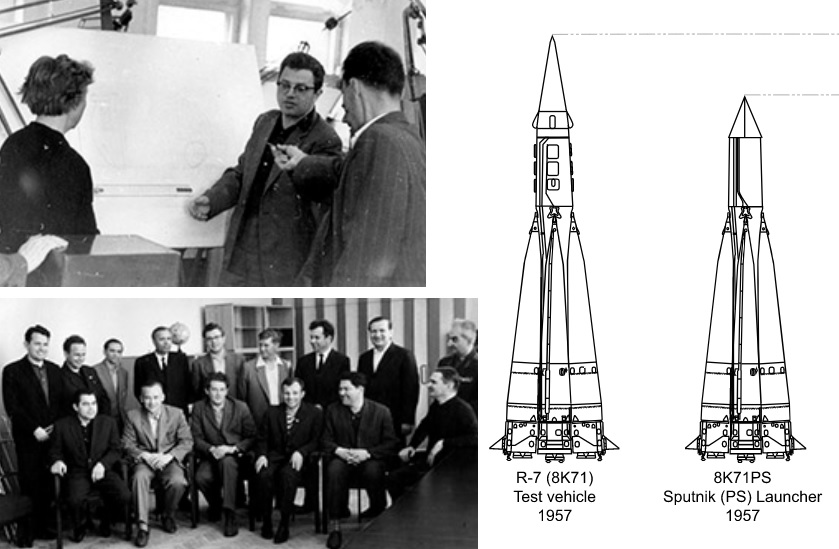
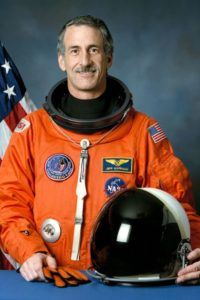 Jeffrey Alan Hoffman (b. 1944) was born in Brooklyn. He was always fascinated by outer space, and went to study astronomy at Amherst College in Massachusetts. Hoffman went on to get a PhD in astrophysics from Harvard, researching cosmic x-rays and gamma rays. He built one of the first aerial gamma ray telescopes. After this, he did postdoctoral work in the UK, eventually working as a project scientist for the European Space Agency. In 1975, Hoffman returned to the US to work at MIT. His main area of focus was x-ray bursts, and he authored over 20 papers on the subject, becoming the world expert on it. One time, he heard his wife reading a passage in a book saying that there will never be a Jewish astronaut. This inspired Hoffman to pursue just that, and he applied to NASA. In 1978, he was selected for NASA’s astronaut training program, together with