Tag Archives: Music

Jew of the Week: Emile Berliner

Inventor of the Gramophone and Helicopter

Emile Berliner, inventor of the Gramophone and the helicopter

Emile Berliner, inventor of the Gramophone and the helicopter

Emile Berliner (1851-1929) was born in Hanover, Germany. Though he studied to be a merchant like the rest of his family members, he was always more interested in invention. With the outbreak of the Franco-Prussian War in 1870, Berliner fled to the US and settled in New York. During the day, he struggled to make ends meet by delivering newspapers and doing other petty jobs, while at night he studied physics. He became interested in the new technology of telephone and began working on sound transmission. Berliner first invented a new phone transmitter that was later adapted to make the first microphone. Bell Telephone Company bought out his patent and hired Berliner. He worked for Bell until 1883, when he established his own company. Building on previous phonograph technology, Berliner revolutionized the world in 1887 by inventing the gramophone and the flat disc record. At first, it was sold as just a toy, and only in Europe. In 1895, Berliner managed to get a $25,000 investment for his invention, and started the US Berliner Gramophone Company. Unfortunately, others stole his patents and sold unauthorized records, and Berliner was eventually unable to sell his own invention. He moved to Canada, started a new company, and soon focused on other technologies. One of these was an automatic loom for mass-producing clothes. Another, more famous, was the first helicopter. For over twenty years, Berliner focused on developing vertical flight machines, with the help of a number of other inventors and scientists. He designed the vertical rotor that made modern helicopters possible. In 1922, Berliner demonstrated the first helicopter to the US Army. Meanwhile, Berliner wrote and published five books, and was a noted advocate for public health and better sanitation. He won a number of prestigious awards for his work, which forever transformed the music, clothing, and flight industries.

Words of the Week

The souls of all the living… On Rosh Hashanah will be inscribed and on Yom Kippur will be sealed: how many will pass from the earth and how many will be created; who will live and who will die… Who will rest and who will wander, who will live in harmony and who will be harried, who will enjoy tranquility and who will suffer, who will be impoverished and who will be enriched, who will be degraded and who will be exalted. But repentance, prayer, and charity avert these severe decrees!
– Verses from Unetanneh Tokef, sung during Rosh Hashanah prayers
Jew of the Week: Benny Goodman

The King of Swing – America’s First Rock Star

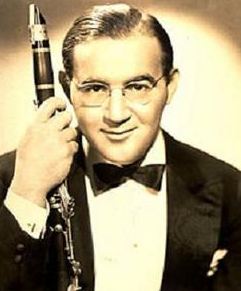
Benny Goodman

Benny Goodman

Benjamin David Goodman (1909-1986) was born in Chicago, the son of a Polish-Jewish father and Lithuanian-Jewish mother, immigrants who met in the U.S. Goodman took his first music lessons when he was 10 years old at the local synagogue. By 12, he made his professional debut (playing the clarinet) at Chicago’s Central Park Theater. At 16 he made his first recordings with the Ben Pollack Orchestra. He would go on to play alongside some of the most popular bands and most famous artists of the day. His own band would appear in a number of films, and on national radio. Despite the open racism and segregation of the time, Goodman began working with African-Americans, and is considered the first major American musician to have an interracial band (which meant he had to avoid playing concerts in the Southern states, where interracial bands were illegal). This was a key step in opening the door for more African-Americans to enter the mainstream music industry. By 1935, Goodman was one of the central forces that ushered in the “swing” era. In fact, he would be crowned the “King of Swing” (in addition to the “Rajah of Rhythm” and the “Patriarch of the Clarinet”). He is often credited with inspiring the start of the “dance craze”, and some consider him “America’s first rock star”. In 1962, Benny Goodman made history when he was sent to the USSR – the first American band on Soviet soil. The tour was designed to ease Cold War tensions, and was hailed a great success on both sides after 32 concerts, including for Soviet leader Nikita Khrushchev. It was a symbolic start of the process of reconciliation between the US and the USSR. Goodman was voted the best clarinetist multiple times, was inducted in the Jazz Hall of Fame, and awarded a Grammy for Lifetime Achievement. His fascinating story was immortalized in a major motion picture, The Benny Goodman Story.

Words of the Week

God would not have preserved our people for so long if we did not have another role to play in the history of mankind.
– Theodor Herzl

Jew of the Week: Albert Einstein

Father of Modern Physics

Albert Einstein (1879-1955) was born in Germany, lived in Italy, and received his higher education in Switzerland. In 1905, Einstein exploded onto the science scene with 4 revolutionary papers on the subjects of the photoelectric effect, Brownian motion, special relativity, and mass/energy equivalence. By 1919 his research and theories were world-famous, with The Times reporting “Revolution in Science – New Theory of the Universe – Newtonian Ideas Overthrown”. He won the Nobel Prize two years later, for the photoelectric effect (not relativity!) In 1922, Einstein travelled the world, with a 12-day stop in Israel, during which he said “I consider this the greatest day of my life.” In 1933, he moved permanently to the US due to the Nazi rise to power. The Nazis raided his house, publicly burned his writings, and even put a bounty on his head worth $5000! Of them, he said, “I must confess that the degree of their brutality and cowardice came as something of a surprise.” Fearing the Nazis would develop an atomic bomb, Einstein penned a letter to President Roosevelt persuading him to start a nuclear weapon research program. Einstein would later call this the greatest mistake of his life – but a necessary one.

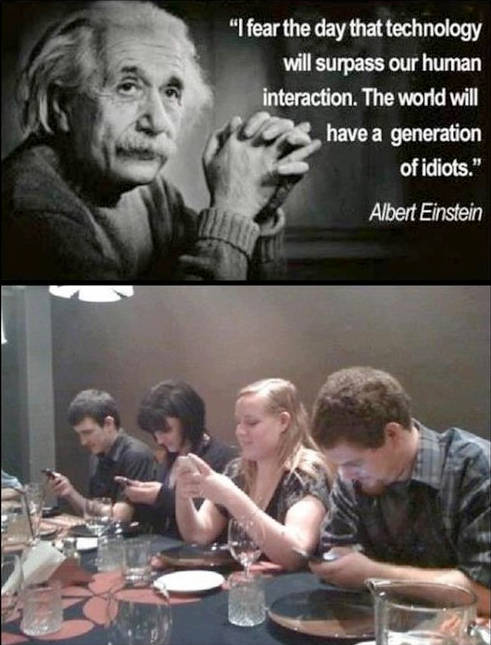
Einstein Predicts the Future...?

Einstein Predicts the Future…?

He spent the rest of his life researching, teaching and writing, based primarily at Princeton. He was a member of the NAACP and fought for civil rights in America. Becoming a vegetarian, Einstein believed mankind as a whole would benefit greatly by adopting such a diet. Three years before his death he was offered to be President of Israel, but was “saddened and ashamed” to decline, humbly admitting he would have no idea how to run a country. Einstein passed away while working on a speech for Israel’s 7th Independence Day. His brain was preserved to be studied, the rest of his body cremated and scattered. Receiving countless awards, Einstein would publish over 300 scientific works, and an additional 150 non-scientific ones. He revolutionized the fields of thermodynamics, light, quantum physics, energy, relativity, cosmology, statistics, motion and momentum, magnetization, refrigeration and a host of others. He was also a musician. So great is his legacy, that “Einstein” has become synonymous with “genius”.

Words of the Week

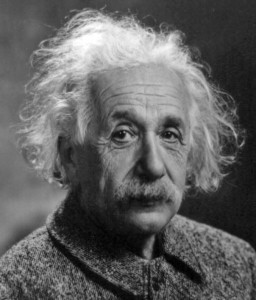
Einstein in 1947

Einstein in 1947

Gems from Albert Einstein:

No problem can be solved from the same level of consciousness that created it.

Education is what remains after one has forgotten what one has learned in school.

Great spirits have always encountered violent opposition from mediocre minds.

The world is a dangerous place to live; not because of the people who are evil, but because of the people who don’t do anything about it.