In Memory of an Israeli Founding Father
 Menachem Begin (1913-1992) was born in what is today Belarus to a religious and Zionist family that came from a long line of great rabbis. Interestingly, the midwife that delivered him was the grandmother of fellow Belorussian Jew Ariel Sharon! Begin went to a religious cheder elementary school, and then a religious Zionist high school, and was also a member of Hashomer Hatzair, the Zionist youth movement. In law school at the University of Warsaw, he organized a Jewish self-defence group to fight rampant anti-Semitism. After graduating, Begin joined Ze’ev Jabotinsky’s Betar organization and soon became the head of its Polish and Czech branches. When Germany invaded Poland in September of 1939, Begin fled to Lithuania. The following month, Lithuania was invaded by the USSR and Begin was imprisoned for his Zionist activity and for being a supposed “British imperialist”. Begin was tortured and sentenced to 8 years in a labour camp. He was released in 1941 and put into a Polish resistance force to fight the Nazis. By the end of 1942, Begin’s commander issued him a leave of absence so that he could go to Israel to fight for the Zionist cause. Begin arrived in the Holy Land and joined the militant Irgun, arguing that the Zionist leadership was too soft and that the British had to be expelled. Against the wishes of the Jewish Agency, Begin organized a revolt against the British, with a step-by-step plan that he modeled on the Irish independence movement. The insurgency was launched in February 1944. Begin’s plan worked, and the British would leave three years later, allowing Israel to declare independence. Throughout this time, Begin was Britain’s “most wanted” man and stayed in hiding, appearing in public rarely and usually disguised as a rabbi. Begin went on to sign a deal with Ben-Gurion to combine their forces and create the IDF, though the process was far from smooth. He then formed the right-wing Herut party, winning 14 seats in Israel’s first election. The Herut party was sidelined as “extremist” and only participated in the governing coalition briefly following the Six-Day War. It only became more prominent in 1973 when, following the Yom Kippur War, Herut joined several other parties to form the new Likud coalition. In the 1977 election, Begin won a landslide in what has been called the mahapakh, a “revolution” in Israeli politics. The main reason for his win was that Begin reached out to Mizrachi and Sephardic Jews, who long felt like second-class citizens under Israel’s Ashkenazi establishment. Begin did not disappoint, and as prime minister started a “Project Renewal” to inject major funding into Mizrachi communities, transforming 82 “slums” into thriving towns. He also pioneered major education reform in Israel, making secondary education compulsory and removing tuition fees for it. Begin’s “economic transformation” shifted Israel away from a socialist economy towards a free-market economy (which saw several hiccups, and admittedly came with both positives and negatives). Most famously, Begin met with Egyptian president Sadat to negotiate the Camp David Accords, resulting in Israel’s first peace treaty with an Arab adversary, for which he won a Nobel Peace Prize. Nonetheless, Begin was severely criticized within his own party, accused of no longer being the hawk he once was, and reneging on his own principals. Perhaps to mitigate this, Begin launched a massive campaign of Jewish settlement in Judea and Samaria (the “West Bank”) and Gaza, quadrupling the Jewish population in these regions, and later formally annexed the Golan Heights. Begin’s other famous achievement was Operation Opera, in which Saddam Hussein’s nuclear reactor was destroyed by the Israeli Air Force in 1981. This gave rise to the “Begin Doctrine”: that Israel would never allow an enemy state to develop nuclear weapons. In November 1982, Begin’s beloved wife passed away and he fell into a deep depression. Together with his own failing health, and Israel’s quagmire in Lebanon, Begin resigned as prime minister and left the post to Yitzhak Shamir. Begin lived out his life in seclusion, leaving his apartment only to say Kaddish at his wife’s grave. Begin died of a heart attack and had requested a simple Jewish funeral, with no state honours. Unlike other leaders who are buried at Mount Herzl, Begin asked to be buried at the Mount of Olives. His funeral was attended by some 75,000 admirers. Altogether, Begin served on the Knesset for 34 years, and over that time had stints as Minister of Communication, Justice, Labour, Transportation, Foreign Affairs, Defence, and Agriculture. He wrote two books. Next Monday is his yahrzeit.
Historic Footage: Menachem Begin and the Lubavitcher Rebbe
Words of the Week
I am completely and unequivocally opposed to the surrender of any of the liberated areas [of Israel] currently under negotiation…
– Rabbi Menachem Mendel Schneerson, the Lubavitcher Rebbe
 Reuven Rivlin (b. 1939) was born in Jerusalem to a family descended from the great
  Schneur Zalman Rubashov (1889-1974) was born in the Belorussian town of Mir, near Minsk, to a deeply religious Chabad family, and was named after Chabad’s founder,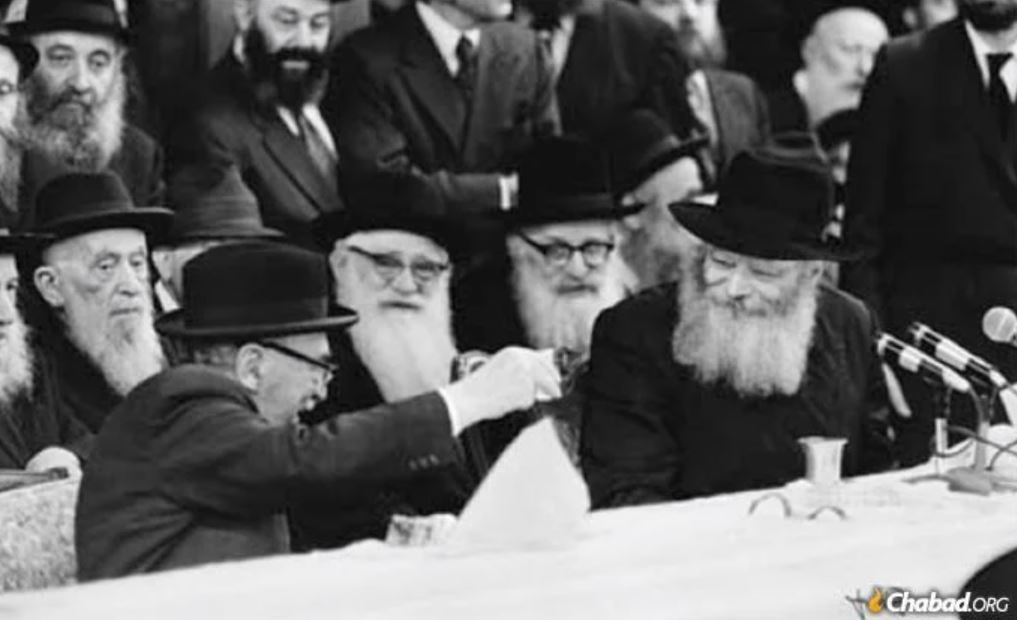
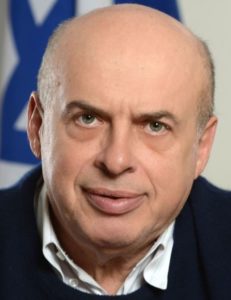 Anatoly Borisovich Sharansky (b. 1948) was born in Donetsk, Ukraine. He was a child chess prodigy, and won his city’s chess championship as a teenager. He went on to study math in Moscow and later worked in a secret Soviet research lab. In 1973, Sharansky applied for an exit visa to Israel and was refused. Henceforth, he became a vocal activist on behalf of Soviet Jewry, and became the world’s most famous refusenik. He soon expanded his scope to work for all human rights, and was the spokesperson for the Moscow Helsinki Group, today Russia’s primary human rights organization. In 1977, Sharansky was arrested on trumped-up charges of treason and espionage, and sentenced to 13 years of hard labour. He was tortured, and kept in solitary confinement for long periods of time. (He would later remark that one of the things that helped him through it was playing chess in his mind.) After ceaseless activism from his wife, mother, and countless international supporters, Sharansky was finally released in 1986. Shortly after, he received a Congressional Gold Medal from the US government. He moved to Israel and started going by his Hebrew name, Natan. A couple of years later, he published a bestselling memoir, Fear No Evil. (This book was passed on by