Tag Archives: Kibbutz

Jew of the Week: Leonard Cohen

Leonard Cohen (Credit: CBC)

Leonard Cohen (Credit: CBC)

Leonard Norman Eliezer Cohen (1934-2016) was born in Montreal, the grandson of a Lithuanian rabbi and a Polish immigrant who founded the Canadian Jewish Congress. Cohen grew up very close to his Jewish community, and attended Montreal’s Jewish Herzliah High School, where he was first inspired to take up poetry by a teacher. While studying at McGill University, he published his first set of award-winning poems. His second book of poetry found even more success, and was seen as an important work in Canadian literature, with one critic calling Cohen “the best young poet in English Canada.” Cohen moved to a small island off the coast of Greece and wrote prolifically, publishing several more books of poetry and novels. One of his later books – a Literary Award winner – was inspired by the Hebrew Bible and consisted of 50 poems that Cohen called “prayers”. Meanwhile, Cohen started recording music in the 1960s as poetry did not bring the income he hoped for. His first album was a big hit in the US and UK. It was his seventh album that had his most famous song, “Hallelujah”, which Cohen went through some 80 drafts writing, and “banging his head on the floor”. The song was inspired by various Biblical scenes, including the stories of Samson and Delilah, and King David and Batsheva. It would be covered by over 200 artists in dozens of languages, and become the subject of a whole book and BBC documentary. In 1994, Cohen entered a period of five years of seclusion during which time he was ordained a Zen Buddhist monk. However, he never abandoned his Jewish roots, and said, “I’m not looking for a new religion. I’m quite happy with the old one, with Judaism.” Cohen was known to keep Shabbat throughout his career, even while on tour. In his 2009 concert in Tel-Aviv, Cohen spoke Hebrew and ended the concert with Birkat Cohanim, the priestly blessing. During the Yom Kippur War, Cohen went to Israel to volunteer at a kibbutz before going to the front lines himself to entertain Israeli soldiers, saying he will “stop Egypt’s bullets”. In his 1972 Jerusalem concert he was so emotional that he had to walk off stage at one point. The crowd started singing to bring him back and a teary-eyed Cohen felt like “the entire audience turned into one Jew”. All in all, Cohen produced 15 albums (the last of which was released just three weeks ago), 13 poetry books, and two novels. He won a plethora of awards – including multiple Junos and Grammys, the Order of Canada, and induction into the Rock and Roll Hall of Fame – and inspired countless musicians, poets, and artists. He has been hailed as one of the most influential songwriters and greatest musicians of all time. Sadly, Cohen passed away earlier this week.

Words of the Week

There is a crack in everything. That’s how the light gets in.
– Leonard Cohen
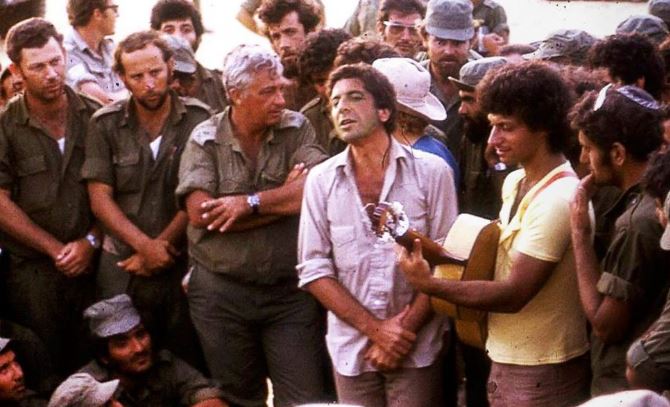
Leonard Cohen performing for the IDF, with Ariel Sharon looking on.
Leonard Cohen performing for the IDF, with Ariel Sharon looking on.

Jew of the Week: Uzi Gal

The Machine Gun that Saved President Reagan

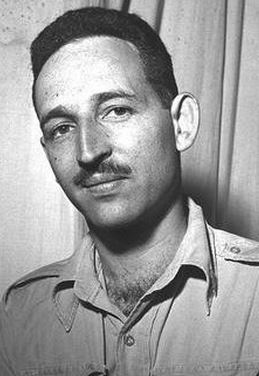
Uzi Gal

Uzi Gal

Uziel Guthardt Glass (1923-2002) was born in Weimar, Germany. His family fled from the Nazis to England in 1933, and from there made their way to Israel in 1936. They joined a kibbutz and changed their last name to Gal. From his youth, Gal was interested in weapons engineering, and designed his first automatic gun (which shot arrows) at age 15. At 20, now a member of the Jewish Haganah defense force, he was arrested by British troops for carrying a gun (forbidden to Jews in Israel at the time) and spent three years in prison. It was during his service in Israel’s War of Independence that he began designing a new, smaller, safer, and more effective submachine gun. In 1951, the IDF adopted his design, giving birth to the famous “Uzi” (although Gal requested that the weapon not be named after him). The weapon was also adopted by over 90 different countries, and became the most popular submachine gun in history, with over $2 billion in sales. It has been used primarily as a personal defense weapon by officers, tank infantry, and special forces units. Most famously, it was the weapon of choice for the US Secret Service – typically hidden in a small briefcase – and was used to save President Ronald Reagan from an assassination attempt in 1981. Along with other military decorations, Gal was the first person to be granted the Israel Security Award. With the high rank of Colonel, Gal retired from the IDF in 1975 in order to take care of his daughter, and moved to Philadelphia for her medical treatment. He continued designing weapons in the US until his passing due to cancer in 2002. In 2003, the Uzi was officially retired by the IDF, praised for its instrumental role in Israel’s many military victories.

Words of the Week

The truth is, we are all living in Israel. It’s just that some of us haven’t realized it yet.
– Sam Harris

Jew of the Week: Ruth Porat

“The Most Powerful Woman on Wall Street”

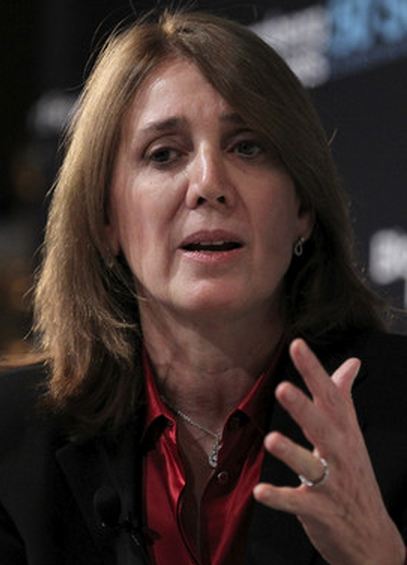
Ruth Porat

Ruth Porat

Ruth Porat (b. 1957) was born in England to Jewish immigrants from Israel. Her father was a Holocaust survivor who escaped to a kibbutz and fought in Israel’s War of Independence. He later became a physicist and moved the family first to Massachusetts and then to California, while doing research at Harvard, MIT and the National Accelerator Lab in Palo Alto. Ruth Porat studied at Stanford, and has Master’s degrees from both The London School of Economics and The Wharton School. Throughout most of her career, Porat worked for Morgan Stanley, rising all the way up to the rank of CFO and Executive Vice President. Before that, she served as the Vice Chair of their Investment Banking division, and the head of their international Financial Institutions Group. During the 2008 Financial Crisis, Porat was a chief adviser to the US Treasury, and was praised for helping to save AIG from total collapse, an event that would have completely tanked the economy. Not long ago, she was nicknamed the “Most Powerful Woman on Wall Street”. At the same time, Porat has been married for over 30 years, and is a mother of three, maintaining a steady “work-family mix”, as she calls it, and encouraging her co-workers to do the same. As one of only a few women with such high positions in the financial world, she has become an important role model. She is also a breast cancer survivor. In the past, working as a co-head of Morgan Stanley’s tech investment division, she directed funds to companies like eBay, and Amazon in their early days, helping to turn them into the giant companies they are today. Due to her vast knowledge of both the financial sector and the digital world, she was recently hired by Google, and as of last week, is their new CFO.

Words of the Week

Transgressions of man towards God – Yom Kippur atones for them. Transgressions of man towards man, Yom Kippur does not atone for them, until one seeks forgiveness from one’s fellow.
– Talmud, Yoma 85b