Tag Archives: Jerusalem

Jew of the Week: Henrietta Szold

Founder of Hadassah, Mother of Israel
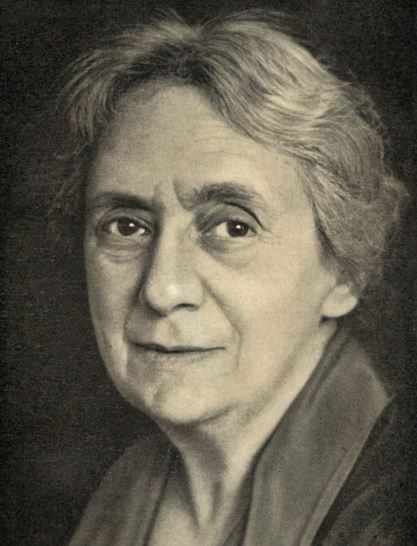
Henrietta Szold

Henrietta Szold

Henrietta Szold (1860-1945) was born in Baltimore, the eldest of eight daughters. After finishing high school, she became a teacher, and while working at both an all-girls school and a Jewish school, she was also taking additional studies at Johns Hopkins University. Soon, she opened up her own night school to assist Russian-Jewish immigrants and teach them English. After some 15 years as a teacher, Szold became the first editor of the Jewish Publication Society (famous for its JPS Tanakh, and now the oldest non-profit publisher of Jewish literature in English). Over the next 23 years at this position, she translated multiple Hebrew books into English, edited many others, wrote countless articles, and helped to produce the popular Jewish Encyclopedia, as well as Marcus Jastrow’s well-known Talmudic Dictionary. Meanwhile, Szold pursued advanced studies at the Jewish Theological Seminary (America’s leading Conservative Jewish academy). At the time, these studies were reserved only for men, but Szold managed to persuade the school president to let her in. In 1898, she was elected to the executive committee of the Federation of American Zionists, the first woman on the board. Her devotion to Zionism became even greater when she took her first trip to Israel in 1909. Three years later, she founded Hadassah, an organization that worked to establish a proper health care system in Israel – for both Jews and Arabs. Under Szold’s leadership, Hadassah helped to create some of Israel’s very first dental clinics, maternity clinics, food banks, medical schools, nursing programs, and at least half a dozen hospitals (Jerusalem’s Hadassah Medical Centre is still one of the largest hospitals in Israel). Today, Hadassah, or the Women’s Zionist Organization of America, is one of the largest volunteer organizations in the world, with over 330,000 active members serving to support health education, women’s rights, freedom of religion, and the State of Israel. Among her many other accomplishments, Szold co-founded the Ihud political party, and played a key role in Youth Aliyah, an organization that rescued over 30,000 Jewish children from the Nazis. Today, many institutions are named after her (including a public school in Manhattan), and Israelis celebrate Mother’s Day on her yahrzeit, the 30th of Shevat. Szold passed away in the Jerusalem hospital she helped to found, and was buried in the nearby Mount of Olives. She was recently inducted into America’s National Women’s Hall of Fame.

Words of the Week

… there is no ending that is not a beginning.
– Henrietta Szold

Jew of the Week: Bracha Qafih

Rabbanit Qafih

Rabbanit Qafih

Bracha Qafih (1922-2013) was born in Yemen to a traditional Jewish family. To save a young orphan boy from being taken away by the Muslim authorities, she was married to him at the age of just 11. The boy grew up to be Rabbi Yosef Qafih, better known as Rabbi Kapach, one of the greatest Yeminite Jewish religious leaders, and a judge on Israel’s Rabbinical Supreme Court. Rabbanit Qafih had three kids by the time she was 18, and immigrated to Israel soon after with her family. Settling in Jerusalem, she opened up her own embroidery business, which grew quickly to employ over 50 women. Qafih then devoted her time to charity work. Each holiday, she would organize food packages for the impoverished of the city, distributing them from her own home with the help of student volunteers. Eventually, she ran a food bank that provided regular sustenance to over 5000 people, an endeavour she oversaw for over 50 years, often putting herself in personal debt. She also ran a gmach for wedding gowns, where poor families could borrow wedding dresses for free, and organized a summer camp for disadvantaged children. She made sure that orphans could have proper bar mitzvahs, and advised countless people in need, including prostitutes and drug addicts, many of which credit her with helping them overcome their challenges. Her inspiration was her grandfather, who took her with him to distribute food to the poor in Yemen from the time that she was just 6 years old. Rabbanit Qafih continued her charity work into her old age, despite her poor health. She was known to already be preparing meals by four in the morning. Among many other decorations, in 1999, Rabbanit Qafih was awarded the Israel Prize for her immeasurable contributions to charity and Israeli society at large, where many affectionately referred to her as their grandmother.

Yom Kippur Begins Tonight! Gmar Chatima Tova to Everyone

Words of the Week

It’s not charity. It’s my responsibility.
– Rabbanit Bracha Qafih

Jews of the Week: Jeremiah and Gedaliah

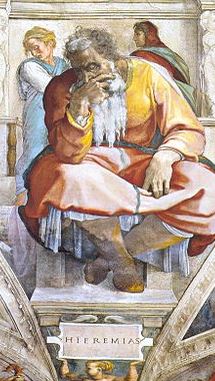
'Jeremiah' by Michelangelo (from the Sistine Chapel)

‘Jeremiah’ by Michelangelo (from the Sistine Chapel)

Yirmiyahu ben Hilkiah (c. 6th century BCE), better known as Jeremiah, was born to a family of Kohanim in Anathoth, Israel towards the end of the First Temple period. As the Kingdom of Judah descended into more and more sin, the righteous Jeremiah began receiving divine revelations prophesying the destruction of Jerusalem and the captivity of the Jewish people by the Babylonians. Although Jeremiah was very young, and did not want to take up the calling of a prophet, he nonetheless followed God’s direction to warn the people of their impending doom, and to inspire them to repent. Unfortunately, the people chastised Jeremiah and he was imprisoned for his teachings. Jerusalem was indeed destroyed, and the people exiled to Babylon. Jeremiah captured these events in his Book of Lamentations (Eichah), and recorded his prophecies in the Book of Jeremiah (written by his scribe Baruch). He is also credited with composing the Book of Kings, making him the author of three of the 24 books of the Tanakh, the Hebrew Bible. After prophesying to five kings of Judah, and surviving the destruction of the Temple, Jeremiah lived out the rest of his life in Egypt. Jewish texts compare Jeremiah to Moses, and he is also honoured as a prophet and holy man by Christians, Muslims, and the Bahai.

Archaeologists have discovered official clay seals bearing the names of Yehuchal and Gedaliah ben Pashur, two of the king's ministers that opposed Jeremiah and imprisoned him, as recounted in the Bible. Gedaliah ben Pashur should not be confused with the righteous Gedaliah ben Ahikam (Photo Credit: Gaby Laron, The Institute of Archaeology, The Hebrew University.)

Archaeologists have discovered official clay seals bearing the names of Yehuchal and Gedaliah ben Pashur, two of the king’s ministers that opposed Jeremiah and imprisoned him, as recounted in the Bible. Gedaliah ben Pashur should not be confused with the righteous Gedaliah ben Ahikam (Credit: Gaby Laron, The Institute of Archaeology, The Hebrew University.)

One of the leaders that Jeremiah supported was Gedaliah ben Ahikam, who was appointed by the Babylonian king Nebuchadnezzar to govern the Judean province after Jerusalem’s destruction, and to facilitate the rebuilding of Israel with the small group of Jews that were not exiled. Gedaliah successfully inspired the people to reestablish their farms and vineyards, rebuild their homes, and to inspire many other Jews who fled before the war to return. Sadly, Gedaliah was assassinated on Rosh Hashanah. Fearing another uprising and the response from King Nebuchadnezzar, the Jews of Israel fled to Egypt, despite Jeremiah’s insistence that God would protect them. This essentially left the land nearly devoid of any Jews for the next several decades, until the end of the Babylonian empire at the hands of the Persians, and the ensuing end of the Jewish exile. To mark the tragedy of the righteous Gedaliah’s assassination, and the temporary end of the Jewish presence in the Holy Land, the day after Rosh Hashanah (today) is observed as a fast day, known as the Fast of Gedaliah.

Words of the Week

Of everything G‑d created in His world, not one thing was created without purpose.
– Talmud, Shabbat 77b