Tag Archives: Israel

Jew of the Week: Rabbi Zecharia Barashi

World’s Oldest Jew

Rabbi Barashi (Credit: Lazar Berman)

Zecharia Barashi (1900-2017) was born in Kurdistan, the last of ten children in an observant Jewish family. His father was a rabbi who traveled from village to village, serving the needs of small Jewish communities in Iraq. Unfortunately, this job did not come with a salary, and the poor family made a meager living by sowing clothes and selling nuts and dates. Several years of harsh poverty, disease, and the difficulties of the First World War left six of the ten children dead. Barashi himself nearly died when he was 11 years old. He would follow in his father’s footsteps and become a rabbi as well. Inspired by Zionism, Barashi struggled to move the family to Israel. In 1936, he finally got a chance by working as a Hebrew interpreter for the Jewish Agency. After a long and arduous journey, the family settled in Jerusalem. Throughout World War II and Israel’s ensuing War of Independence, Barashi supported the war effort by digging trenches, and paving roads and runways. In 1950, the Jews of Iraq and Kurdistan made a mass aliyah to Israel, and Barashi soon became their spiritual leader. He would go on to earn the esteemed title of Chacham, “Sage”. He also published four important books on Judaism. He was in the midst of writing his fifth book when, at the age of 111, his eyesight became too poor. Deeply respected as one of Israel’s greatest rabbis, Barashi was known for his incredible memory, humility, and great sense of humour. Sadly, he passed away earlier this week. Until that moment, he was the world’s oldest living Jew. He was also Israel’s oldest living resident, having spent over 80 years in Jerusalem. Although he outlived two of his own children and his beloved wife, he is survived by five more children, 29 grandchildren, 72 great-grandchildren, and 24 great-great-grandchildren. His advice for a long life: “Always be happy, never jealous. Stay active. And never overeat, always leave the table a little hungry.”

Words of the Week

“My brain is the key that sets my mind free.”
Harry Houdini

Rabbi Barashi with Shimon Peres (Credit: Mark Neyman/Flash90)

Jew of the Week: Judith

Heroine of Chanukah

Judith displaying the head of Holofernes

Judith displaying the head of Holofernes

Yehudit bat Merari (c. 2nd century BCE) was a Jewish woman who lived in the town of Bethulia in Israel. Her husband, Menashe, fought and died with the Maccabees during the Chanukah wars against the Syrian-Greeks. When a massive Greek legion led by General Holofernes invaded her village, the local men were too frightened to fight back. Taking matters into her own hands, the young widow (together with her maid) crossed enemy lines and pretended to be a Greek spy. Slowly, she got closer to the Greek authorities and eventually made it to the tent of Holofernes. One night, Judith plied him with wine and fed him cheese until he was asleep. She then decapitated him with his own sword. Judith brought the head back to the fearful Israelites and roused them to attack the Greeks. Her inspirational words and wise military counsel led to a monumental Jewish victory. Jewish texts credit this event as the turning point of the war, leading to the recapture and re-dedication of the Holy Temple, the preservation of Judaism, and the ultimate collapse of the Syrian-Greek empire. Judith is often listed as one of the genuine prophetesses of Israel, and a great heroine like Esther, Deborah, Yael, and many others before her. (She was even canonized as a saint in Catholicism!) In honour of her feat, it is customary to eat dairy products during the 8-day festival of Chanukah, and for women to abstain from any work while the Chanukah lights are burning. Judith continued to lead the nation until her passing at the age of 105.

Chanukah Begins Saturday Night! Chag Sameach!

Words of the Week

The darkest time of the night is just before dawn.
Midrash Tehillim, Chapter 22

Jew of the Week: Leonard Cohen

Leonard Cohen (Credit: CBC)

Leonard Cohen (Credit: CBC)

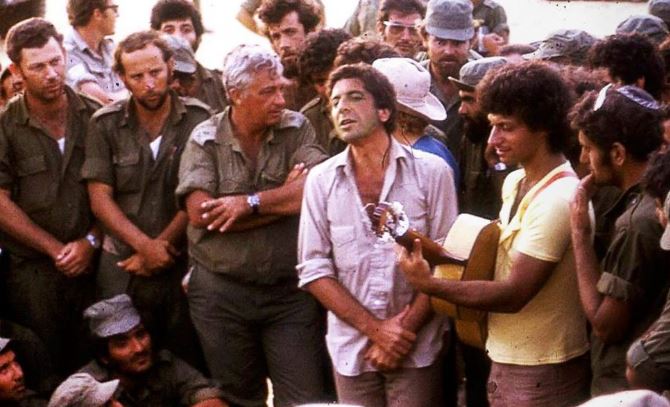
Leonard Norman Eliezer Cohen (1934-2016) was born in Montreal, the grandson of a Lithuanian rabbi and a Polish immigrant who founded the Canadian Jewish Congress. Cohen grew up very close to his Jewish community, and attended Montreal’s Jewish Herzliah High School, where he was first inspired to take up poetry by a teacher. While studying at McGill University, he published his first set of award-winning poems. His second book of poetry found even more success, and was seen as an important work in Canadian literature, with one critic calling Cohen “the best young poet in English Canada.” Cohen moved to a small island off the coast of Greece and wrote prolifically, publishing several more books of poetry and novels. One of his later books – a Literary Award winner – was inspired by the Hebrew Bible and consisted of 50 poems that Cohen called “prayers”. Meanwhile, Cohen started recording music in the 1960s as poetry did not bring the income he hoped for. His first album was a big hit in the US and UK. It was his seventh album that had his most famous song, “Hallelujah”, which Cohen went through some 80 drafts writing, and “banging his head on the floor”. The song was inspired by various Biblical scenes, including the stories of Samson and Delilah, and King David and Batsheva. It would be covered by over 200 artists in dozens of languages, and become the subject of a whole book and BBC documentary. In 1994, Cohen entered a period of five years of seclusion during which time he was ordained a Zen Buddhist monk. However, he never abandoned his Jewish roots, and said, “I’m not looking for a new religion. I’m quite happy with the old one, with Judaism.” Cohen was known to keep Shabbat throughout his career, even while on tour. In his 2009 concert in Tel-Aviv, Cohen spoke Hebrew and ended the concert with Birkat Cohanim, the priestly blessing. During the Yom Kippur War, Cohen went to Israel to volunteer at a kibbutz before going to the front lines himself to entertain Israeli soldiers, saying he will “stop Egypt’s bullets”. In his 1972 Jerusalem concert he was so emotional that he had to walk off stage at one point. The crowd started singing to bring him back and a teary-eyed Cohen felt like “the entire audience turned into one Jew”. All in all, Cohen produced 15 albums (the last of which was released just three weeks ago), 13 poetry books, and two novels. He won a plethora of awards – including multiple Junos and Grammys, the Order of Canada, and induction into the Rock and Roll Hall of Fame – and inspired countless musicians, poets, and artists. He has been hailed as one of the most influential songwriters and greatest musicians of all time. Sadly, Cohen passed away earlier this week.

Words of the Week

There is a crack in everything. That’s how the light gets in.
– Leonard Cohen

Leonard Cohen performing for the IDF, with Ariel Sharon looking on.

Leonard Cohen performing for the IDF, with Ariel Sharon looking on.