Tag Archives: Hebrew

Jew of the Week: Abenezra

Abenezra’s Commentaries

Avraham ben Meir ibn Ezra (1089 – c. 1167 CE) was a world-renowned scholar born in Tudela, Spain. He became famous at an early age for both his beautiful poetry and philosophical genius. In 1140, ibn Ezra (also known as Abenezra) left Spain and began a fascinating journey that took him across North Africa, to the Holy Land, back through Europe, Italy, France and England. It was during this time that he wrote most of his famous works, including some of the first Hebrew grammar books, and a commentary on the entire Torah and Tanakh. His commentary contained such depth that subsequently many commentaries were written on ibn Ezra’s commentaries! He is famous for his rationalism and logic; in religious matters, too, sometimes even criticizing sacred texts. Not surprisingly, he was also a scholar of mathematics and science, writing several treatises on astronomy, arithmetic and even a manual for using an astrolabe. He is credited with being among the key figures who introduced Europe to the Indian system of mathematical symbols and decimal fractions (still used to this day). Ibn Ezra’s poetry continues to be recited around the world, in both translations and the original Hebrew and Arabic. Among other titles, he has been called “ibn Ezra the Great” and the “Admirable Doctor”. The lunar crater Abenezra is named after him.


Words of the Week

Words are the pen of the heart; song is the pen of the soul.
– Rabbi Schneur Zalman of Liadi
Jew of the Week: Ayn Rand

Ayn Alisa Zinovyevna Rosenbaum Rand

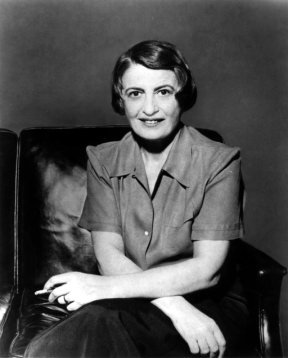
Alisa Rosenbaum (1905-1982) was born in St. Petersburg. She taught herself to read at age 6, and had decided to become a writer by 9. She was among the first group of women to enroll in a Russian university, studying history and philosophy, devouring all forms of literature in not only Russian, but German and French, too. She went on to study cinema arts, and took on the pseudonym Ayn Rand, from the Hebrew ayin (עין), meaning “eye”. In 1925 she came to Manhattan, and shortly after moved to Hollywood where she became a screenwriter. (Her first job was with Cecille B. DeMille – the guy who made The Ten Commandments). She catapulted to fame with the publishing of her novel The Fountainhead. The book sold over 3.5 million copies (despite being initially rejected by 12 publishers!) and was turned into a motion picture in 1949. The Fountainhead strongly influenced people around the world, inspiring Rand to move to New York and start a philosophy circle for her admirers, among them future Federal Reserve Chairman Alan Greenspan. Rand’s greatest work came in 1957. This novel, Atlas Shrugged, became the basis for a new philosophical movement called Objectivism. In a 1991 survey by the Library of Congress, readers cited Atlas Shrugged as the second most influential book of all time, after the Bible! A passionate political activist throughout her life, Ayn Rand’s career included 12 books, along with a variety of films and Broadway plays. A woman with a complex mind, she called homosexuality “immoral” and “disgusting” but at the same time fought to repeal all laws against it. She was a staunch pacifist, and yet heavily supported Israel in its wars, calling them “civilized men fighting savages”. In her words: “When I die, I hope to go to Heaven, whatever the Hell that is.”

Words of the Week

Do something instead of killing time. Because time is killing you.

– Paulo Coelho

Jew of the Week: William Sidis

The Smartest Man That Ever Lived?

Genius.

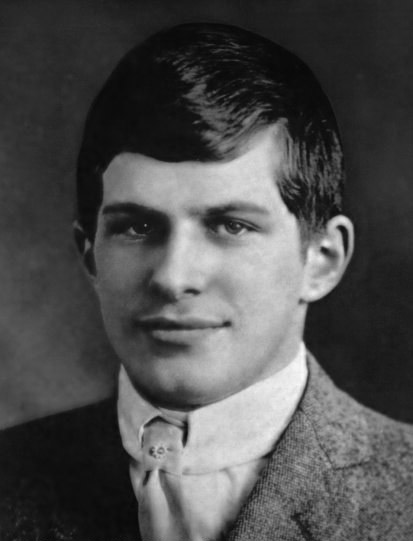
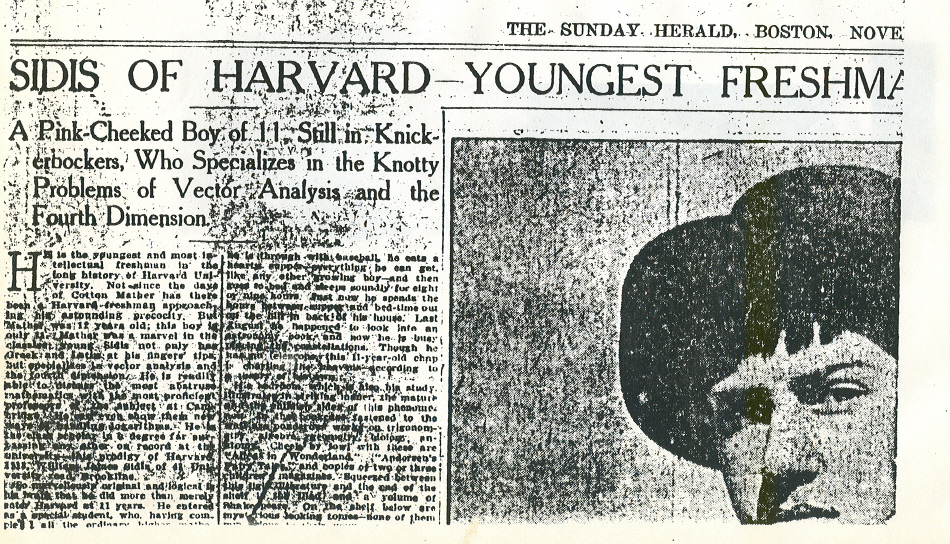
William James Sidis (1898-1944) was born to Ukrainian Jews who fled to America because of the pogroms. Sidis was quickly recognized as a child prodigy. His parents were geniuses in their own right – doctors, polyglots and professors – but Sidis would outdo them both. At 1.5 years, he was already reading the New York Times. At age 4, he wrote his first book (in French). By 8, he spoke fluently in English, Russian and Hebrew, as well as Latin, Greek, French, Russian, German, Armenian and Turkish. He later invented his own language called Vendergood. At age 11, William enrolled in Harvard, becoming the youngest person in history to do this. A year later, he was lecturing at the Harvard Mathematical Club. At 17, he had a teaching job at Rice University, where he wrote a geometry textbook in Greek. At 21, he was thrown in prison for participating in violent Communist rallies. After his release, he lived in seclusion and isolation until his death of a brain hemorrhage at age 46. He spoke 40 languages. New York’s Aptitude Testing Institute placed his IQ between 250 and 300, giving him the highest intelligence quotient in history (in comparison, Einstein’s was around 170). Despite his genius, he appears to have left no legacy. Much of his life remains clouded in mystery.

Boston Herald Headline – 1909

Words of the Week

A person is forbidden to eat before he feeds his animals.
– Talmud, Brachot 40a