
First Ladies of the IDF
 Sara “Surika” Braverman (1918-2013) was born in Romania. She joined Hashomer Hatzair, the Zionist youth movement, when she was just 9 years old. She made aliyah at 20 and co-founded Kibbutz Shamir in the Galilee. She served with the pre-IDF Haganah, and then joined its elite special forces unit, the Palmach. During World War II, she agreed to join a group of soldiers to form a “Jewish commando” unit that would parachute into Nazi-occupied Europe with the British Special Operations Executive (SOE). The mission was to go undercover and assist in underground operations while rescuing Allied pilots and helping Jews escape. Out of 240 that volunteered, 110 were taken for training in Egypt, and 33 were ultimately selected, including Braverman.
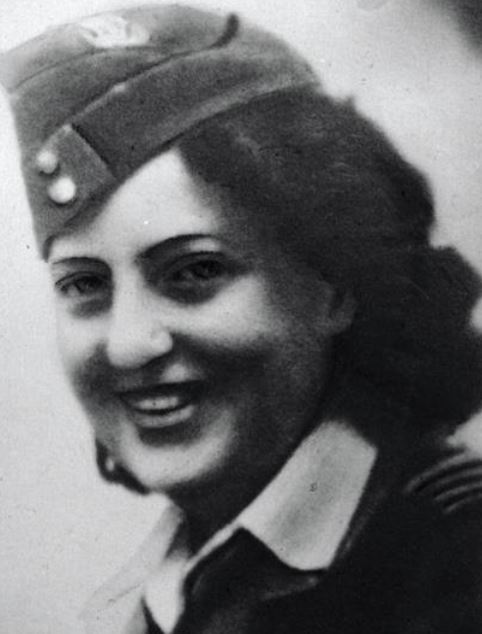 Another inductee was Hanna Szenes (1921-1944), originally from Hungary. Her parents noted her bright mind early on, and put her in a prestigious private school. However, Jewish students had to pay triple the tuition, and Szenes nearly dropped out because she couldn’t afford it. (The school later reduced her tuition as she was a gifted student.) Such discrimination led her to become a passionate Zionist. Upon graduation, she made aliyah and studied at the Nahalal Girls’ Agricultural School. Szenes soon joined a kibbutz, as well as the Haganah. In 1943, she joined the British Women’s Auxiliary Air Force and became a paratrooper. She was then recruited by the SOE and met Sara Braverman. In March of 1944, they were air-dropped in Yugoslavia. Their mission to go into Hungary was called off, but Szenes went anyway with part of the group. They were captured and tortured. Szenes refused to give up any information, and was ultimately executed by firing squad. Her remains were returned to Israel in 1950, and her diary and inspiring poems (in both Hebrew and Hungarian) were posthumously published and became hugely popular. Meanwhile, Braverman had stayed behind and joined Josip Tito’s underground partisans. When her mission ended, she was smuggled out through Italy and returned home. At the start of Israel’s War of Independence, Braverman founded the IDF Women’s Corps at the request of Chief of Staff Yaakov Dori. She recruited 32 other women and the group trained together in Tel Aviv. She went on to promote IDF service among Israeli women for decades to come, and is today known as the “IDF’s First Lady”.
Words of the Week
The gravest sin for a Jew is to forget what he represents.
– Rabbi Abraham Joshua Heschel

 Anna Miriam Roth (1910-2005) was born in what is now Slovakia to Jewish-Hungarian parents. She studied psychology and pedagogy at Brno University in the Czech Republic, and was a member of Hashomer Hatzair, the Zionist youth organization. Upon graduating, she made aliyah to the Holy Land on her own and took up studies at Tel Aviv’s teacher’s college before enrolling at the Hebrew University. In 1937, she co-founded Kibbutz Sha’ar HaGolan, where she lived most of her life and worked as a teacher. Back in Europe, her entire family perished in the Holocaust. To make matters worse, during Israel’s War of Independence, the Arab forces burned down her kibbutz—including all photographs and letters from her family. In 1955, Roth published The Preschool Method, one of the first textbooks for early childhood education. She followed that up with The Theory of the Kindergarten in 1956, and The Child and You in 1958. A couple of years later, Roth relocated to New York to further her studies. She went on to earn a Master’s in education from Columbia University, as well as a Master’s in pedagogy from City College, New York. Upon her return to Israel, she continued her writing career, and soon began writing children’s books, too. Among her first were the very popular A Tale of Five Balloons (which sold over half a million copies and won a UNICEF Smile Award), HaBayit Shel Yael (“Yael’s House”), and Hot Corn. Perhaps her most famous work is Yuval HaMebulbal (“Confused Yuval”), now also an Israeli television show for kids. All in all, Roth wrote 23 books for children, along with 6 books on childhood education. She won the Ze’ev Price for Lifetime Achievement in 1990, and the Bialik Prize for Literature in 2002. Roth worked as a teacher for nearly five decades, and trained many of Israel’s educators. She is credited with being both a pioneer of Israeli education and of early childhood education worldwide.