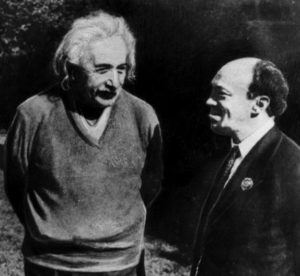
Michael Saul Dell (b. 1965) was born in Houston, Texas to a Jewish family of German ancestry. He had a mind for business from a very young age, applying to take a high school equivalency exam at just 8 years of age, working in a restaurant by 12, and earning money from stocks throughout his teen years. At 15, he earned $18,000 (more than his high school teachers) by selling newspaper subscriptions to a specific demographic he had targeted by looking through public court records. It was during his first year of university studies that Dell started to put together personal computers in his dorm room. Shortly after, he founded his company, PC’s Limited, and quickly sold some $80,000 in upgraded computers, before incorporating as Dell Computer. By the time he was just 27, Dell’s company was already among the Fortune 500 world’s largest corporations, making him the youngest ever CEO on the list. In 1996, Dell Inc. was one of the first companies to sell computers over the web, and was soon making $1 million a day in online sales. Just five years later, it had become the world’s largest maker of personal computers. Today, it has 138,000 employees, and remains one of the top tech firms and computer manufacturers. Last year, Dell Inc. completed its acquisition of EMC Corporation in a deal worth a record-breaking $67 billion. Michael Dell is still the company’s CEO, and is also on the boards of the World Economic Forum, and three international business schools. He has been voted CEO of the Year and Entrepreneur of the Year. In 1999, he and his wife founded the Michael and Susan Dell Foundation, which has since donated an astounding $1.23 billion to various causes around the world, including schools and medical institutions, charities in India, Africa, and across America, as well as the IDF. Most recently, Dell pledged $36 million to his hometown of Houston for its relief efforts following Hurricane Harvey.
Words of the Week
There may be food, there may be drink, but if there is no peace, there is nothing.
– Rabbi Shlomo ben Itzchak (“Rashi”, 1040-1105)
 Mark Elliot Zuckerberg (b. 1984) was born in White Plains, New York to a Jewish family with German, Austrian, and Polish ancestry. He excelled in high school, won multiple awards, and by the time he was ready to go to college, knew Hebrew, French, Latin, and Greek. Zuckerberg was first taught programming by his father, and later had a private tutor, who called him a “prodigy”. In his youth, he created an instant messaging app for his father’s dentistry (a year before AOL’s Instant Messenger came out), as well as a music player that learned its user’s listening preferences. Not surprisingly, Zuckerberg went to Harvard to study computer science and psychology. He was a member of the Jewish fraternity AEPi. During this time, he made a number of programs, including one to coordinate with friends to choose the same classes, and another to rank people’s appearance (called Facemash) which was so popular it quickly crashed Harvard’s servers. In early 2004, Zuckerberg launched “Thefacebook”, and soon dropped out of school to work on it. After recruiting some friends, he moved his team to Silicon Valley. It wasn’t long before he had offers to buy out Facebook, which was now sweeping college campuses across the country. Zuckerberg refused, not wanting to have people’s information controlled by “media corporations owned by conglomerates”. The company went public in 2012, valued at a record-setting $104 billion. Today, Facebook boasts 2 billion active users, and nearly $30 billion in revenue. The company also owns Instagram, WhatsApp, and Oculus. Meanwhile, Zuckerberg has become a noted philanthropist. He donated over $100 million in 2010, before becoming America’s biggest charity donor in 2013 when, in a single act, he donated Facebook shares worth nearly $1 billion, making it the largest charitable gift ever. He has since pledged to donate 99% of his wealth. One of his main projects is to bring internet access to the billions of people that still do not have it. Zuckerberg has been ranked first in a list of the “Top 100 most influential people of the Information Age”. In recent years, he has taken a greater interest in both politics and religion. Last December, someone asked “Aren’t you an atheist?” to which he responded: “No. I was raised Jewish and then I went through a period where I questioned things, but now I believe religion is very important.” In May, he gave a commencement speech at Harvard (which finally awarded him an honourary degree years after he dropped out) and concluded with a traditional Hebrew Mi Sheberach blessing, stating that he always recited it when faced with challenges. Zuckerberg is still the CEO of Facebook, with a salary of $1. There have been rumours that he is planning to run for president in 2020.
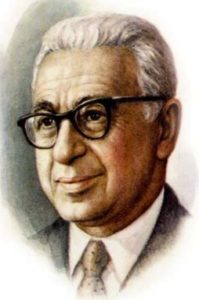 Matvei Isaakovich Blanter (1903-1990) was born in the Russian Empire in a small Ukrainian town. He studied music and became a master pianist and violinist. In the 1920s, Blanter became popular for his dance and jazz songs. After the rise of Stalin, he was “recruited” to write propaganda pieces and composed some of the Soviet Union’s greatest hits. In 1938, he wrote the music for the internationally-acclaimed song “Katyusha”, by far the most well-known Russian tune in the world. (Click