Category Archives: Religious Leaders

Spiritual and Religious Greats of the Jewish People

Jews of the Week: Nathan, Benzion and Yoni Netanyahu

Nathan Mileikowsky (1879-1935) was born in what is now Belarus to an Orthodox Jewish family descended from the great Vilna Gaon. When he was ten, he joined the famous Volozhin yeshiva and after eight years of diligent study was ordained as a rabbi. During this time he became drawn to Zionism and soon dedicated his time to the Zionist cause. He traveled across Europe, Russia, and later the United States to raise support for Zionism – becoming one of the world’s most popular Zionist speakers – as well as to raise money for the Jewish National Fund. In 1920, Mileikowsky made aliyah to Israel. He headed a school in Rosh Pina, promoted settlement of the Galilee, and wrote articles for the Hebrew press – often under the pen name “Netanyahu”. He continued to tour globally, at one point giving over 700 lectures in under 9 months, and publishing some of these talks in a popular book. Towards the end of his life, Mileikowsky settled in Herzliya and established a farm.
Benzion Netanyahu

Benzion Netanyahu

His son, Benzion Mileikowsky (1910-2012), was born in Warsaw while Nathan was head of its Hebrew Gymnasium. Growing up in Israel, he adopted his father’s pen name “Netanyahu”. Benzion studied at the Hebrew University in Jerusalem, taking on a more hard-line approach to Zionism. He became editor of a number of Zionist newspapers, and later the chief editor of the Encyclopaedia Hebraica. In 1940, Benzion moved to New York to build American support for the Jewish state, serving as executive director of an American Zionist group. Later on, he became a professor of Judaic studies and medieval history at Cornell University. Benzion published five books on Jewish history, and edited a number of others. His three sons are: Iddo, a doctor and author; Benjamin, Israel’s longest-serving prime minister; and Yoni, the eldest son.

Last known photograph of Yoni Netanyahu

Last known photograph of Yoni Netanyahu

Yonatan “Yoni” Netanyahu (1946-1976) was born in New York, went to high school in Pennsylvania, and studied at Harvard. He first enlisted in the IDF in 1964, and fought in the Six-Day War, getting wounded while rescuing a soldier behind enemy lines. A few years later, he joined Israel’s special forces unit, Sayeret Matkal, and by 1972 became its deputy commander. For his heroic service during the 1973 Yom Kippur War he was awarded a distinguished medal. In 1976, now commander of Sayeret Matkal, Yoni led Operation Entebbe, successfully rescuing over 100 Israeli hostages held in Uganda. Sadly, Yoni was the mission’s sole casualty, and passed away during the flight back home. In 1980, his personal letters were published, and were described as a “remarkable work of literature”. Both a film and play have recently been made about his life.

Words of the Week

God treats a person the same way they treat their children.
– Rabbi Shlomo of Karlin

Jew of the Week: Rabbi Col. Jacob Goldstein

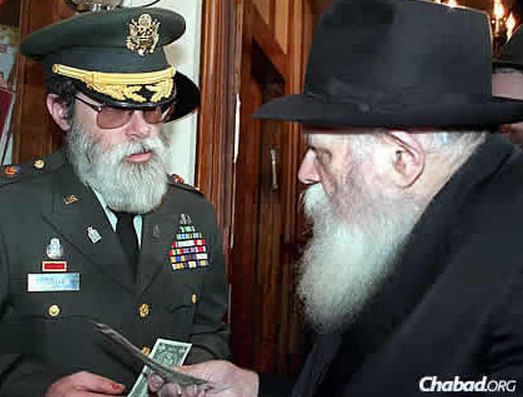
Rabbi Goldstein (Courtesy: JEM/Chabad.org)

Rabbi Goldstein (Courtesy: JEM/Chabad.org)

Jacob Z. Goldstein (b. 1947) was born in Brooklyn to a devout Chabad family. In 1967, the Lubavitcher Rebbe instituted the Tefillin Campaign to get all Jews – especially those distant from Jewish religious practice – to regularly don tefillin. Goldstein diligently took up the cause. He was soon visiting a military base to provide tefillin for Jewish soldiers. By 1977, the base’s Catholic chaplain requested that Goldstein enlist in the army as a chaplain himself. With blessings from the Lubavitcher Rebbe, Goldstein agreed. He has since served all over the world, in places like Afghanistan and Iraq, Bosnia and South Korea, Grenada, Israel, and even Cuba’s notorious Guantanamo Bay. Following the 9/11 attacks, Rabbi Goldstein was the Chief Chaplain at Ground Zero. Similarly, he was in charge of the chaplaincy in New Orleans following Hurricane Katrina. Over the years, he has helped to permit wearing beards for religious reasons in the armed forces, bring kosher meals to American soldiers, pave the way for more Jewish chaplains, and establish holiday observances and prayer services at military bases around the globe. He has risen to the rank of Colonel, and despite the typical mandatory retirement age of 60, has remained in the armed forces for an additional eight years due to a lack of chaplains in the force. Rabbi Goldstein finally retired last month after 38 years of dedicated service. In addition to his military role, he is also the longest-serving chairman of his Community Board in New York, and has been noted as a successful local politician, and a promoter of interracial cooperation and understanding.

Shavuot Starts This Saturday Night! Click To Learn More

Words of the Week

Fundamental to Judaism is the belief in One God, and the quest to seek unity in all things… What is truly remarkable is that this idea has also gained prominence in the sciences, particularly in recent years. Increasingly, scientific theory and research is focusing on the endeavor to express all physical phenomena in a single formula and, more importantly, to discover the singular unifying force which underlies all other forces, so that all other forces are shown to be aspects and outgrowths of this singular force…
The Lubavitcher Rebbe

Rabbi Goldstein with the Lubavitcher Rebbe (Courtesy: JEM/Chabad.org)

Jew of the Week: Rabbi Aharon Lichtenstein

In Memory of an Outstanding Rabbi

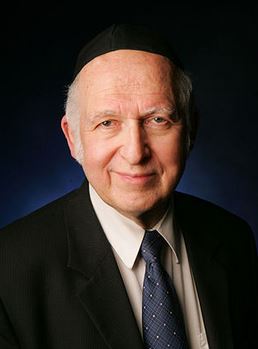
Rabbi Lichtenstein

Rabbi Lichtenstein

Aharon Lichtenstein (1933-2015) was born in Paris, France. His family fled the War in 1941, settling in the U.S., where Lichtenstein grew up. He went on to study at Yeshiva University, earning both a B.A. and rabbinic ordination, and continued his studies at Harvard, graduating with a Ph.D in Literature. He returned to Yeshiva University as a Talmud teacher, and then served as its dean (Rosh Yeshiva). After several years in that post, he made aliyah to Israel in 1971, and headed another Yeshiva, while quickly becoming a famed scholar and the central leader for Modern Orthodox and Religious Zionist Jews. He soon became one of the world’s top authorities in Halakha (Jewish law), too. Working with the ‘Takana’ organization, Rabbi Lichtenstein helped to combat harassment within the religious world, while also supporting the cause of women and encouraging women’s Torah studies. His support and outreach efforts spread beyond the religious world, encompassing secular communities, and even non-Jewish communities. Rabbi Lichtenstein also wrote a number of highly-acclaimed texts and commentaries. A noted scholar, he could easily quote both Jewish wisdom and secular philosophy. Last year he was awarded Israel’s highest honour – the Israel Prize. Sadly, Rabbi Lichtenstein passed away last week. Upon news of his passing, religious and political leaders from across the spectrum united to eulogize and honour him, including both Ultra-Orthodox and Reform rabbis, as well as conservative and liberal politicians. Israeli Prime Minister Benjamin Netanyahu described him as a “Zionist leader and Torah scholar of unparalleled stature… He loved the Land of Israel, the people of Israel, and the Torah of Israel.”

Words of the Week

God transcends all definitions, including the definition of “existence”.
Maimonides (Rabbi Moshe ben Maimon)