Tag Archives: World War I

Jew of the Week: Fritz Haber

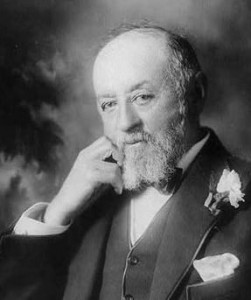
Fritz Haber

Fritz Haber

Fritz Haber (1868-1934) was born to a traditional Jewish-German family in what is today Poland. He studied chemistry in Berlin, receiving his doctorate in 1891 and then going to apply his expertise in his father’s successful dyes and pharmaceuticals business. The two didn’t work well together, though, and Haber returned to academia. (In order to obtain a higher position at a time when Jews were barred from such posts, Haber nominally converted to Christianity.) His research in organic chemistry, electrochemistry, dye technology, gasses, and textiles brought him a great deal of recognition. In 1898 he was made an associate professor, and by 1906 a full professor at Karlsruhe University, among the most prestigious schools in Germany. It was there that Haber made his biggest breakthrough. Together with Carl Bosch, he invented a process that would quickly and cheaply produce ammonia (the key component of fertilizer) from abundant atmospheric nitrogen. Until then, ammonia had to be mined from very limited reserves. Today, over 100 million tons of ammonia is made annually using the “Haber Process”, helping to feed half of the world’s population. Haber won the 1918 Nobel Prize for this work. Unfortunately, Haber also applied his know-how to less honourable endeavours. Aside from the fact that ammonia is a central ingredient of explosives, too, and the Haber Process helped to arm the German military, Haber headed the Ministry of War’s Chemistry Section during World War I, developing gasses for chemical warfare (as well as the gas masks to protect from them). To be fair, many of the world’s top chemists during this time period worked on chemical warfare to assist in their nation’s war effort. As Haber himself said, “During peace time a scientist belongs to the World, but during war time he belongs to his country.” His wife did not agree, and committed suicide after failing to convince him to abandon his project. After the war, Haber started a company that produced pesticides. Incredibly, their most famous product was Zyklon B, later used in the gas chambers of the Holocaust. Haber fled Germany when the Nazis came to power. He accepted a position in what would later be the Weizmann Institute in Israel, but passed away on the journey there. Few people have at once been able to cause both so much harm and so much good. While half of the world’s food production today depends on the Haber process, so do much of its explosives, and Haber is often called “the father of chemical warfare”. Haber’s work simultaneously brought death to millions of people, and life to millions more.

Words of the Week

When God desired to create man, Truth said: “He should not be created, for he is full of lies.” Kindness said: “He should be created, for he is full of kindness.”
– Midrash Rabbah, Bereshit 8:5
Jews of the Week: Straus and Bloomingdale

Macy’s and Bloomingdale’s 

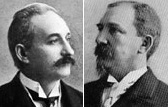
Lyman and Joseph Bloomingdale

Lyman and Joseph Bloomingdale

Lyman Bloomingdale (1841-1905) and Joseph Bloomingdale (1842-1904) were the sons of German-Jewish immigrants who settled in New York. Their father Benjamin started a small clothing shop, and it was here that Lyman and Joseph sold their first hoop skirts for ladies. In 1872, the brothers opened their own store. Business boomed, and in 1886, the company expanded and opened its current world-famous Bloomingdale’s location. Over the next century, Bloomingdale’s went on to open dozens of stores across America, and become one of the most recognizable department store brands in the world. In 1930, Bloomingdale’s joined together with another department store giant – Macy’s. Macy’s began in 1858 as a small dry goods store. Thirty years later, a pair of Jewish brothers (who originally only supplied Macy’s with tableware) became partners in the business, and the shop’s fortunes boomed.

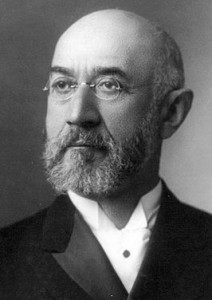
Isidor Straus

The brothers were Isidor Straus (1845-1912) and Nathan Straus (1848-1931), who were also German-Jewish immigrants like the Bloomingdales. Eventually, the two became the sole owners of Macy’s, and turned the company into an internationally-recognized brand, which now has 850 locations. The elder Isidor served as a US Congressmen and was a noted philanthropist and social activist. Tragically, he and his wife were aboard the Titanic when it sank in 1912. Despite his wealth and status, which immediately guaranteed him a seat on a lifeboat, Isidor refused so that all women and children could be saved first. He and his wife did not survive. His brother Nathan was also supposed to cruise the Titanic, but instead decided to take a trip to Israel. This decision saved his life, and Nathan saw this is a divine message.

Nathan Straus

Nathan Straus dedicated the rest of his life to support the Jewish state, going on to donate two thirds of his wealth for the cause. His money opened up countless schools, health clinics and public kitchens in Israel. The modern city of Netanya is named after him. Meanwhile, Nathan also did a great deal at home. He opened a pasteurized milk institute that gave out free milk to children, and is credited with significantly reducing the incidence of milk-borne diseases. During the recession of 1893, he gave away coal and meat for free, opened lodgings for 64,000 people, and provided 50,000 meals for a penny each. In the recession of 1914-15 he provided over one million such penny meals, and during World War I, sold his private yacht in order to feed orphans. His personal motto was: “The world is my country, to do good is my religion.”

Words of the Week

God transforms spirituality into physicality; the Jew makes physical things spiritual.
– Rabbi Israel Baal Shem Tov

Jew of the Week: Albert Ballin

The Inventor of Cruises

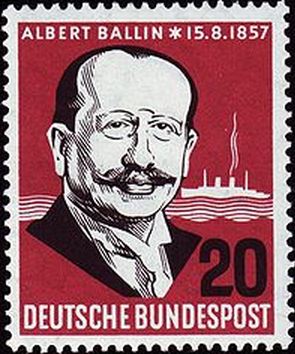
Commemorative Stamp of Albert Ballin

Commemorative Stamp of Albert Ballin

Albert Ballin (1857-1918) was born in Hamburg, Germany to a lower-middle class family. At 17, Ballin’s father died so the young man took over his father’s work at an emigration agency. By 22, he owned the agency, and at 29 he was the director of HAPAG, a ship liner providing service from Hamburg to New York. Ballin transformed the company into the world’s largest sea company with 175 ships. He revolutionized the business, focusing on providing customer service and a comfortable voyage. By using return voyages to deliver goods, Ballin was able to cut the price of a Transatlantic trip by nearly 40%. This work made it possible for myriads of Jews to escape Eastern Europe before, and during, the World Wars, saving countless lives. He would often sail on his own ships and ask the customers how their voyage could be improved. To make sea travel even better, Ballin constructed a massive neighbourhood on an island near Hamburg’s port (later called BallinCity) where voyagers could relax, shop, pray, and receive health inspections and travel documents. Ballin pioneered the production of ever larger and more luxurious ships. Perhaps his greatest legacy is the invention of the cruise ship. When Transatlantic voyages were perilous in the winter, Ballin had an idea to use his idle ships in other ways, outfitting them for “pleasure cruises”, where the voyage was not only a means to get somewhere, but the destination itself. Many scoffed at the idea (some said Ballin totally lost his mind), but the first such voyage, a 57-day Mediterranean adventure in 1891, was a huge success and sparked the cruise ship industry. Ballin became the German Emperor’s ship operator, and was nicknamed the “Kaiser’s Jew”, though his religion cost him many great opportunities. The Kaiser once admitted that Ballin would have been made Chancellor if he weren’t a Jew. A gentle and kind man, Ballin also donated anonymously to a great many causes, and strove to make peace between the European powers. Unable to prevent World War I, he was labelled as a “pacifist traitor” of Germany, and at 61, overdosed on sleeping pills. His home in Hamburg is now the UNESCO Institute for Lifelong Learning.


Words of the Week

Why is the Torah called “fire”? Just as fire receives no impurities, so too the words of Torah.
– Talmud, Berachot 22a