
Tag Archives: Tanakh

Jew of the Week: Yehoshua bin Nun

Holy Warrior

God miraculously causes the sun to stand still, allowing the Israelites under Yehoshua's command to win the battle (painting by John Martin)

God miraculously causes the sun to stand still, allowing the Israelites under Yehoshua’s command to win the battle (painting by John Martin)

Hoshea bin Nun (c. 1355-1245 BCE) was born in Egypt during the time of the Israelite slavery. Upon the return of Moses, Hoshea became his trusted servant and right-hand man. He was the only one allowed to approach Mt. Sinai other than Moses himself, and is one of the few people in the Torah described as being filled with a Godly spirit. In the wilderness, he became the chief military commander of the Israelite army, leading them to multiple victories. When the Israelites originally reached the Holy Land, Hoshea was dispatched as one of the twelve spies. It was then that Moses renamed him Yehoshua (more commonly known as Joshua), to give him strength for his mission. He was the only one, along with Caleb, to bring back a positive report, and for this was rewarded with permission to enter the land of Israel, while the rest of the generation was condemned to perish in the wilderness over a forty year period. At the end of those forty years, when Moses passed away, Yehoshua took over and led the Jews into Israel, overseeing their successful reclamation and re-settlement of the land with a series of miraculous victories. His work complete, Yehoshua passed away in the Holy Land at the age of 110, having gained a reputation for wisdom, humility, and most of all, being a beloved caretaker of his people. He is believed to be the author of the Biblical book of Joshua. As his origins are obscure, and he alone has the moniker “bin” in his name (as opposed to the standard “ben”, which means son), several legends have come forth regarding his birth. In one of the most enigmatic, it is said that the baby Yehoshua was among those newborns thrown into the Nile River by Pharaoh’s soldiers. However, he was swallowed up by a great fish which was later caught by fishermen; Yehoshua was thereby accidentally rescued from the fish’s belly, hence the name “bin Nun” (nun means “fish” in Aramaic). Yehoshua’s yahrzeit is commemorated on the 26th of Nisan, which this year falls on Saturday.

Words of the Week

The Persian Empire was always against the Muslim Arab Empire, especially against the Sunnis. The threat is from Persia, not from Israel.
– Saudi Prince Alwaleed bin Talal

Jew of the Week: Abenezra

Abenezra’s Commentaries

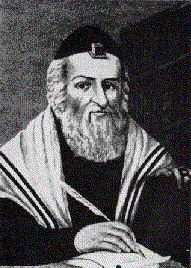
Avraham ben Meir ibn Ezra (1089 – c. 1167 CE) was a world-renowned scholar born in Tudela, Spain. He became famous at an early age for both his beautiful poetry and philosophical genius. In 1140, ibn Ezra (also known as Abenezra) left Spain and began a fascinating journey that took him across North Africa, to the Holy Land, back through Europe, Italy, France and England. It was during this time that he wrote most of his famous works, including some of the first Hebrew grammar books, and a commentary on the entire Torah and Tanakh. His commentary contained such depth that subsequently many commentaries were written on ibn Ezra’s commentaries! He is famous for his rationalism and logic; in religious matters, too, sometimes even criticizing sacred texts. Not surprisingly, he was also a scholar of mathematics and science, writing several treatises on astronomy, arithmetic and even a manual for using an astrolabe. He is credited with being among the key figures who introduced Europe to the Indian system of mathematical symbols and decimal fractions (still used to this day). Ibn Ezra’s poetry continues to be recited around the world, in both translations and the original Hebrew and Arabic. Among other titles, he has been called “ibn Ezra the Great” and the “Admirable Doctor”. The lunar crater Abenezra is named after him.


Words of the Week

Words are the pen of the heart; song is the pen of the soul.
– Rabbi Schneur Zalman of Liadi

Jew of the Week: the Vilna Gaon

Genius Is His Middle Name

the Vilna Gaon

Eliyahu ben Shlomo Zalman Kramer (1720-1797) was born in a small village in what is now Belarus. Known popularly as the Vilna Gaon – the Genius from Vilnius – it is said he committed the entire Torah to memory by age 5, and by age 11 the entire Talmud. It wasn’t long before he was one of European Jewry’s greatest legal authorities. A prolific writer, he penned commentaries on the Tanakh, Talmud, Mishnah and many other works (a large number of them Kabbalistic). Dedicating every moment of his life to Torah learning, he generally studied secular subjects only while in the bathroom (where study of Torah is forbidden). It was there that he became an expert in astronomy and Euclidean geometry, later instructing his disciples to write a mathematical treatise called Ayil Meshulash. The Vilna Gaon led a simple, saintly, ascetic lifestyle, sleeping just 2 hours a day, usually in 4 half-hour segments. For much of his life he was a travelling nomad, though his aim was always to settle in Israel. Himself unable to accomplish this goal, at least three groups of his students and their families did succeed in making Aliyah, bringing over 500 people to Tzfat and Jerusalem long before the Zionist movement. The Vilna Gaon passed away on Tishrei 19, the 5th day of Sukkot.

Psalm of the Day on the day of Gilad Schalit’s release from captivity. Incredibly, the psalm explicitly mentions Gilad’s name, as well as freedom from captivity, the holiday of Sukkot, and Tuesday. Schalit was freed on Tuesday, during the holiday of Sukkot!

Words of the Week

“On Simchat Torah the Torah scrolls wish to dance, so we become their feet.”
– Chassidic saying