
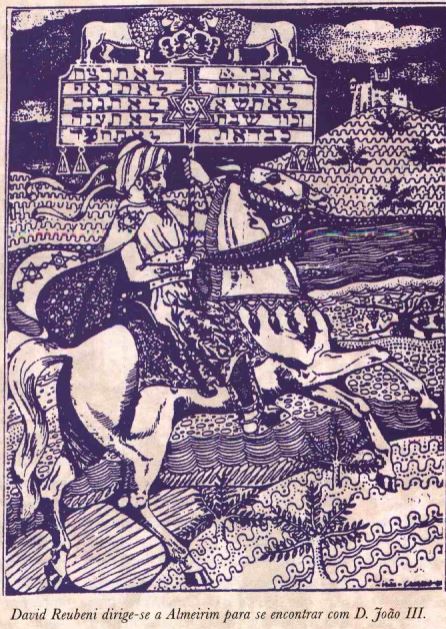
 David Reubeni was born around 1490 in a place called Chabor – the location of which is disputed to this day, though the best evidence points towards Afghanistan, where certain Pashtun tribes still practice Jewish customs (despite being officially Muslim) and speak of a folk hero named Daoud Roubani. In 1522, Reubeni left on a long journey around the world, going to India, Africa, throughout the Ottoman Empire and Europe. Along the way he claimed to be a messenger from the distant Jewish Kingdom of Chabor. His wisdom, piety, and military genius were evident to all who met him, including the Pope and a host of other rulers and dignitaries. To these leaders he proposed a plan to conquer Israel from the Ottomans through a Jewish-Christian alliance. The plan gained a lot of steam, and even appeared to be manifesting at one point. Pope Clement VII supported it, and King Juan III of Portugal promised eight ships and 4000 cannons. However, the messianic fervour that resulted inspired some Jews to rebel against the Inquisition, causing the loss of key allies. Meanwhile, skeptical Jews joined anti-Semities and opponents in preventing what they felt was another “false messiah”, though Reubeni never claimed to be one. It was Emperor Charles V of Spain who eventually had Reubeni and his key supporters arrested. They were assigned to the Inquisition and never heard from again. Reubeni’s cause and time of death are unknown, though his diary survives in Oxford (a second copy was destroyed by the Nazis). His story is as fascinating as it is mysterious: a man with an unknown beginning and an unknown end, hailing from a lost Jewish kingdom, who nearly succeeding in reestablishing a Jewish state in Israel four centuries before the Zionist movement.
Words of the Week
A person must seek out a spiritual livelihood with all the intensity of his strength, just as he seeks a material livelihood.
– The Lubavitcher Rebbe (Hayom Yom, Cheshvan 14)

 Chaim Yosef David Azulai (1724-1807) more commonly known as the Chida (derived from his initials), was born in Jerusalem to a family with a long line of rabbis. From childhood he showed amazing proficiency in Jewish study, and learned under the great Torah scholars of the day. His name was soon well-known across the Jewish community of the Holy Land, and before he was 30, the Chida was selected to be the community’s emissary to Europe. He would go on several international trips to raise support and funds for the Jews in Israel (long before the start of the Zionist movement). Two of these trips lasted over 5 years each, and took him across Africa and Europe. Many credit him with sustaining the small Jewish community of Israel, which would have otherwise been extinguished by various Turkish and Arab warlords. During his travels he made sure to visit any ancient libraries he came across, and diligently studied their manuscripts, which earned him fame as a great scholar of all subjects. Meanwhile, he was able to publish roughly 70 different works on Judaism (writing his first book at age 16), ranging from Jewish law and scriptural commentaries to prayer books, mysticism and Kabbalah. His works are also important to secular scholars, as the Chida recorded a detailed diary during his trips around the world, giving historians an eyewitness account of the 18th-century. His incredible travels included a meeting with the Sultan of Turkey and King Louis XVI of France, a stint as Chief Rabbi of Cairo, as well as some dangerous encounters with the Knights of Malta and the Russian Navy. By the end of his life, he was considered a saint by both Jews and non-Jews alike.