Tag Archives: Sephardic Jews

Jew of the Week: Dona Gracia Mendes

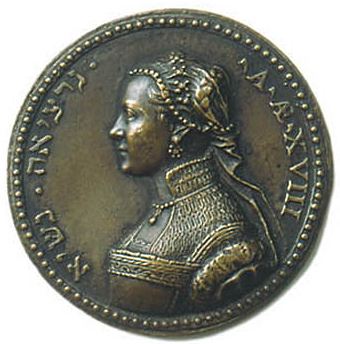
Commemorative Coin of Dona Gracia Mendes

Commemorative Medal of Dona Gracia Mendes

Hanna ‘Gracia’ Nasi (1510-1569) was born in Lisbon, Portugal to a family of conversos – aka Marranos, Jews who were forcibly converted to Christianity – and named Beatriz de Luna Miquez. She married Francisco Mendes Benveniste, a wealthy spice trader and banker. When she was only 28, Gracia’s husband passed away, leaving the business to her and his brother. Gracia thus joined her brother-in-law in Antwerp (then part of the Spanish Netherlands). From there, she organized an escape network for Jews to flee Spain and Portugal from the Inquisition, smuggling them in spice ships, providing them with money and documents to make their way to the Ottoman Empire where Jews were still welcome. This saved the lives of countless Jews, who nicknamed her ‘Our Angel’. Shortly after, her brother-in-law died as well, leaving Gracia alone at the helm of the massive Mendes financial empire, dealing with the likes of European kings, the Sultan of Turkey, and several Popes. At the time, she was possibly the most powerful woman in the world. After a series of political intrigues, which included an unjust imprisonment and several attempts to seize her wealth, Gracia settled in Istanbul, where she was now free to return to her religion. She built and financed dozens of synagogues and yeshivas across the Ottoman Empire. In 1558, the Sultan granted her a lease for the desolate town of Tiberias in Israel. Gracia began rebuilding the town, allowing Jewish refugees to settle there, with the vision of reestablishing a Jewish homeland in Israel. Many historians consider this the earliest modern Zionist attempt. Today, Donna Gracia has become a feminist icon, and is celebrated as a hero around the world. Both Philadelphia and New York City host a ‘Dona Gracia Day’, and the Turkish government has sponsored exhibits in her honour. There is a museum exploring her life in Tiberias, and the ‘La Senora’ synagogue of Istanbul, named after her, still stands to this day. Dona Gracia is the aunt of past Jew of the Week Joseph Nasi


Words of the Week

One of the greatest tragedies of intellectual human experience is that we study Bible stories when we are 55 in the same manner as we studied them when we were 5.
– Rabbi Yaakov Kamenetsky
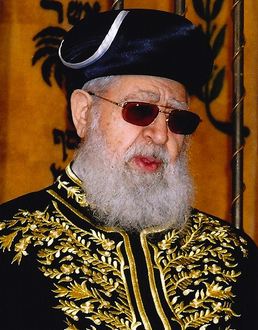
Jew of the Week: Rav Ovadia Yosef

Rav Ovadia Yosef

Rav Ovadia Yosef

Abdullah Ovadia Yousseff (1920-2013) was born in Baghdad, Iraq and immigrated with his family to Jerusalem at the age of 4. He was quickly recognized as a young prodigy with a photographic memory and a profound depth of understanding, and ordained as a rabbi at age 20. Shortly after, Rav Ovadia moved to Cairo, Egypt where he headed a yeshiva and Jewish court until his return to Israel upon the State’s independence. In 1952 he published the first of several great works, which propelled him into the spotlight. He then founded an advanced yeshiva for gifted students. By 1973, Rav Ovadia was appointed Israel’s Sephardic Chief Rabbi. He served in this post until 1984 when he founded the Shas political party – today the 4th largest in the Knesset – and served as its spiritual guide until his last days. A scholar above all else, he pored through thousands of works. Once, he tumbled off a ladder while reaching for a book, breaking his back. As no one was there to help him, he grabbed the nearest text and studied it for 3 hours until someone found him. Possessing a great love for the Jewish people, Rav Ovadia always strove to make life simpler for the Jews, earning a reputation for being very lenient when it came to Jewish law. He was heavily engaged in kiruv – bringing secular Jews back to their heritage and into the spiritual fold. He especially focused his efforts on Mizrahi and Sephardic Jews (who often suffered discrimination and a lower socio-economic status in Israel) and is thus credited with restoring Jewish and national pride among this demographic. Many stories highlight his love and service to the people. Once, he suffered a heart attack and was rushed to hospital for life-saving surgery. He had the surgery delayed for several hours as he was in the middle of writing a letter to a woman in distress, and feared that if he died there would be no one to help her. Sadly, Rav Ovadia passed away on Monday. Nearly a million people attended his funeral in Jerusalem – the largest funeral in Israel’s history. Many have hailed his passing as the end of an era in the country’s history.

Words of the Week

The righteous promise little and do a lot; the wicked promise much and don’t do even a little.
– Talmud, Bava Metzia 87a

Jew of the Week: Samuel Gompers

Champion of the Working Class

Samuel Gompers on the cover of TIME Magazine

Samuel Gompers on the cover of TIME Magazine

Shmuel Gompers (1850-1924) was born in London to a Jewish family that immigrated from the Netherlands. At age 10 he was taken out of school and sent to work as a cigarmaker to help his struggling family make a living. After a long day’s work, Gompers would continue his Jewish studies, focusing on the Talmud, which he later compared to studying civil law. Still struggling, the family moved again when Samuel was 13, to Manhattan. The childhood poverty he experienced inspired him to be a champion for the little guy. At 14 he joined the local cigarmakers’ union, while starting a debate club to hone his political skills. By age 25, Gompers was elected president of the local union, and later vice-president of the international union. Under his tenure, sick benefits and death benefits were introduced, along with a shorter (8 hour) work day, fair wages and safe working conditions. Gompers co-founded and headed the American Federation of Labor until his death, by which point it had over 3 million members, making it the largest such federation in the world. During this time, the AFL supported the implementation of a holiday for workers – now celebrated as Labor Day. For the first six years, he did not receive a salary for his work! His extensive knowledge got him appointed to the Council of National Defense during World War I, and in 1919 he participated in the post-war peace process as an official adviser on labor issues. At his death in 1924, Gompers was given a state funeral with thousands coming to mourn his passing. His life-long goal was giving every worker the opportunity for “a decent home, decent food and clothing, and money enough to educate their children”. He served as the central inspiration for generations of labor leaders after him. Across the US, countless streets, parks and squares are named after him, along with a class of navy ships. At his funeral it was said: “his idealism, his unfaltering courage, and love of his fellow-men were nurtured by his Jewish past… He was the pioneer of the American Labor movement and he played a great and honorable part in liberating men from bondage.”


Words of the Week

The desire to be good to all with no restrictions – not in the quantity of those to whom we are good, nor in the quality of the good we perform – that is the essence of the soul of Israel.
– Rabbi Avraham Itzhak Kook