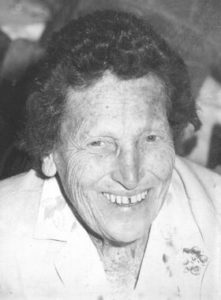
 Born in South Africa to poor immigrants from Russia, Tikvah Alper (1909-1995) showed a talent for maths and sciences at an early age. At age 20, she traveled to Berlin to work on her doctorate with former Jew of the Week Lise Meitner, where she published an award-winning paper on delta rays. Alper had a son who was born deaf, so she moved to the U.S. to study diligently from the best experts in the field, herself becoming a teacher for the deaf. Returning to South Africa, Alper was a professor at Witwatersrand University, where she became famous for championing black people’s rights, causing her to draw the ire of the government. For opposing apartheid, she lost her position at the National Physics Laboratory, and nearly lost her passport, too. Alper fled to Britain, where she worked for the remainder of her life in a radiobiology lab. It was there that she researched various brain-eating disorders and proposed a new mechanism of disease: an infectious protein. At the time, the idea was laughable, but it has since been proven and confirmed (now called a “prion”), especially after the mad cow disease scare. Alper’s book Cellular Radiobiology became the bible for radiobiologists. All of these things, as well as her iconic feminism, made her a heroic figure for many around the world, and her London home became a meeting place for the best and brightest in the field of radiobiology. Alper enjoyed sailing, and continued to travel the world well into her 80s.
This Friday Night is Tu B’Shvat! Click to Learn More About This Little-Known Holiday
Words of the Week
A person’s main vitality lies in his intellect. One who is not using his intellect to its full potential is considered asleep. Many people who seem to be alive are in fact sleeping their lives away…
– Rebbe Nachman of Breslov
 The 10th richest person in the U.S., Michael Rubens Bloomberg was born in Massachusetts, the grandson of immigrants from Europe and Russia. In the 1970s he worked for a Wall Street firm where he learned that information is the key to success, and people are willing to pay for it. So, when the company he worked for was bought out, he used his severance money to start a company called Market Systems, which built terminals that gave their users on-the-fly and up-to-date financial information, presented in various graphs and charts to make it simple to understand. The company started selling its terminals in 1982 and they were an instant hit. By 1990, over 8000 ‘Bloomberg’ terminals were in use around the world. Today, that number has risen to 310,000, and Bloomberg LP also includes a news channel, radio stations, magazines (such as BusinessWeek) and software. Michael Bloomberg himself left the helm of the company to become popular mayor of New York City. His mayoral salary is a symbolic $1. A mayor of the people, Bloomberg often rides the NYC subways to work. More impressively, The Chronicle of Philanthropy lists him as the leading individual donor in the U.S. for two years in a row. Bloomberg has donated hundreds of millions of dollars to hospitals, schools, environmental causes, and scientific research, as well as the arts. Many of his contributions are anonymous. He recently pledged another $500 million together with Bill Gates. Some have stated Bloomberg is the greatest contributor to higher education institutions in history, donating over $800 million to Johns Hopkins alone. All of these factors may be why Bloomberg has been elected to a third term as mayor, despite the two-term limit. And some say he will be president in the near future. If so, it would make him the first Jewish Commander-in-Chief.