Tag Archives: Physics

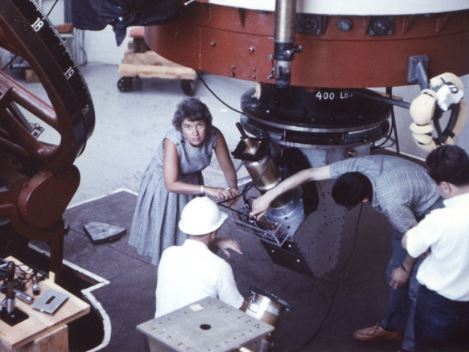
Jew of the Week: Vera Rubin

Vera Rubin at the Lowell Observatory (Credit: Carnegie Institution)

Vera Rubin at the Lowell Observatory (Credit: Carnegie Institution)

Vera Cooper (1928-2016) was born in Philadelphia. Her parents were Jewish immigrants from Eastern Europe (who changed their last name from Kobchefski to Cooper). From the young age of just 10, Cooper was interested in astronomy, and was later the only woman studying the subject in her college. She intended to continue graduate studies at Princeton but was forbidden because of her gender. Cooper went to Cornell University instead and studied astrophysics and quantum physics. There she also met her husband, Robert Rubin, who was pursuing graduate studies in chemistry. The two had four children, all of whom became Ph.D scientists and mathematicians. Rubin completed her Master’s in 1951 and went to Georgetown University for her doctorate. Around this time, she discovered that whole galaxies are rotating around their centres – an idea so revolutionary that it was initially rejected. Her 1954 Ph.D thesis was similarly revolutionary, showing that galaxies must be clumped in clusters. No one paid attention to this work for another two decades, when it was confirmed to be true. In 1965, Rubin was the first woman allowed to use Caltech’s famous Palomar Observatory. She then became a Senior Fellow at Washington’s Carnegie Institution, where her research was focused on “galactic and extragalactic dynamics”, among other things. Rubin made critical calculations with regards to galactic rotation rates, and together with her friend Robert Ford, discovered what is now known as the Rubin-Ford effect. In her studies, she found that galaxies are spinning so fast that they should be flying apart. They do not fly apart because gravity keeps them together. But, there is not enough visible matter in galaxies to generate so much gravity! This led Rubin to confirm the existence of invisible dark matter. This was perhaps her biggest breakthrough, and completely transformed astrophysics. For her tremendous achievements, Rubin has won multiple awards, including the National Medal of Science and the Royal Astronomical Society’s prestigious Gold Medal. There is also an asteroid named after her. Sadly, Rubin passed away earlier this week. Despite being 88 years old, Rubin continued her scientific research (focusing on the motion of distant stars) until the last days of her life. She was a pioneer for women in science, and worked tirelessly to get more women elected to the National Academy of Sciences. Rubin was proud of her Jewish heritage, and often spoke of the beauty and value of science and religion when studied together. In addition to half a dozen important scientific publications, Rubin wrote a book, and was featured in two documentaries. She was once described as an American “national treasure”.

Words of the Week

The first gulp from the glass of natural sciences will turn you into an atheist, but at the bottom of the glass God is waiting for you.
– Werner Heisenberg, Nobel Prize-winning physicist

Jew of the Week: Franz Boas

Father of American Anthropology

Franz Boas

Franz Boas

Franz Boas (1858-1942) was born in Germany, the son of Jews who had left their Orthodox upbringing and raised their children in a very liberal environment. Boas studied physics, geography, and mathematics at a number of prestigious German universities. Although his first Ph.D was in physics, Boas was more fond of geography. In 1883, he went on an expedition to Baffin Island to live among the Inuits. He soon realized that the prevailing European notion of aboriginals as uncivilized “savages” was wrong, and concluded that “we ‘highly educated people’ are much worse, relatively speaking”. From there, Boas continued his studies of non-European cultures, working from Berlin’s Royal Ethnological Museum. He came to the conclusion (unpopular at the time) that all human beings and all cultures were equal. Ironically, he was a victim of rising anti-Semitism, and was constantly prodded to convert to Christianity in order to be accepted in German society. Boas moved to the United States and became the assistant editor of the journalĀ Science. Two years later, he was appointed head of Clark University’s new department of anthropology, and in 1896, began lecturing at Columbia University as well. He soon developed a Ph.D program in anthropology – the first in America – and cofounded the American Anthropological Association. His students would go on to found more Ph.D programs in universities across America. Not surprisingly, Boas is often referred to as the “father of American anthropology”. Over the years, Boas played a central role in developing the science of anthropology. His 1911 The Mind of Primitive Man was the major textbook on the subject for years, and his writings heavily influenced just about every branch of anthropology. Meanwhile, Boas was a vocal opponent of racism, eugenics, cultural evolution, and social Darwinism, and it has been said that he “did more to combat race prejudice than any other person in history.” During the Nazi era, Boas worked tirelessly to help German and Jewish scientists escape Europe, and assisted many of them in finding positions in America. He was also editor of The Journal of American Folklore, founded theĀ International Journal of American Linguistics, served as president of the New York Academy of Sciences, as well as president of the American Association for the Advancement of Science. By the time of his death he was among the most well-known, influential, and respected scientists in the world.

Words of the Week

The righteous do not complain about wickedness, but increase righteousness. They do not complain about heresy, but increase faith.
Rabbi Abraham Isaac Kook

Jew of the Week: Jack Goldman

Jacob Goldman (Photo Credit: Joyce Dopkeen, The New York Times)

Jacob Goldman (Photo Credit: Joyce Dopkeen, The New York Times)

Jacob E. Goldman (1921-2011) was born in Brooklyn to Jewish-Russian immigrants. He studied at both Yeshiva University and the University of Pennsylvania, where he got his Ph.D in physics. After brief stints working for Westinghouse and as a teacher for Carnegie Tech, he joined the Ford Motor Company’s Scientific Research Laboratory, where he helped to develop the sodium-sulfur battery for electric cars and large-scale energy storage, among many other things. Rising through the ranks, he soon became head of the department, and the first Jew to be an executive at the formerly anti-Semitic Ford Company. In the 1960s, Goldman was brought to Xerox to head its new computing division, and serve as chief scientist and technical officer. At the time, the computer industry was just getting underway, and Goldman convinced the authorities at Xerox to start a new research facility on the West Coast, near Stanford University, where they would be able to recruit young talent. For a while, the New-York based Xerox was reluctant to open up a new lab so far away, but eventually gave Goldman a chance. Teaming up with fellow physicist George Pake, the two opened up the Palo Alto Research Center, better known as PARC, in 1970. This lab would go on to completely revolutionize the digital world and the computer industry. PARC scientists, under the visionary leadership of Goldman and Pake, developed the laser printer, Ethernet, and most importantly, the first personal computer, as well as the first computer to have a graphical user interface (GUI) with an easy to use “desktop”. The concept of windows, folders, and icons that are operated by a computer mouse was also developed at PARC, as were the basics for LCD screens and optical discs. Interestingly, one of the few people who got a tour of PARC was a young Steve Jobs, who was so inspired by what he so that he went on to found Apple, drawing on most of PARC’s technologies for his own designs. Ultimately, it was Apple and Microsoft that took advantage of PARC’s advancements, as Xerox failed to support Goldman in commercializing those technologies. Nonetheless, Goldman is considered a key figure in transforming computers from massive industrial calculators to personal interactive tools used by the public.

Words of the Week

Jews have tended to prefer the power of ideas to the idea of power.
– Rabbi Lord Jonathan Sacks