The Persian Jew Who Inspired India

18th century illustration of Dara Shikoh (right) learning with Sarmad
Sa’id Sarmad Kashani (c. 1590-1661) was born in Armenia to a religious Persian-Jewish family of merchants. At a young age, he translated the Torah into Farsi. He later took up studies under Muslim scholars and mystics like Mulla Sadra and Mir Findiriski. Some believe he nominally converted to Islam at this time, but remained a practicing Jew. On one merchant trip to Mughal India, Sarmad met a Hindu scholar called Abhay Chand. The two learned about each other’s faiths, and it is believed Chand converted to Judaism. Sarmad eventually gave up his wealth and became an ascetic wandering mystic. He and Chand traveled and taught together all across India, eventually settling in Delhi. Sarmad made a great name for himself as a poet and philosopher. Over 300 of his short poems have survived to this day. He also wrote the entry for “Judaism” in the 17th-century Dabistan, an anthology explaining all of the world’s religions. The Mughal crown prince Dara Shikoh (whose father built the Taj Mahal) was so impressed by Sarmad’s wisdom that he became a disciple, too. Sarmad went on to devise a new mystical system, drawing on Judaism, Sufi Islam, and Hinduism. Countless followers and disciples across India learned from him. However, when Dara Shikoh was deposed by his brother, the new Mughal emperor executed Shikoh and all of his associates, including Sarmad. The emperor demanded that Sarmad recite the Shahadah (proclaiming “there is no God but Allah and Muhammad is His prophet”), but Sarmad refused and was beheaded. According to legend, Sarmad then picked up his own head and walked away—and the new emperor never had a peaceful night’s sleep ever again! Sarmad’s tomb became a popular pilgrimage site and is still revered as a holy place in India today. His story inspired numerous Indian leaders, including Abul Kalam Azad, a colleague of Gandhi (and his predecessor as president of the Indian National Congress). Azad once described himself as a modern-day Sarmad. Scholars see “Sarmad the Jew” as a key figure in the history of religions; a mystic that influenced the development of Judaism, Islam, and Hinduism; as well as an early pioneer of interfaith dialogue.
Passover Begins Monday Night – Chag Sameach!
Secrets of the Ten Plagues & the Passover Seder
Words of the Week
In the chronicles of world history, no question has managed to capture the world’s interest for very long; a few decades seems to be the outer limit for consideration of even the most pressing global problems. But the world has been busy trying to figure out the question of the Jews for thousands of years – and they have not tired of the discussion! In every generation, the old questions arise anew: Are the Jews good or bad? Do the Jews bring benefit to the world or do they cause problems? Why, it is as if we have just appeared on the scene – as if the world has never before known what a Jew looks like!
– Rabbi Yerucham Levovitz (1875-1936)

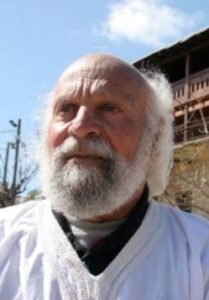 Eli Avivi (1930-2018) was born in Iran and made aliyah to the Holy Land with his family when he was just two years old. As a teenager, he joined Plugat HaYam, or Palyam, founded in 1945 as the navy arm of Palmach, the “special forces” of the pre-IDF Haganah. The primary task of Palyam was to escort and defend Jewish refugee ships coming from Europe, as well as ships containing arms for the young Jewish state. Avivi was one of seventy sailors that facilitated the arrival of 70,000 Jews to Israel over the course of 66 missions. He was also among the four hundred Palyam marines that fought in Israel’s War of Independence. Still drawn to the sea after the battles were over, Avivi became a fisherman. This took him on sailing trips around the world, and at one point he spent a year living in Greenland with the natives. Returning to Israel to visit his family in 1952, Avivi happened upon an abandoned fishing village near the Lebanese border, formerly inhabited by Arabs that had fled during the war. The young sailor settled there, making a living by selling fish to a nearby kibbutz. He eventually got married, and he and his wife continued a quiet, peaceful life mostly removed from civilization. In 1963, the Israeli government decided to turn the entire area into a national park, and sent the couple eviction notices. They battled the government until 1971, when their land was fenced in and their huts bulldozed, causing Avivi to declare independence from the State of Israel! The couple was promptly arrested. Their peaceful protests soon brought international attention, leading to an agreement with the government that resulted in the formation of the micro-state of “Akhzivland”. (The name comes from the archaeological ruins of the Biblical town of Achziv that the village was built upon.) Avivi’s success was partly owed to the support he had from