Tag Archives: Orthodox Jews

Jew of the Week: Rabbi Aharon Lichtenstein

In Memory of an Outstanding Rabbi
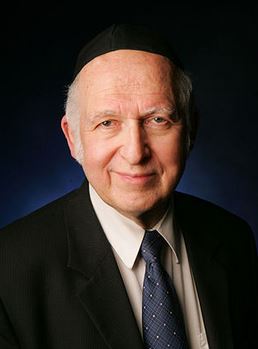
Rabbi Lichtenstein

Rabbi Lichtenstein

Aharon Lichtenstein (1933-2015) was born in Paris, France. His family fled the War in 1941, settling in the U.S., where Lichtenstein grew up. He went on to study at Yeshiva University, earning both a B.A. and rabbinic ordination, and continued his studies at Harvard, graduating with a Ph.D in Literature. He returned to Yeshiva University as a Talmud teacher, and then served as its dean (Rosh Yeshiva). After several years in that post, he made aliyah to Israel in 1971, and headed another Yeshiva, while quickly becoming a famed scholar and the central leader for Modern Orthodox and Religious Zionist Jews. He soon became one of the world’s top authorities in Halakha (Jewish law), too. Working with the ‘Takana’ organization, Rabbi Lichtenstein helped to combat harassment within the religious world, while also supporting the cause of women and encouraging women’s Torah studies. His support and outreach efforts spread beyond the religious world, encompassing secular communities, and even non-Jewish communities. Rabbi Lichtenstein also wrote a number of highly-acclaimed texts and commentaries. A noted scholar, he could easily quote both Jewish wisdom and secular philosophy. Last year he was awarded Israel’s highest honour – the Israel Prize. Sadly, Rabbi Lichtenstein passed away last week. Upon news of his passing, religious and political leaders from across the spectrum united to eulogize and honour him, including both Ultra-Orthodox and Reform rabbis, as well as conservative and liberal politicians. Israeli Prime Minister Benjamin Netanyahu described him as a “Zionist leader and Torah scholar of unparalleled stature… He loved the Land of Israel, the people of Israel, and the Torah of Israel.”

Words of the Week

God transcends all definitions, including the definition of “existence”.
Maimonides (Rabbi Moshe ben Maimon)

Jew of the Week: Rabbi Elio Toaff

“The Pope of the Jews”

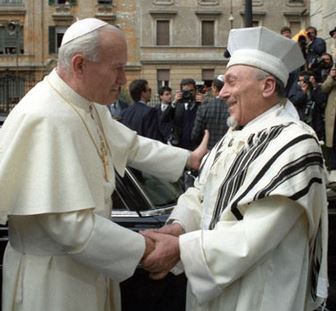
Rabbi Toaff with Pope John Paul II

Rabbi Toaff with Pope John Paul II

Elio Toaff (1915-2015) was born in Livorno, Italy, the son of Livorno’s chief rabbi. Despite the fact that his father did not want his son to follow in his footsteps, Toaff nonetheless pursued religious studies (as well as law and theology at the University of Pisa) and was ordained a rabbi by age 24. At 26, he was appointed rabbi of Ancona. Not long after, Germany occupied northern Italy, and Toaff became a resistance fighter. Captured by the Nazis and sentenced to death, he managed to escape while digging his own grave. Following the war, Toaff became the rabbi of Venice, and a professor at its university. In 1951, he became the Chief Rabbi of Rome (and, in effect, the Chief Rabbi of Italy) a post he held for 51 years until retiring in 2002. He had the monumental task of restoring Italy’s Jewish communities after the massive destruction they experienced during the war. Rabbi Toaff focused his efforts on rebuilding Jewish infrastructure, reigniting Jewish education, and bridging the gaps between Jews and non-Jews. In 1986, he invited Pope John Paul II to Rome’s Great Synagogue for a joint prayer. The Pope accepted, marking the first time in history a pope visited and prayed at a synagogue. The two had a very close relationship. Incredibly, Rabbi Toaff was one of just two people that the Pope mentioned in his last will and testament (the other being the Pope’s personal secretary), writing “How can I fail to remember the rabbi of Rome?” Rabbi Toaff cleared the way for the Pope to visit Israel in 2000, and to establish formal diplomatic relations between the Jewish State and the Vatican. Rabbi Toaff was beloved by Jews and Catholics alike, and was a central voice of morality in Italy, as well as the primary authority in Jewish law. Toaff was knighted by the Italian Republic, and given the title of ‘Senator for Life’. He was commonly nicknamed “the Pope of the Jews”. Sadly, Toaff passed away on Sunday. He would have turned 100 years old next week.

Words of the Week

A rabbi doesn’t work only for his community or for the Jews. A rabbi has to talk to every human being who needs him. He belongs to everybody. He is for everybody.
– Rabbi Elio Toaff

Jew of the Week: Rabbi Menachem Ziemba

Rabbi of the Warsaw Ghetto

Rabbi Menachem Ziemba

Rabbi Menachem Ziemba

Menachem Ziemba (1883-1943) was born in a Warsaw suburb in Poland, and raised by his grandfather, a Hasidic rabbi. As a young man, Ziemba quickly proved himself as a genius Torah scholar and Hasidic master. By 18, he was already married, and for the next few decades was wholly dedicated to Jewish studies, writing over 10,000 pages of his Torah-related thoughts, and teaching at the Mesivta Yeshiva. Out of both humility and devotion to Torah, he refused to take on more prestigious roles of rabbinic leadership, including an offer at being Chief Rabbi of Jerusalem. However, in 1935, at the request of his own rabbi, Ziemba started taking on community roles and obligations. He soon became world-renowned for his wisdom and took up a key position with Agudas Yisroel, the central organization of Ashkenazi-Orthodox Jews. Following the Nazi invasion of Poland, Ziemba was quarantined in the Warsaw Ghetto along with 400,000 Jews, in an area less than one and a half square miles. Despite the fact that he lost his wife in the Ghetto, Rabbi Ziemba constantly worked towards inspiring hope and optimism among the Jews. He laboured tirelessly to ensure that Jews could continue observing Torah law in the Ghetto, smuggling in provisions (including Kosher for Passover goods) and religious articles, secretly setting up areas of Torah study, and continuing to teach Judaism quietly. He even broke through his own apartment roof so that he could build a proper sukkah for the community. Rabbi Ziemba was given multiple opportunities to leave the Ghetto (including one by the Catholic Church) but refused to abandon his people. Though initially favouring passive resistance, after the 1942 deportations that killed hundreds of thousands of Jews, Rabbi Ziemba was convinced that the Jews had to fight back. He was an important supporter of the 1943 Warsaw Ghetto Uprising, and was himself the first to donate funds in order to purchase weapons. To quell the uprising, the Nazis began destroying the Ghetto and burning it down. Rabbi Ziemba was caught in one of these fires, and shot by SS troops while trying to escape. To great shock and sadness, he was killed on the 19th of Nisan, 72 years ago today. Following the uprising, the rest of his family was rounded up and taken to Treblinka, where they were also killed. The vast majority of his writings and teachings were burned in the Warsaw Ghetto, though three books survived, and are still studied today. In 1958, Rabbi Ziemba’s body was exhumed and brought to Israel, where he was finally laid to rest.

Words of the Week

In the past, during religious persecution, we were required by the law ‘to give up our lives even for the least essential practice.’ In the present, however, when we are faced with an arch-enemy whose unparalleled ruthlessness and program of total annihilation know no bounds, Halakha [Jewish law] demands that we fight and resist to the very end with unequaled determination and valor for the sake of Sanctification of the Divine Name.
– Rabbi Menachem Ziemba