
The Military Genius Who Made War—and Peace
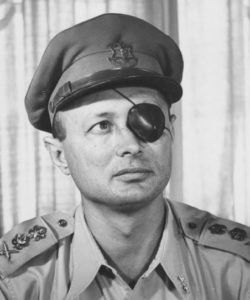 Moshe Dayan (1915-1981) was born on the first kibbutz, Degania Alef, to Jewish-Ukrainian parents. He was named after Moshe Barsky, a kibbutznik from Degania who was murdered in an Arab attack. At just 14 years of age, Dayan joined the Haganah defense force. In 1936, he began training with a British military unit headed by his hero, Major General Wingate. During World War II, Dayan was part of a unit that ran covert operations in Nazi-allied Vichy French territory and participated in the Allied invasion of Syria and Lebanon. In one battle, a sniper bullet missed his head, but the resulting shrapnel destroyed his left eye. His eye muscles were ruined, too, so he could not be fitted with a glass eye, and henceforth wore his characteristic black patch. During Israel’s Independence War, Dayan commanded the Jordan Valley units, and was able to stop the Syrian advance. He also led the takeover of towns like Ramle and Lod, and was part of the negotiating team that brought the war to an end. In 1949, Dayan took charge of the Southern Command and worked to secure Israel’s borders. This meant a policy of strong retaliation for Arab attacks, at times brutal. While it brought him a lot of condemnation, Dayan insisted that it was “the only method that proved effective”. In 1953, Ben-Gurion appointed Dayan the new Chief of Staff, and the latter went on to implement Ben-Gurion’s “three-year defence programme” to reorganize the IDF. Among his accomplishments was founding a military academy for high-ranking officers and establishing new intelligence units. In 1955, Dayan and Shimon Peres signed a series of deals with France to strengthen the IDF, leading to the purchase of over 100 jets, 260 tanks, and 300 trucks. In 1956, Dayan led Israel’s operation in the Sinai (jointly with France and England) and proved his military genius. The French later awarded Dayan with a Legion of Honour. After retiring from the IDF, Dayan joined Ben-Gurion’s government as Minister of Agriculture. During the Six-Day War, he took the military reins again as defense minister and oversaw the liberation of Jerusalem. He remained defense minister until the Yom Kippur War, after which he resigned due to what is generally considered to be his greatest failure. He subsequently fell into a deep depression. In 1977, Dayan returned to government as foreign minister and, no longer the hawk he once was, played a key role in the peace treaty with Egypt. Dayan spoke Arabic fluently, and lamented that more Israelis didn’t. He wrote four books and was also an amateur archaeologist, amassing a large collection of antiques which are now at the Israel Museum. In 1981, he founded a new political party, Telem, but passed away shortly after from a heart attack and complications of cancer. The New York Times eulogized him as “a general who made war, a diplomat who made peace.”
Words of the Week
We cannot save each water pipe from explosion or each tree from being uprooted. We cannot prevent the murder of workers in orange groves or of families in their beds. But we can put a very high price on their blood, a price so high that it will no longer be worthwhile for the Arabs, the Arab armies, for the Arab states to pay it.
– Moshe Dayan

 Anna Miriam Roth (1910-2005) was born in what is now Slovakia to Jewish-Hungarian parents. She studied psychology and pedagogy at Brno University in the Czech Republic, and was a member of Hashomer Hatzair, the Zionist youth organization. Upon graduating, she made aliyah to the Holy Land on her own and took up studies at Tel Aviv’s teacher’s college before enrolling at the Hebrew University. In 1937, she co-founded Kibbutz Sha’ar HaGolan, where she lived most of her life and worked as a teacher. Back in Europe, her entire family perished in the Holocaust. To make matters worse, during Israel’s War of Independence, the Arab forces burned down her kibbutz—including all photographs and letters from her family. In 1955, Roth published The Preschool Method, one of the first textbooks for early childhood education. She followed that up with The Theory of the Kindergarten in 1956, and The Child and You in 1958. A couple of years later, Roth relocated to New York to further her studies. She went on to earn a Master’s in education from Columbia University, as well as a Master’s in pedagogy from City College, New York. Upon her return to Israel, she continued her writing career, and soon began writing children’s books, too. Among her first were the very popular A Tale of Five Balloons (which sold over half a million copies and won a UNICEF Smile Award), HaBayit Shel Yael (“Yael’s House”), and Hot Corn. Perhaps her most famous work is Yuval HaMebulbal (“Confused Yuval”), now also an Israeli television show for kids. All in all, Roth wrote 23 books for children, along with 6 books on childhood education. She won the Ze’ev Price for Lifetime Achievement in 1990, and the Bialik Prize for Literature in 2002. Roth worked as a teacher for nearly five decades, and trained many of Israel’s educators. She is credited with being both a pioneer of Israeli education and of early childhood education worldwide.