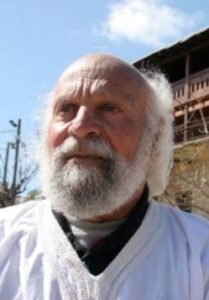
 Eli Avivi (1930-2018) was born in Iran and made aliyah to the Holy Land with his family when he was just two years old. As a teenager, he joined Plugat HaYam, or Palyam, founded in 1945 as the navy arm of Palmach, the “special forces” of the pre-IDF Haganah. The primary task of Palyam was to escort and defend Jewish refugee ships coming from Europe, as well as ships containing arms for the young Jewish state. Avivi was one of seventy sailors that facilitated the arrival of 70,000 Jews to Israel over the course of 66 missions. He was also among the four hundred Palyam marines that fought in Israel’s War of Independence. Still drawn to the sea after the battles were over, Avivi became a fisherman. This took him on sailing trips around the world, and at one point he spent a year living in Greenland with the natives. Returning to Israel to visit his family in 1952, Avivi happened upon an abandoned fishing village near the Lebanese border, formerly inhabited by Arabs that had fled during the war. The young sailor settled there, making a living by selling fish to a nearby kibbutz. He eventually got married, and he and his wife continued a quiet, peaceful life mostly removed from civilization. In 1963, the Israeli government decided to turn the entire area into a national park, and sent the couple eviction notices. They battled the government until 1971, when their land was fenced in and their huts bulldozed, causing Avivi to declare independence from the State of Israel! The couple was promptly arrested. Their peaceful protests soon brought international attention, leading to an agreement with the government that resulted in the formation of the micro-state of “Akhzivland”. (The name comes from the archaeological ruins of the Biblical town of Achziv that the village was built upon.) Avivi’s success was partly owed to the support he had from David Ben-Gurion, as well as Israel’s Shin Bet intelligence agency, whom he occasionally assisted. Avivi made himself president (democratically elected by his own vote), built borders around his territory, created a flag and national anthem, wrote a constitution, and even issued passports. Although it was not recognized by any other country, Akhzivland attracted many visitors, including many celebrities. Paul Newman was known to visit, and Sophia Loren “absolutely loved it”. Young people were particularly drawn to the absolute freedom permitted in Akhzivland. In 1972, Avivi threw a music festival inspired by Woodstock, attracting so many people that there were traffic jams for 100 kilometres around. (Future music festivals were forbidden.) Avivi continued to rule his micronation until last month, when he succumbed to pneumonia. Once called the “defiant hippy king”, he was unofficially the Middle East’s longest-serving head of state, of the Middle East’s “most peaceful country”. He has left behind a national museum full of thousands of artifacts that he discovered in the archaeological ruins and on his many sea dives. His wife Rina hopes to make an agreement with Israel to create a permanent Eli Avivi/Akhzivland memorial at the site.
Words of the Week
A human being is a part of the whole, called by us “Universe,” a part limited in time and space. He experiences himself, his thoughts and feelings as something separate from the rest—a kind of optical delusion of his consciousness. The striving to free oneself from this delusion is the one issue of true religion. Not to nourish it but to try to overcome it is the way to reach the attainable measure of peace of mind.
– Albert Einstein, in a 1950 letter to Robert S. Marcus
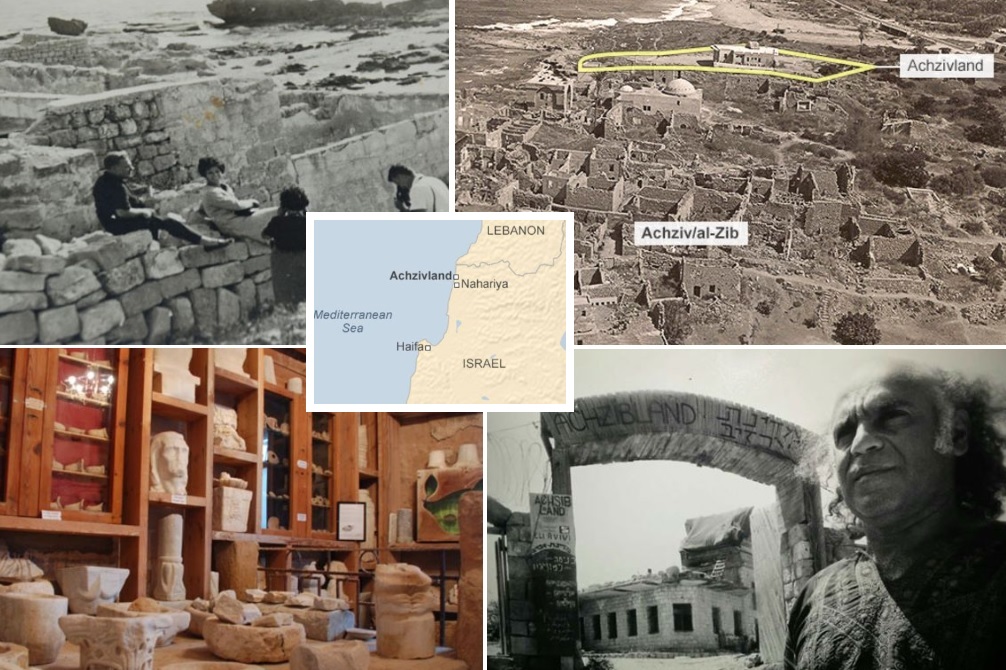
Clockwise from top left: Sophia Loren visits Akhzivland in 1966; the official borders of the microstate; Avivi by his “border crossing”; artifacts from the national museum. (Images courtesy of BBC)
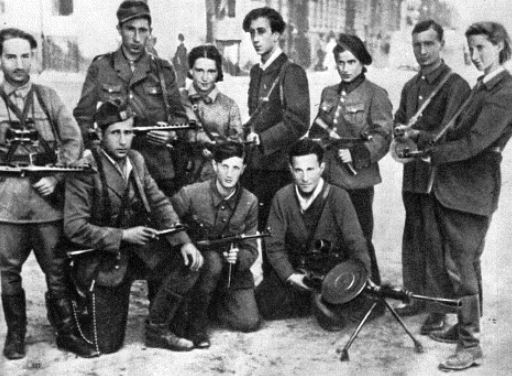
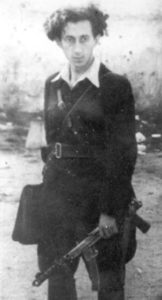 Abel “Abba” Kovner (1918-1987) was born in what is today Belarus and grew up in Vilnius (then part of Poland). As a young man, he was a member of HaShomer HaTzair, the Zionist youth movement. When the Nazis invaded Vilnius in 1941, Kovner escaped to a convent, but soon returned to the Vilna Ghetto to organize a Jewish resistance. At the start of 1942, Kovner secretly published a manifesto inside the Ghetto to inspire the Jews to fight back, writing that it was better to die than “go like lambs to the slaughter”. Along with several other young men, Kovner formed the United Partisan Organization, possibly the first armed underground Jewish group in Nazi Europe. Before they could launch their first large-scale attack, the Vilna Ghetto was liquidated in 1943, forcing the group to flee to the surrounding forests. From there, they launched a guerrilla warfare campaign against the Nazis. The small group began calling themselves “the Avengers” (HaNokmim) and were successful enough to draw the attention of the Red Army. They would go on to coordinate with the Soviets to crush the Nazis in Eastern Europe. Once the fate of the Nazis was sealed towards the end of 1944, Kovner was among the founders of a new group, called Bricha (“Escape”), which worked to get Jewish refugees out of Europe and to the Holy Land. Over the next couple of years, they would successfully move 250,000 Holocaust survivors to Israel. Having seen first-hand the horrific devastation inflicted by the Nazis, Kovner yearned for revenge. He started yet another group, called Nakam (“Vengeance”), seeking to punish Germany for the Holocaust. “Plan B” was to poison the water supply in Allied prisoner-of-war camps where Nazi SS soldiers were kept. The far more controversial and shocking “Plan A” was to poison the water supplies of several major German cities in order to kill 6 million Germans, one for each Jew lost in the Holocaust. Thankfully, Plan A was soon abandoned, though Kovner was still arrested by the British and held in a Cairo prison for several months. He did aim to accomplish Plan B, and Nakam members infiltrated a POW camp bakery in April 1946, coating the loaves of bread with arsenic. Over two thousands German soldiers fell ill, though no deaths were reported. In December 1947, Kovner joined the Haganah and fought in Israel’s Independence War as a captain of the Givati Brigade. Following this, he lived out the remainder of his life in a kibbutz, working tirelessly to strengthen the nascent state. He also helped to design several Holocaust museums, and testified at the Eichmann trial. More famously, Kovner wrote a series of poetry books (in Hebrew and Yiddish) describing the struggles he faced during the Holocaust and in Israel’s early years. This made him one of the country’s most celebrated poets and writers. For this, he won the Israeli Prize for Literature in 1970. A heavy smoker, Kovner succumbed to tracheal cancer before his 70th birthday.