Podolsky and Rosen
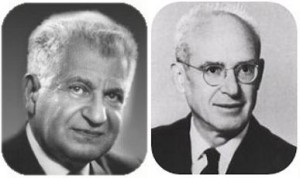
Nathan Rosen (1909-1995) was born in Brooklyn and studied at MIT during the Great Depression. While still young, he published several famous papers, including ‘The Neutron’, which predicted the structure of the nucleus a year before it was discovered. Between 1935 and 1945 he was Albert Einstein’s personal assistant at Princeton. Together, they discovered (mathematically) a “bridge” connecting distant areas of space – now called a wormhole. With Einstein’s encouragement, Rosen moved to the nascent State of Israel and joined Haifa’s Technion in 1953. He later served as President of Ben-Gurion University, founded the Israel Academy of Sciences and Humanities, the Physical Society of Israel, and the International Society for General Relativity and Gravitation. Aside from all this, he is most famous for coming up with the well-known “EPR Paradox” together with Einstein and a fellow Jewish scientist named Podolsky (hence “EPR”).
Boris Yakovlevich Podolsky (1896-1966) was born in Russia to a poor Jewish family which immigrated to the U.S. in 1913. He served in the US Army and worked as an electrical engineer before returning to school and earning a PhD from Caltech. In 1933 he was given a fellowship at Princeton, which led to his collaboration with Einstein and Rosen on the EPR Paradox. Interestingly, some have suggested that Podolsky was a Soviet spy, codenamed “Quantum”, and helped the Soviets start their nuclear program during World War II. His major legacy, however, is in the great work he did on solving various complex physics problems of the day.
Words of the Week
Education is not the learning of facts, but the training of the mind to think.
– Albert Einstein

 Donna Ivy Faske (b. 1948) was born in Forest Hills, New York and grew up in the “Jewish Greenwich” of Five Towns, Long Island. She was raised by a single mother who worked as a fashion model. Karan began her fashion career drawing sketches for Liz Claiborne. Although she dropped out of designer school, her talent propelled her onward, working first with fellow Jew Anne Klein, and eventually starting her own company with husband Stephen Weiss. In 1985, the Donna Karan Co. line premiered for the first time – with the motto “modern clothes for modern people” – and was an instant hit. Along with her popular Essentials and Signature lines, in 1988, Karan launched a new line for youth that has since gained even greater fame: abridging ‘Donna Karan New York’ to DKNY. The brand became huge worldwide (and currently operates 70 stores around the globe), and is often seen as a symbol of New York City itself, likely due to the famous ad poster, which has been called a ‘New York landmark’. A winner of multiple awards, Karan has been nicknamed ‘The Queen of Seventh Street’.