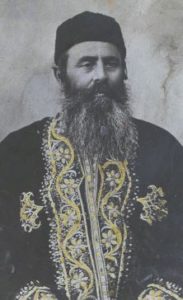
 Shlomo ben Yakov Moussaieff (1852-1922) was born in the emirate of Bukhara (present-day Uzbekistan). Both a renowned rabbi and a wealthy businessman, he made aliyah to the Holy Land in 1888 – bringing with him forty cases of gold – and was one of the founders of Jerusalem’s famous Bukharian Quarter. Moussaieff built four synagogues, and homes for 25 poor families. Meanwhile, he published a prayer book and disseminated it widely, making it his mission to inspire more Jews to pray regularly. He also continued his business ventures, particularly in real estate, tea, silk, and gemstones. Moussaieff was an avid collector of rare manuscripts, and amassed an impressive library with 225 ancient texts, including prized manuscripts of Maimonides and the mystical teachings of the Arizal. Until his last days, Moussaieff was committed to the development of Israel, and stated in his will that only those of his seven children that remain in Israel would receive any inheritance.
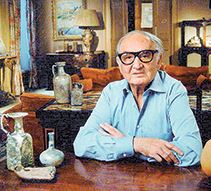 His grandson, also Shlomo Moussaieff (1923-2015), though better known as Sam, would become even more famous. One of twelve children raised in Jerusalem, Sam Moussaieff ran away from home as a teen to avoid his strict father. Living in a synagogue, he worked for a carpenter and sold ancient coins he would find in Jerusalem’s caves and tombs. Once arrested by Arab policemen, he ended up in a Muslim school for nearly a year, becoming proficient in Arabic and the Koran. At 17, Moussaieff enlisted in the British Army to fight the Nazis. After World War II, he fought for Israel’s independence and was captured by the Jordanians, who imprisoned him for a year. Moussaieff returned to Jerusalem and joined the family jewellery business. He soon opened his own antiquities shop in Jaffa, at times getting in trouble for smuggling goods. In 1963, Moussaieff was offered to have his record cleared of legal issues, as well as the rights to an exclusive shop in London’s Hilton Hotel, in exchange for handwritten letters from Maimonides which he owned. Moussaieff accepted and moved to London. His shop soon specialized in jewellery, and he became the dealer of choice for wealthy barons from Arab oil states thanks to his pristine Arabic. Moussaieff became world-renowned for his extremely rare and special gems. He owned the most precious stone in the world: a red diamond valued at $20 million. In 2011, he was ranked among the richest Londoners, with an estimated worth of some $350 million. Moussaieff amassed a personal collection of over 60,000 ancient artifacts, including millennia-old seals from Jerusalem’s First Temple, and reportedly even items associated with the forefather Abraham! His stated goal was to collect indisputable evidence proving the accuracy of the Torah. Moussaieff was given an honourary degree by Bar Ilan University (to whom he donated many artifacts, including his grandfather’s ancient manuscripts) which established the Dr. Shlomo Moussaieff Center for Kabbala Research. Interestingly, Moussaieff once purchased an ancient Torah scroll for $1 million from the Allenby family – who had the Torah because the elder Shlomo Moussaieff gave it as a gift to General Allenby during World War I!
Words of the Week
My spirit moved me to leave the land of my birth, in which I grew up, and to ascend to the Holy Land, the land in which our ancestors dwelled in happiness, the land whose memory passes before us ten times each day in our prayers…
– Rabbi Shlomo Moussaieff, in the introduction to his prayer book, Hukat Olam

 Emma Lazarus (1849-1887) was born in New York City. Her father came from a Jewish family that immigrated from Germany, while her mother was from an illustrious Sephardic-Portuguese family that settled in America before the Revolution. Lazarus studied literature and language, speaking German, French, and Italian. She became a famous poet, novelist, and playwright; one of the first successful Jewish-American authors. Her first book of poetry was published when she was just 17 years old, and she went on to collaborate with such great writers as Ralph Waldo Emerson. Lazarus was also an influential social activist. Her first cause was fighting for tax reform and fairer distribution of land. After hearing of the violent pogroms in Russia, she advocated strongly on behalf of Russian Jews and helped settle Jewish refugees in New York. Lazarus worked for the Hebrew Emigrant Aid Society, training impoverished immigrants and helping them find work. She also co-founded the Hebrew Technical Institute to educate Jewish refugees. Meanwhile, Lazarus argued passionately for the creation of a Jewish state in Israel – thirteen years before Theodor Herzl arrived on the scene! (For this, among other reasons, she was once described as the “fiery prophet of the American Jewish community.”) Lazarus is undoubtedly most famous for her poem “The New Colossus”, which she wrote to raise money for the construction of the Statue of Liberty. The sonnet’s powerful words – familiar to most Americans – have inspired many, and have been quoted by leaders like John F. Kennedy and Barack Obama. Two decades after she first wrote it, the poem was etched onto a bronze plaque at the base of the Statue. It has been said that the poem transformed the Statue into a symbol of immigration and freedom, and defined “the American vision of liberty”. Sadly, Lazarus did not live to see this day. She tragically died at the young age of 38, from lymphoma. She has since been inducted into the National Women’s Hall of Fame.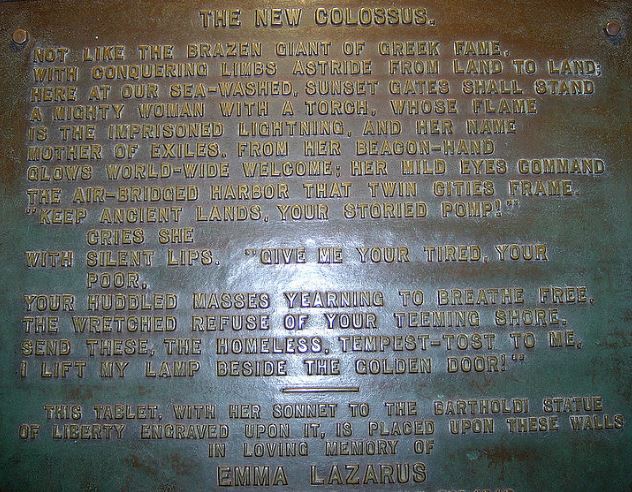
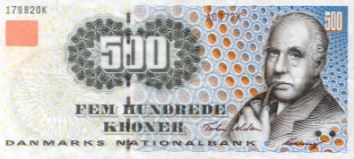
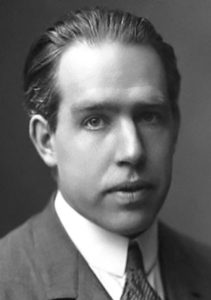 Niels Henrik David Bohr (1885-1962) was born in Copenhagen. His mother was from a prominent Jewish-Danish family, and he was partly named after his grandfather, David Baruch Adler, an influential banker and parliamentarian. Bohr’s father was a famous physiology professor, who rejected his Lutheran roots in favour of atheism. (Bohr himself would later renounce any association with the Church of Denmark.) At 20, Bohr won a gold medal from the Royal Danish Academy of Sciences for his work on water viscosity and surface tension. He went on to earn a Master’s in mathematics and a Ph.D in physics. Bohr combined Rutherford’s ideas on the atom with Planck’s quantum theories to produce a revolutionary new atomic model, known as the Bohr model. This model finally made sense of the mysterious properties of atoms, and solved a major hurdle that baffled scientists for over 30 years. The discovery would earn Bohr a Nobel Prize in Physics. By 1917, Bohr was the Chair of Theoretical Physics at the University of Copenhagen, and sought to establish a new centre for physics research. Bohr got the government on board, and after receiving large donations from wealthy Danish Jews (together with the Carlsberg brewery), founded the Institute of Theoretical Physics – now known as the Niels Bohr Institute. There, his students discovered the 72nd element of the Periodic Table – whose existence Bohr had proposed – and named it Hafnium, the Latin name for Copenhagen. When the Nazis came to power, Bohr opened the doors of his institute to fleeing Jewish scientists. Denmark itself would soon be under Nazi control. In 1943, Bohr was informed that he would be arrested since, despite his mixed ancestry, he was considered a Jew according to the Nuremberg Laws. Bohr fled to Sweden, where he met with Swedish King Gustaf V to convince him to open Sweden’s doors to Jewish refugees. Bohr succeeded, and over 7000 Danish Jews were rescued and given asylum in Sweden. He then headed to England, where he assisted the war effort through the British “Tube Alloys” weapons project, before heading to the US to advise the Manhattan Project. Although he claimed his help was not needed to make the first nuclear bomb, others have admitted that he solved an important puzzle that made it happen. Bohr campaigned against the use of nuclear weapons for the rest of his life. It was his vision that resulted in the creation of the International Atomic Energy Agency, which monitors the use of nuclear power. Bohr went on to become the President of the Royal Danish Academy of Arts and Sciences. He chaired the Nordic Institute for Theoretical Physics, and played a central role in the founding of the world-famous CERN research organization. In addition to his monumental work in quantum physics, Bohr was a noted philosopher. Along with countless other awards, Bohr was bestowed the Order of the Elephant, the highest honour in Denmark (usually reserved only for royalty and heads of state), and is on the Danish 500-krone bill. He is one of just a handful of people who has an element on the Periodic Table named after him (bohrium).