
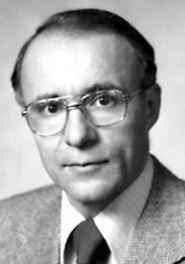
 Arno Allan Penzias (b. 1933) was born in Munich. As a six year old, he was evacuated from Nazi Germany through the British Kindertransport rescue operation which saved 10,000 Jewish children. He was later reunited with his parents, who brought the family to New York. Penzias grew up in Brooklyn and went on to study physics. He graduated among the top of his class, then served two years in the US Army as a radar officer. From there, he got a research position at Columbia University’s Radiation Lab, where he helped to develop the maser (a “microwave laser”). After earning a Ph.D in physics from Columbia, Penzias got a job at Bell Labs to do astronomy research with microwave receivers. He was soon joined by Robert Wilson. The two noticed their antenna picking up an inexplicable signal. After ruling out all forms of interference, and carefully cleaning the antenna, the weak signal persisted. The two collaborated with another physicist, Robert Dicke, to show that this signal was the cosmic microwave background (CMB) radiation, the remnants of the universe’s birth, as predicted by the Big Bang Theory. The existence of CMB confirmed that the universe had a beginning, with a burst of radiation, and simultaneously confirmed ancient Jewish teachings about the universe’s origins. The Zohar, a famous mystical commentary on the Torah that was first published some 700 years ago, explains that the universe began with a nikuda hada d’zohar, a singular point of radiance, from which all things were formed. The Zohar explains that this ever-expanding radiance continues to fill the universe, based on the words in the Biblical Book of Daniel (12:3) which describes the “radiance of the firmament”. In fact, this is how the book got its name, Zohar meaning “radiance”. Penzias’ and Wilson’s monumental discovery brought about a beautiful harmony between Torah and science, at once confirming both the modern Big Bang Theory and the holy words of the ancient Jewish Sages. The two physicists won the 1978 Nobel Prize in Physics. Penzias continued his work at Bell Labs for a total of 37 years, rising to the position of Vice President of Research. He was made a Fellow of the American Academy of Arts and Sciences, and the National Academy of Sciences. Penzias later moved to Silicon Valley to advise venture capitalists and tech start-ups. Despite being in his 80s, he is still a venture partner at New Enterprise Associates, and says he has “no plants to retire”.
Words of the Week
Astronomy leads us to a unique event, a universe which was created out of nothing, one with the very delicate balance needed to provide exactly the conditions required to permit life, and one which has an underlying (one might say ‘supernatural’) plan.
– Arno Penzias
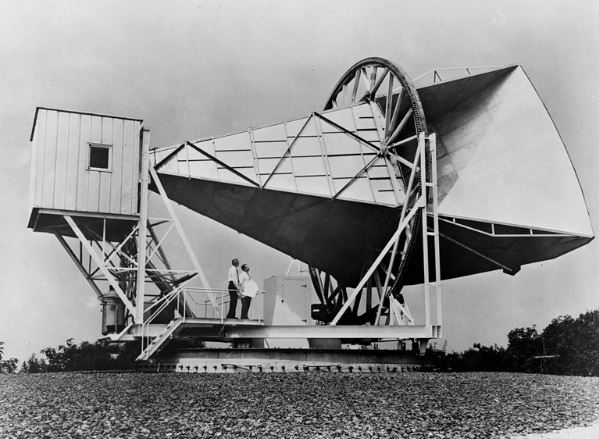
Penzias and Wilson at the antenna where they made their famous discovery
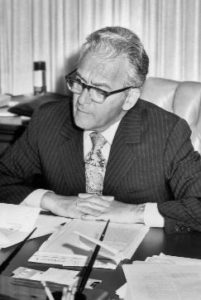 Sol Price (1916-2009) was born in New York City to Jewish-Russian immigrants from Belarus. He grew up in San Diego, where he earned a philosophy degree at San Diego State University before getting a law degree from the University of Southern California. Price was admitted to the bar in 1938. After over a dozen years as a business lawyer, Price had an idea to open a new kind of department store, offering wholesale prices on quality goods sold in bulk. Price opened his first store, called FedMart, in an old airport hangar in 1954. He charged a small membership fee ($2 per family) and kept prices even lower by avoiding advertising, major credit cards, and expensive real estate, and maintaining a small inventory. The model was a great success, and Price expanded rapidly. He pioneered many innovations in retail, including being the first to sell gasoline at wholesale prices, and being the first to have an in-store pharmacy and opticianry. By 1974, FedMart had 45 stores and over $300 million in sales. The following year, FedMart was bought out by a German retailer, and Price was soon kicked out of the company. He then started a new chain, Price Club, in an old factory once owned by Howard Hughes. Price Club expanded quickly, too, and went public in 1980. A few years later, one of Price Club’s employees teamed up with a wealthy lawyer (whose own Jewish family was successful in retail) to start a competing wholesaler, called Costco. In 1993. Price Club merged with Costco to form PriceCostco, together having 206 locations and $16 billion in sales. By 1997, Costco became the official company name, and today, Costco has over 700 locations around the world, with 85 million members, and 174,000 employees. It is the second largest retailer, and the 18th richest company in the world, with $120 billion in revenue. Costco is second only to Wal-Mart. Ironically, Sam Walton wrote in his book that he “borrowed” most of his ideas from Sol Price, and called his store “Wal-Mart” because he liked Sol Price’s FedMart! Not surprisingly, Price is often called the “father of the wholesale retail industry”. He was also a generous philanthropist, having donated tens of millions to various causes, especially in his hometown of San Diego.
 Chaim Gedaliah Rickover (1900-1986) was born in Poland. When he was six years old his family fled to the United States to escape the Russian pogroms that had killed over 3000 Jews in Eastern Europe. The family settled in Chicago, where Rickover started working at just nine years of age for three cents an hour. He excelled academically, and after graduating from high school with honours, was nominated by a Jewish congressman to the US Naval Academy. Rickover distinguished himself while serving on a destroyer ship and was among the youngest people to ever be promoted to an officer. He went back to school and earned a Master’s in electrical engineering before doing further studies at Columbia. At 29, he decided to serve on a submarine, and was soon in command of one. His translation of the German Das Unterseeboot became the textbook of the US Submarine Service. Throughout World War II, Rickover repaired electrical systems on US Navy ships, for which he earned the Legion of Merit. Following the war, he applied to join the Manhattan Project’s new program to develop nuclear power plants. He was soon the deputy manager of the division developing nuclear-powered navy ships. Rickover saw that the greatest potential was for nuclear submarines, and ultimately succeeded in persuading the Secretary of the Navy to endorse building one. Rickover led its development, and played a central role in designing a nuclear reactor fit for submarines. His vision came to life in 1954 with the launch of the famous USS Nautilus. It put him on the cover of TIME Magazine that year. By 1958, Rickover was vice admiral of the Navy, and awarded a Congressional Gold Medal. His program would go on to produce over 200 nuclear-powered submarines, and 23 aircraft carriers and cruisers. Incredibly, none of these has ever had a meltdown – a feat credited to Rickover’s insistence on safety and obsessive attention to detail. (The Soviet Navy suffered at least 14 meltdowns in the same time period!) Rickover became known as the “Father of the Nuclear Navy”. He was the longest serving officer in US naval history, with 63 years of service under 13 presidents. A four-star admiral, his 61 civilian awards included a Presidential Medal of Freedom and two Congressional Gold Medals (an extremely rare feat). He was also awarded 15 honourary degrees, and made an honourary Commander of the Order of the British Empire. Rickover stated that he was not proud of his work, and saw it as a “necessary evil” to protect his country. He once said he wished “nuclear power had never been discovered” and hoped that the nuclear fleet would be dismantled.