The Sage Who Saved Judaism
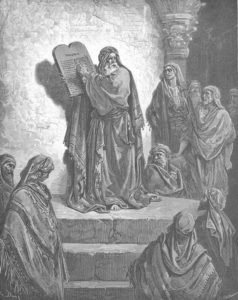
“Ezra Reads the Law to the People” by Gustave Doré
Ezra ben Serayah (c. 5th century BCE) was born in Babylon to a family of Jewish priests, kohanim, descendants of Aaron. He spent his early days immersed in Torah study, under the tutelage of Baruch ben Neriah, disciple of the prophet Jeremiah. Ezra soon became the most renowned scholar and scribe in Babylon’s community of exiled Jews. Earlier, the Persian Emperor Cyrus the Great had freed the Jewish community and permitted them to return to Israel and rebuild the Temple. While the majority stayed in Babylon, a group of 42,360 Jews returned to rebuild Jerusalem. Unfortunately, few among them were learned, and in those first decades many ended up intermarrying with the non-Jewish settlers that were brought to Israel by the Assyrians and Babylonians. Ezra soon decided to head to Israel himself, along with a second wave of 1,500 Jews. Upon arrival, he wept at the poor state that the Jewish community was in. He immediately started teaching Torah, decreed that the Torah must be read publicly every Monday and Thursday (which is still done in all synagogues today), and put an end to intermarriages. So successful were his campaigns that the Tanakh states the Jews started to keep the holidays as properly and fervently as they did in the times of Joshua, the successor of Moses. As a priest, Ezra was involved in restoring the new Temple’s services. More importantly, he was able to discover and prepare a new Red Heifer, allowing the entire nation to be spiritually purified. Ezra wrote numerous holy texts, and is fittingly known as Ezra HaSofer, “the Scribe”. He composed the majority of the Book of Chronicles, which concludes the Tanakh, as well as the Book of Ezra, which records the historical events of the time. Ezra was one of the last prophets of Israel, and penned his prophecies under the name Malachi, also a Biblical book. He was one of the co-founders of the Great Assembly, a group of 120 prophets and sages who, among other things, codified the Tanakh and composed the first formal Jewish prayers (including the Amidah). The Talmud credits Ezra with reviving the Torah in the Holy Land, and even states that had Moses not given us the Torah, Ezra would have been worthy of doing so. He passed away on the ninth of Tevet, which is next Monday.
Words of the Week
Predicting rain doesn’t count, building an ark does.
– Warren Buffet
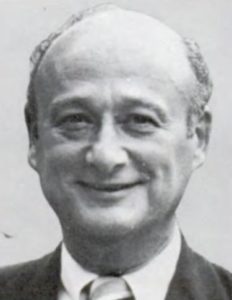

 Anna Miriam Roth (1910-2005) was born in what is now Slovakia to Jewish-Hungarian parents. She studied psychology and pedagogy at Brno University in the Czech Republic, and was a member of Hashomer Hatzair, the Zionist youth organization. Upon graduating, she made aliyah to the Holy Land on her own and took up studies at Tel Aviv’s teacher’s college before enrolling at the Hebrew University. In 1937, she co-founded Kibbutz Sha’ar HaGolan, where she lived most of her life and worked as a teacher. Back in Europe, her entire family perished in the Holocaust. To make matters worse, during Israel’s War of Independence, the Arab forces burned down her kibbutz—including all photographs and letters from her family. In 1955, Roth published The Preschool Method, one of the first textbooks for early childhood education. She followed that up with The Theory of the Kindergarten in 1956, and The Child and You in 1958. A couple of years later, Roth relocated to New York to further her studies. She went on to earn a Master’s in education from Columbia University, as well as a Master’s in pedagogy from City College, New York. Upon her return to Israel, she continued her writing career, and soon began writing children’s books, too. Among her first were the very popular A Tale of Five Balloons (which sold over half a million copies and won a UNICEF Smile Award), HaBayit Shel Yael (“Yael’s House”), and Hot Corn. Perhaps her most famous work is Yuval HaMebulbal (“Confused Yuval”), now also an Israeli television show for kids. All in all, Roth wrote 23 books for children, along with 6 books on childhood education. She won the Ze’ev Price for Lifetime Achievement in 1990, and the Bialik Prize for Literature in 2002. Roth worked as a teacher for nearly five decades, and trained many of Israel’s educators. She is credited with being both a pioneer of Israeli education and of early childhood education worldwide.