
NASA’s First Jewish Astronaut
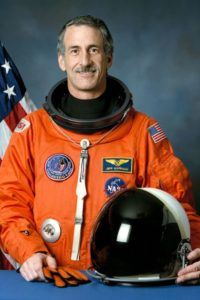 Jeffrey Alan Hoffman (b. 1944) was born in Brooklyn. He was always fascinated by outer space, and went to study astronomy at Amherst College in Massachusetts. Hoffman went on to get a PhD in astrophysics from Harvard, researching cosmic x-rays and gamma rays. He built one of the first aerial gamma ray telescopes. After this, he did postdoctoral work in the UK, eventually working as a project scientist for the European Space Agency. In 1975, Hoffman returned to the US to work at MIT. His main area of focus was x-ray bursts, and he authored over 20 papers on the subject, becoming the world expert on it. One time, he heard his wife reading a passage in a book saying that there will never be a Jewish astronaut. This inspired Hoffman to pursue just that, and he applied to NASA. In 1978, he was selected for NASA’s astronaut training program, together with Judith Resnik. The two became NASA’s first Jewish astronauts. Hoffman went on his first mission in 1985 aboard the Space Shuttle Discovery, during which the crew deployed two satellites and conducted numerous scientific experiments. At this point, Hoffman became just the second Jewish man in space (following Russian cosmonaut Boris Volynov). During his fourth trip to space, Hoffman was responsible for repairing the Hubble Space Telescope. Before that flight, his rabbi asked him if he would take some Judaica with him, and Hoffman happily agreed. He took a mezuzah—which he affixed to his cabin with Velcro—a tallit, as well as a dreidel and mobile menorah, since it was during Chanukah. (Click here to see Hoffman spin a dreidel in space!) On another flight, Hoffman took a Torah with him and made sure to read it while flying over Jerusalem. During his last mission in 1996, Hoffman set a new record, becoming the first astronaut to spend 1000 hours aboard space shuttles. All in all, he spent more than 50 days in space, and logged over 21 million space miles travelled. Since retiring as an astronaut, he has been teaching as a professor at MIT, and visiting professor at the University of Leicester. He has also written a book called An Astronaut’s Diary.
When Jews and Greeks Were Brothers: The Untold Story of Chanukah
Words of the Week
…Science can only be created by those who are thoroughly imbued with the aspiration toward truth and understanding. This source of feeling, however, springs from the sphere of religion.
– Albert Einstein
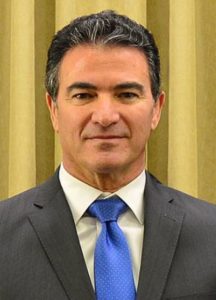 Yosef Meir Cohen (b. 1961) was born in Jerusalem to a religious-Zionist family with deep roots in the ancient city. He is a 9th-generation Israeli, and his ancestors were among the founders of the Mea Shearim neighbourhood, one of the first outside Jerusalem’s Old City walls. Cohen grew up studying in yeshivas and was a member of the
 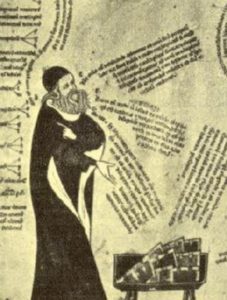 Avraham bar Chiya (c. 1070-1145) was born in Barcelona to a Sephardic Jewish family. It appears that his family was persecuted by its Christian rulers, so they fled to the neighbouring Arab kingdom of Zaragoza. Bar Chiya came from a long line of rabbis, and was also extensively trained in science, math, and astronomy. Famed for his wisdom, he became the court astronomer of Al-Musta’in II. Eventually, he was appointed minister of police and given the title sahib al-shurtah, “city governor”. This is why he was known in the Jewish community as HaNasi, “the prince” or “the president”. Al-Musta’in II was unable to defend his domain from the Christians, who soon took over. Bar Chiya moved to southern France for a while and lived in Narbonne and Provence. There he composed some of the most important scientific texts of the Medieval era. He translated a number of Arabic works into Latin, opening their study for Europeans, and played a key role in introducing the Hindu numerals we use today (by way of Arabia) to Europe, and thus to the rest of the world. Bar Chiya also synthesized ancient Greek wisdom with contemporary Arabic knowledge, and published new discoveries in number theory, arithmetic, geometry, optics, astronomy, and music theory. His Treatise on Measurement and Calculation inspired later greats like Plato of Tivoli and the world-famous Fibonacci. Meanwhile, Bar Chiya also served as the chief rabbi of the Jewish communities he presided over, and composed two important Jewish commentaries and texts. He is credited with being the first person to write a scientific book in Hebrew, and played an instrumental role in the development of the Hebrew language. His disciples included both Jews and non-Jews, among them the great