Google!
 Sergey Mikhaylovich Brin (b. 1973) was born in Moscow to Russian-Jewish parents. After many long months trying to emigrate from the Soviet Union, the family was finally permitted to leave in the spring of 1979, when Brin was six years old. The family lived in Vienna, then Paris, and finally made it to the US with help from the Hebrew Immigrant Aid Society. Brin’s father got a job as a math professor at the University of Maryland, and his mother worked as a researcher for NASA. Following in his parents’ footsteps, Brin studied math and computer science at the University of Maryland. He went on to do graduate studies at Stanford, and there met Larry Page.
 Lawrence Edward Page (b. 1973) was born in Michigan. His mother is Jewish, and his grandfather lives in Israel. Page’s parents were both computer scientists, and he grew up immersed in technology. He was also passionate about music, and credits music training with helping to shape his analytical mind. Page studied computer engineering at the University of Michigan before heading over to Stanford. Together with Brin, the two co-authored a paper on “The Anatomy of a Large-Scale Hypertextual Web Search Engine”. They then developed a new algorithm that would dramatically improve the capabilities of search engines. Brin and Page used their dorm rooms as office and lab, scrapping together whatever money they could for servers and other parts, and slowly building the infrastructure for their new search engine. (There were a number of other people involved, too, who were instrumental in its development.) The new search engine, originally called BackRub, was launched on the Stanford website in 1996. By the following year, Brin and Page understood that the search engine had the potential to transform the world. They renamed it “Google”, and bought the google.com domain on September 15, 1997 (twenty-three years ago, today). The rest is history.
Last year, Brin and Page both stepped down from Google (and its new parent company, Alphabet) though they are still employees and controlling shareholders. Both are big investors in green technology, space exploration, life extension, and Tesla Motors. They are also noted philanthropists. Among their donations are Brin’s $1 million to the Hebrew Immigrant Aid Society, and over $160 million to fight Parkinson’s disease (which his mother suffers from); and Page’s $15 million to fight Ebola and over $20 million to find treatments for vocal cord illnesses, which he suffers from. Brin and Page are currently the 13th– and 14th-richest people in the world.
Words of the Week
You always hear the phrase, “money doesn’t buy you happiness”. But I always, in the back of my mind, figured a lot of money will buy you a little bit of happiness. But it’s not really true.
– Sergey Brin

Google’s first logo, as it appeared on September 15, 1997 when the website was launched.
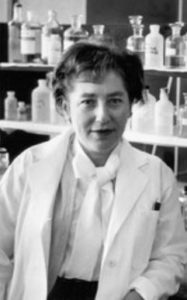 Mildred Cohn (1913-2009) was born in New York to Jewish-Russian immigrants. Her father was a rabbi and Cohn grew up in a religious, Yiddish-speaking home, though one which also prioritized secular education and the arts. Cohn graduated high school by the age of 14 and got her Bachelor’s degree in biochemistry at 18, followed by her Master’s from Columbia University. Unable to afford any further schooling, Cohn got a job researching for the National Advisory Committee for Aeronautics (NACA), which would later become NASA. She was the only woman among seventy men, and was told she shouldn’t expect any promotions. Two years later, she had enough money to return to school, pursuing her PhD at Columbia under recent Nobel Prize-winner Harold Urey. Cohn focused her work on carbon and oxygen isotopes. From there, she moved on to Washington University to do research on metabolism using sulfur isotopes. Later, she switched to using nuclear magnetic resonance and made a huge breakthrough in 1958 when she was able to visualize ATP, the central energy molecule that powers human cells and essentially all living things. Cohn discovered much of what we know about ATP and how it works. All in all, she wrote 160 scientific papers and won numerous awards, including the National Medal of Science (awarded to her by President Reagan). She was the first female editor of the Journal of Biological Chemistry and the first female president of the American Society for Biochemistry and Molecular Biology. In 2009 she was inducted in the National Women’s Hall of Fame. Cohn was married to renowned Jewish physicist Henry Primakoff. Many of her ATP discoveries came while she was working at the lab of another great Jewish scientist, Gerty Cori.
 Gerty Theresa Radnitz Cori (1896-1957) was born in Prague. Her father was a chemist who had invented a new way of refining sugar. At 16, Cori decided to become a doctor, but found that she was missing nearly all the prerequisites. So, in one year she took eighteen years-worth of courses in Latin, science, and math. Cori passed her entrance exam and was among the first women ever to be admitted to Prague’s medical school. After graduating, she worked at a children’s hospital and also did research on blood disorders, the thyroid gland, and the body’s ability to regular temperature. Due to persistent food shortages and rising anti-Semitism after World War I, Cori and her husband (also a doctor and scientist) left Prague and moved to New York. The couple did research together at what is now the Roswell Park Cancer Institute in Buffalo, focusing on glucose metabolism. Cori published 11 papers of her own, and another 50 together with her husband. By 1929, the Coris had figured out how the body metabolized glucose in the absence of oxygen, a process now known as the Cori Cycle. For this, they won a Nobel Prize in 1947. This made Cori the first American woman to win a Nobel Prize (and only the third woman overall), as well as the first woman ever to win a Nobel Prize in Medicine. In 1931, the couple took over a lab at Washington University (with Cori being paid one-tenth her husband’s salary). Here they made many more vital scientific discoveries, and mentored a new generation of scientists—six of which went on to win Nobel Prizes of their own. For this reason, their lab was deemed a National Historic Landmark in 2004. Like Mildred Cohn, Gerty Cori won countless awards and was inducted into the National Women’s Hall of Fame. There are craters on the Moon and on Venus named after her, as well as a commemorative US stamp. After battling the disease for a decade, Cori succumbed to bone cancer, likely caused by her extensive work with X-rays.