Founder of the Paralympic Games
 Ludwig Guttman (1899-1980) was born to a German-Jewish family in what is now Poland. After serving in World War I, he volunteered at a hospital and first encountered a paraplegic patient. This inspired him to go to medical school and he went on to become a renowned neurosurgeon, specializing in spinal cord injuries and paralysis. He also taught at the University of Freiburg, where he supervised a Jewish fraternity that focused on fitness and physical training to give Jewish students more strength and confidence in the face of rampant anti-Semitism. When the Nuremberg Laws were passed by the Nazis, Guttman was stripped of his job and title. He was given an inferior position at the Breslau Jewish Hospital, where he eventually became the medical director. During Kristallnacht, Guttman witnessed the desecration of his synagogue and the abuse of his fellow congregants. That night, he admitted 64 Jewish patients that took refuge in his hospital, and was able to save 60 of them from deportation by the SS agents that came the next day. The following year, the Nazis gave him a visa and sent him on a medical mission to Portugal. Guttman never returned to Germany, and settled in England instead. He joined the Nuffield Department of Neurosurgery in Oxford. Guttman came up with the idea of turning paraplegic patients over in their beds every two hours to prevent bed sores, a small move that drastically cut the mortality rate. In 1943, the Royal Air Force asked Guttman to found and head the National Spinal Injuries Centre at Stoke Mandeville Hospital to look after injured pilots who commonly had spinal problems. It was here that Guttman realized how sports could be a powerful tool for rehabilitation. In 1948, he organized the first Stoke Mandeville Games for disabled war veterans, a huge success. Four years later, he turned it into an international event, and in 1956 was recognized by the IOC (International Olympic Committee) for his pioneering work. The Stoke Mandeville Games became an official part of the 1960 Rome Olympics, and by 1984 was known as the Paralympic Games. (When host city Mexico refused to hold the games in 1968, Guttman arranged for them to be held in Israel). Guttman founded what would become the English Federation of Disability Sport, as well as the International Spinal Cord Society. He was the first editor of the scientific journal Spinal Cord. The Guttmann Institute in Barcelona is named after him, as is the Ludwig Guttmann Prize awarded by the German Medical Society for Paraplegia. He was the subject of a BBC documentary called The Best of Men, and was knighted by Queen Elizabeth II in 1966. There are currently over 4400 athletes competing at the Tokyo Paralympic Games, the largest ever.
Words of the Week
It might seem bizarre, but in my opinion science offers a surer path to God than religion.
– Paul Davies, renowned physicist
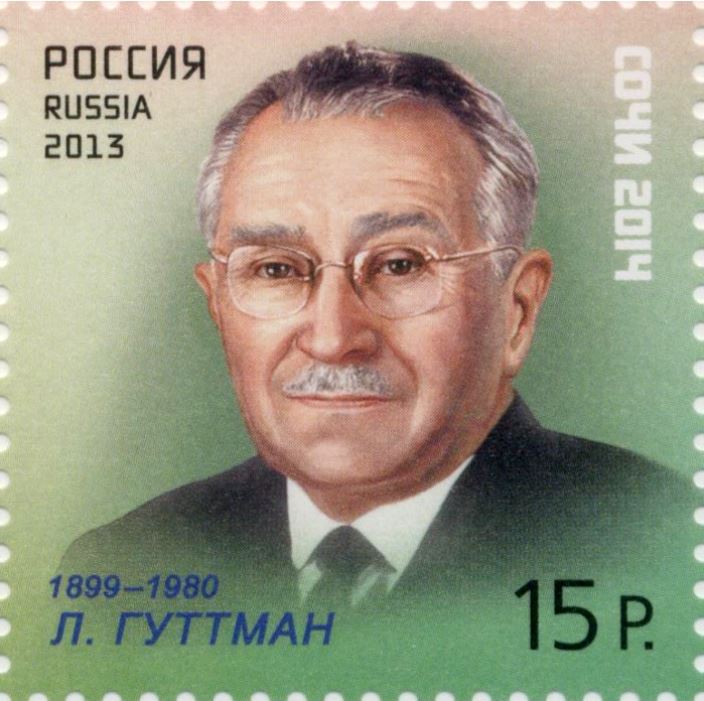
Russian commemorative stamp of Ludwig Guttman, in its “Sports Legends” series released before the 2014 Sochi Olympics.
 Anatoliy Davidovich Daron (1926-2020) was born in Odessa, Ukraine. An avid pianist, he initially wished to become a musician. At age 12, he read a book about space and was inspired to become a rocket scientist, with the hopes of one day flying to Mars. That same year, World War II broke out and the family fled to Russia’s Stavropol region. A few years later, the Nazi invasion came to his town just as he was graduating high school—he got his diploma, written by the principal on a scrap piece of paper, while everyone was fleeing! Doron went on to study rocketry in Moscow, and soon joined OKB-456, the Soviet state institution tasked with missile and rocket development, under the leadership of Valentin Glushko. There, Daron worked on the USSR’s first intercontinental ballistic missiles (ICBMs). When the anti-Semitic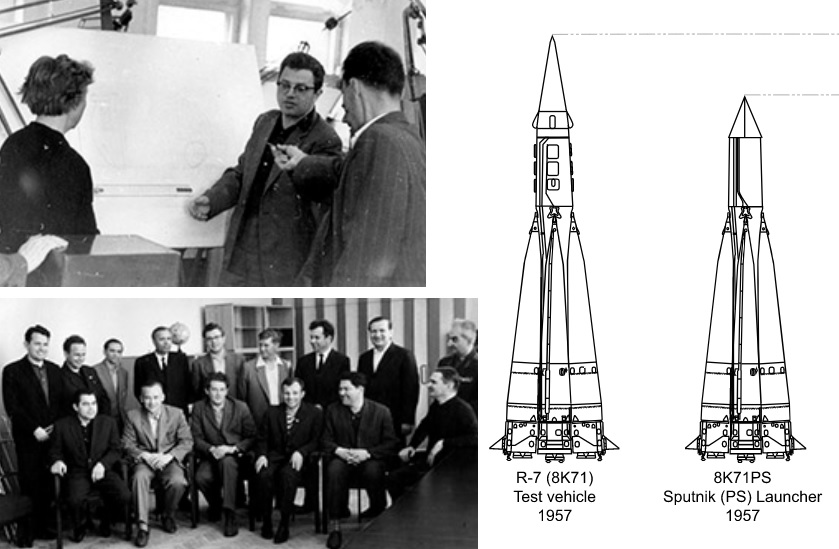
 Shlomo Gerzovsky (1913-1997) was born in Uman, Ukraine. When the Communist Revolution began, the family fled to Romania, and eventually made its way to the Holy Land. Gerzovsky, now with the Hebraized last name “Gur”, started studying at the Mikveh Israel Agricultural School. In 1936, the Arab Revolt began, with Arab mobs attacking both British nationals and Jewish residents. In response, Gur was among the co-developers of the Homa u’Migdal (“Wall and Tower”) system, a method of building settlements with pre-fabricated protective walls and a watchtower—quickly assembled, sometimes overnight. Gur co-founded the first such settlement, Kibbutz Tel Amal, then helped to establish a whopping 56 others. All settlements were built legally according to existing Ottoman law, on land purchased by the JNF. They served as safe havens for Jews during the violent Arab pogroms, and ensured that Jewish life in the Holy Land would continue to flourish. In 1945, Gur travelled to the US to further his scientific studies. He returned in 1947 to fight alongside the Haganah, and was placed in charge of overseeing weaponry. Soon after, he established and directed Israel’s new Science Corps (heil hamadah), the focus of which was developing new weapons to protect the State of Israel. Together with