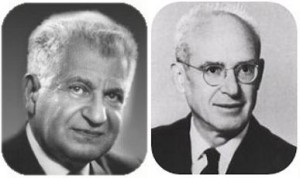
Podolsky and Rosen
Nathan Rosen (1909-1995) was born in Brooklyn and studied at MIT during the Great Depression. While still young, he published several famous papers, including ‘The Neutron’, which predicted the structure of the nucleus a year before it was discovered. Between 1935 and 1945 he was Albert Einstein’s personal assistant at Princeton. Together, they discovered (mathematically) a “bridge” connecting distant areas of space – now called a wormhole. With Einstein’s encouragement, Rosen moved to the nascent State of Israel and joined Haifa’s Technion in 1953. He later served as President of Ben-Gurion University, founded the Israel Academy of Sciences and Humanities, the Physical Society of Israel, and the International Society for General Relativity and Gravitation. Aside from all this, he is most famous for coming up with the well-known “EPR Paradox” together with Einstein and a fellow Jewish scientist named Podolsky (hence “EPR”).
Boris Yakovlevich Podolsky (1896-1966) was born in Russia to a poor Jewish family which immigrated to the U.S. in 1913. He served in the US Army and worked as an electrical engineer before returning to school and earning a PhD from Caltech. In 1933 he was given a fellowship at Princeton, which led to his collaboration with Einstein and Rosen on the EPR Paradox. Interestingly, some have suggested that Podolsky was a Soviet spy, codenamed “Quantum”, and helped the Soviets start their nuclear program during World War II. His major legacy, however, is in the great work he did on solving various complex physics problems of the day.
Words of the Week
Education is not the learning of facts, but the training of the mind to think.
– Albert Einstein
 Feigele Peltel (1921-2012) was born in Warsaw, Poland. At 21 she joined the Jewish Combat Organization. Using her “Aryan” looks and fluency in Polish, she was able to pose as a Pole and come in and out of the Warsaw Ghetto. Through this, she smuggled weapons and supplies in, while saving countless children (and adults) by bringing them out of the ghetto. Her code name was ‘Vladka’, which she later adopted as her legal name. She also worked as a recruiting agent to bring more people into the resistance. One of these was Benjamin Meed, whom she would later marry in the U.S. Together they were among the key organizers of the infamous Warsaw Ghetto Uprising. Vladka wrote a popular book about her experiences, and along with her husband, continued to work in Holocaust education for the rest of her life.
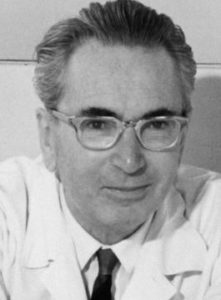 Meanwhile, Viktor Emil Frankl (1905-1997) was a distinguished psychiatrist and neurologist in Austria. He showed a talent for psychology at an early age, and provided psychoanalysis for high school students free of charge while in med school. He later worked in the dreaded “Suicide Pavilion” where he treated over 30,000 women at risk for suicide. After the Nazi takeover, Frankl was first demoted, then imprisoned, and spent three years in concentration camps. He used these experiences to develop a new philosophy of psychology, described in his world-famous book Man’s Search for Meaning (originally titled Saying Yes to Life in Spite of Everything). Frankl founded logotherapy, based on the belief that the central motivating force in humans is to find meaning in life, and most problems stem from this deficiency. Frankl revolutionized the field of psychology, wrote several highly-acclaimed books, and won multiple prestigious awards. Interestingly, he proposed that just as there is a Statue of Liberty on the East Coast, there should be a Statue of Responsibility on the West Coast. Plans are now in the works to build
 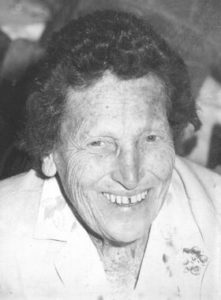 Born in South Africa to poor immigrants from Russia, Tikvah Alper (1909-1995) showed a talent for maths and sciences at an early age. At age 20, she traveled to Berlin to work on her doctorate with former Jew of the Week