Category Archives: Science & Technology

Jews in the World of Science and Technology

Jew of the Week: Aletta Jacobs

A Great Pioneer for Women’s Rights

Aletta Jacobs

Aletta Henriëtte Jacobs (1854-1929) was born in a small village in the Netherlands, the eighth of twelve children. Growing up, she often accompanied her doctor father to work and developed a passion for medicine. Unfortunately, medical school (as well as high school) was barred to women at the time. Undeterred, Jacobs studied on her own, and passed the exam to become a pharmacist. This made her quite famous, and in 1871 the Dutch Prime Minister personally granted her permission to attend the University of Groningen. Jacobs was the university’s first female student, and eight years later became the first female physician in the Netherlands. During a brief period of study in London, Jacobs joined a group of suffrage activists and became a noted feminist. She discovered the need for effective contraceptives for women, and back in Amsterdam, starting to work on a new type of diaphragm. Many credit her as a co-inventor of the device. Jacobs opened her own medical clinic, focused on serving the poor. She fought tirelessly to alleviate the terrible living conditions of Amsterdam’s impoverished neighbourhoods, campaigned for public housing, worker’s rights, and for an end to prostitution. By 1903, Jacobs left the field of medicine and devoted herself full time to women’s rights. She traveled around the world to speak about women’s issues, and inspired many along the way. She also wrote regularly for a Dutch newspaper. During World War I, she was a staunch peace activist, meeting with European leaders to stop the conflict. She even met with US President Woodrow Wilson in 1915 to try to convince him to mediate an end to the fighting. In 1919, Jacobs saw the fruits of her labour when the Netherlands finally granted women the right to vote. She continued her important work until the last days of her life. Jacobs is included in the official ‘Canon of Dutch History’, which is taught in all primary and secondary schools in the Netherlands.

Words of the Week

I will insist that the Hebrews have done more to civilize men than any other nation… They have given religion to three quarters of the globe and have influenced the affairs of mankind, more and more happily than any other nation, ancient or modern.
John Adams, 2nd President of the United States, in a letter to F.A Van der Kemp, 1809
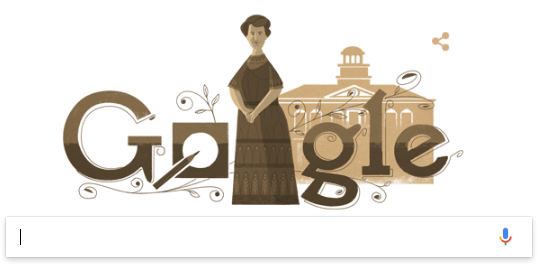
On February 9th (her birthday), Aletta Jacobs was featured in a Google Doodle

Jew of the Week: Hermann Schapira

Founder of the Jewish National Fund

Zvi Hermann Hirsch Schapira (1840-1898) was born to a religious Russian-Jewish family in a small Lithuanian village. He studied to become a rabbi and at age 24 was appointed to his first post. However, he soon decided to pursue his passion for the sciences and ended up studying at a Berlin academy. Three years later, he settled in Odessa and worked for several years as a merchant. In 1878, Schapira moved to Heidelburg and spent another four years studying math and physics, during which time he earned his doctorate. He became a math professor at the University of Heidelburg, and published several important papers. Throughout this time, he continued studying Jewish literature, and contributed to three Hebrew periodicals. By 1884, Shapira was a vocal Zionist, and suggested the establishment of a Jewish National Fund which would buy land in Israel and help settle Jews there. He formally proposed the idea to the First Zionist Congress in 1897, where he also suggested the establishment of a Hebrew University in Jerusalem. Tragically, Schapira died the following year from pneumonia. The Jewish National Fund would finally be launched three years later, and it would take another two decades before the Hebrew University would open its doors. The JNF would go on to become one of the most important organizations in Israel’s history, and instrumental in the nascent state’s success. It purchased over 50% of Israel’s landmass, developed over 250,000 acres of its land, planted some 260 million trees, built nearly 200 dams and reservoirs, and established over 1000 parks. The JNF also played a key role in the founding of Tel Aviv in 1909, and in running Israel’s first postal service. It still owns about 13% of Israel’s land, and in the past decade alone, helped Israel expand its water capacity by 7%. The JNF is perhaps most famous for its Tu b’Shevat tree-planting drive, which over a million Jews participate in every year.

Happy Tu b’Shevat!

Words of the Week

When God created the first man, He showed him all the trees of the Garden of Eden, and said to him: “See My works, how beautiful and praiseworthy they are. And everything that I created, I created it for you. Be careful not to spoil or destroy My world, for if you do, there will be nobody after you to repair it.”
– Midrash (Kohelet Rabbah 7:13)

Jew of the Week: Dan Bricklin

“Father of the Spreadsheet”

Daniel Singer Bricklin (b. 1951) was born in Philadelphia and studied at its Akiba Hebrew Academy. He graduated from MIT in 1973 with a degree in electrical engineering and computer science. His first job was working at a tech company called DEC, replacing typewriters with computers for newspaper companies. He then became DEC’s project leader on its development of the first word-processing software. After a few years, Bricklin moved on to work at FasFax, designing some of the first electronic cash registers for fast food companies. In 1979, he got an MBA from the Harvard Business School. During his studies there, fed up with repetitive and tedious calculations, Bricklin came up with an idea for an electronic spreadsheet. Teaming up with his friend, the two put together a new program called VisiCalc for the Apple II computer. This was the first spreadsheet software ever made, and the foundation for future spreadsheet programs like Excel. In fact, it was VisiCalc that transformed the computer from a mysterious device reserved for techies to a practical tool used by mainstream businesses and consumers. VisiCalc skyrocketed sales of the Apple II, leading Steve Jobs to admit that it “propelled the success of Apple… more than any other single event… If VisiCalc had been written for some other computer, you’d be interviewing somebody else right now.” A New York Times article at the time wrote humorously, but accurately: “All Hail VisiCalc.” For this, Bricklin was awarded the prestigious Grace Murray Hopper Award, among many others. Since then, Bricklin has started a number of other successful tech and software companies, and is currently the president of Software Garden, and the CTO of Alpha Software. He has also published a book, and has been featured in two documentaries. Watch Bricklin’s short and fascinating TED talk here.

Words of the Week

In the absence of any other proof, the thumb alone would convince me of God’s existence… Atheism is so senseless and odious to mankind that it never had many professors.
– Isaac Newton