
The Rabbi Who Discovered the Quadratic Formula
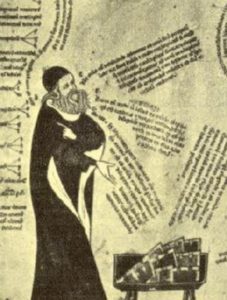 Avraham bar Chiya (c. 1070-1145) was born in Barcelona to a Sephardic Jewish family. It appears that his family was persecuted by its Christian rulers, so they fled to the neighbouring Arab kingdom of Zaragoza. Bar Chiya came from a long line of rabbis, and was also extensively trained in science, math, and astronomy. Famed for his wisdom, he became the court astronomer of Al-Musta’in II. Eventually, he was appointed minister of police and given the title sahib al-shurtah, “city governor”. This is why he was known in the Jewish community as HaNasi, “the prince” or “the president”. Al-Musta’in II was unable to defend his domain from the Christians, who soon took over. Bar Chiya moved to southern France for a while and lived in Narbonne and Provence. There he composed some of the most important scientific texts of the Medieval era. He translated a number of Arabic works into Latin, opening their study for Europeans, and played a key role in introducing the Hindu numerals we use today (by way of Arabia) to Europe, and thus to the rest of the world. Bar Chiya also synthesized ancient Greek wisdom with contemporary Arabic knowledge, and published new discoveries in number theory, arithmetic, geometry, optics, astronomy, and music theory. His Treatise on Measurement and Calculation inspired later greats like Plato of Tivoli and the world-famous Fibonacci. Meanwhile, Bar Chiya also served as the chief rabbi of the Jewish communities he presided over, and composed two important Jewish commentaries and texts. He is credited with being the first person to write a scientific book in Hebrew, and played an instrumental role in the development of the Hebrew language. His disciples included both Jews and non-Jews, among them the great Rabbi Abraham ibn Ezra, and the Flemish astronomer Rudolf of Bruges. The first historical appearance of the quadratic equation (with a complete solution of x2 – ax + b = c) appears in one of Bar Chiya’s works! He is also referenced in many philosophical works as “Abraham Judaeus”. All in all, his impact on the development of science, mathematics, and human history is unparalleled.
Jew of the Week Turns 10 Years Old Today!
What I Learned from 10 Years of Writing Jew of the Week
Words of the Week
The mind of man plans his way, but God directs his steps.
– King Solomon (Proverbs 16:9)
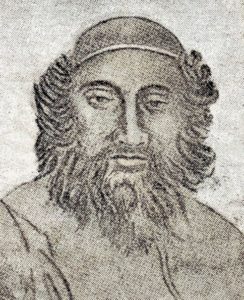
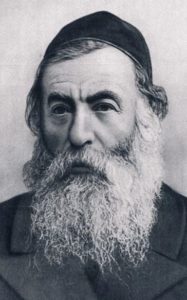 Yitzchak Yaacov Reines (1839-1915) was born near what is now Pinsk, Belarus to a long line of rabbis. He studied at the famous Volozhin Yeshiva where he received his rabbinic ordination in 1867. Rabbi Reines became the rabbi of the town of Svintsyan, Lithuania, just north of Vilnius. There, he opened his own yeshiva which, for the first time, included a secular studies curriculum as well. In 1882, a large assembly of rabbis gathered in St. Petersburg to discuss easing the plight of Russian Jewry, then suffering immense persecution and poverty. Reines proposed spreading his successful yeshiva model across Russia, allowing Jews to integrate into mainstream society (and economy) without abandoning their faith and traditions. The assembly rejected his plan, so Reines continued his mission on his own. His Svintsyan Yeshiva created a ten-year program that would give students both rabbinic ordination and a government-approved job. Unfortunately, the yeshiva faced too much opposition and shut down after four years. Meanwhile, Rabbi Reines was an active member of Hovevei Zion. In 1893, together with Rabbi Shmuel Mohilever, he proposed that Jews settle in their ancestral Holy Land and organize a mercaz ruhani, “spiritual centre”, that would combine Torah with good-old-fashioned agricultural labour. In 1899, Reines participated in the Third Zionist Congress, following which he kept a regular correspondence with