Category Archives: Religious Leaders

Spiritual and Religious Greats of the Jewish People

Jew of the Week: Salome Alexandra

Queen of Judea

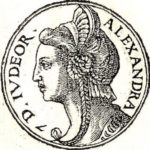
Shlom-Tzion (139–67 BCE), more commonly known by her Hellenized name Salome Alexandra, has the distinction of being the only true, independent Jewish Queen of Israel in history. Her husband was the king Alexander Yannai, a Sadducee who sparked a civil war and began an extermination campaign against traditional Judaism. At his death, Salome took over and restored peace to the kingdom. She ended her husband’s cruel persecutions of the rabbis (recalling many of them from exile in Egypt, including her brother, the great Shimon ben Shetach). She also re-established the Sanhedrin, the Jewish Supreme Court. Together with the sages of the day, a public school system was instituted for all children, rich or poor. Salome also championed the rights of women and developed the marriage document (ketuba) with clauses that protect the bride, as we still use to this day. Greatly expanding the army and fortifying Judea’s borders, Salome protected the kingdom from foreign powers (particularly Armenia and Syria). Her reign was marked by incredible prosperity, and the Talmud recounts that during her nine-year rule the rains always came in their times, oats grew as large as olives and wheat grains as large as kidney beans. Sadly, the kingdom quickly unraveled at her death, and was shortly after conquered by Rome.

Words of the Week

Freedom of choice has been granted to every person: if he desires to turn toward a good path and be righteous, the ability to do so is in his hands; and if he desires to turn toward an evil path and be wicked, the ability to do so is in his hands…

– Rabbi Moses ben Maimon (Maimonides)

Jew of the Week: Shimon bar Yochai

The Zohar

One of the greatest sages of all time, Shimon bar Yochai (c. 2nd century CE), also known as Rashbi, lived in the era following the destruction of the Second Temple nearly two thousand years ago. He was one of just a handful of new students of the great Rabbi Akiva, whose original 24,000 students all perished, likely at the hands of the Roman Empire. Judaism was literally on the verge of extinction when Rabbi Shimon and a few others began to teach the masses once again. However, a spy informed on bar Yochai, forcing him to hide in a cave with his son for 13 years, where they did nothing but study Torah, living off a nearby carob tree and a spring of water. They attained such a level of greatness that it is said the whole universe was sustained only in their merit. After a change in the Roman government, Shimon and his son emerged from the cave. They established an academy in Tekoa where the top minds of the day studied (including Yehuda haNasi, who would later begin the process of writing down the Oral Torah). Unfortunately, a new Roman government began persecuting Jews once more. Rabbi Shimon headed a delegation to Rome. It just so happened that the Emperor’s daughter was suffering from an incurable ailment that no physician could cure. With his mystical powers, Shimon cured the girl and for his reward, asked that the edict against the Jews be rescinded. He thus saved the community, and returned to Israel spending the rest of his life re-establishing the Jewish nation. It was on the 18th of Iyar, the 33rd day of the Omer period, that Rashbi gathered his students and began revealing the deepest secrets of the Torah. It is said that of all the secrets he revealed, just one out of 22 parts was ultimately preserved. This one volume was later published as the famous Zohar, the primary text of Kabbalah. Because of this great revelation of light, Shimon bar Yochai’s extraordinary life is celebrated on Lag B’Omer (“Lag” meaning 33), with the lighting of large bonfires and many other mystical customs.

Words of the Week

There are three crowns: the crown of the Torah, the crown of priesthood, and the crown of royalty; but the crown of a good name surpasses them all.
– Rabbi Shimon bar Yochai

Jews of the Week: Miriam and Aaron

Holy Siblings

The Exodus

When it comes to Passover, most of the attention is placed on Moses (realizing this, the Jewish Sages who composed the Passover Haggada omitted any mention of Moshe!) Few give credit to Moses’ elder siblings (and prophets) Aaron and Miriam. It was the prophecy of the eldest Miriam that inspired the Israelites in Egypt to start procreating again, after they had previously decided not to bring any more children into such a cruel existence. That stimulus gave birth to Moses. It was Miriam who ensured the basket stayed afloat in the Nile, and who made sure Moses received a Jewish wet nurse (his mother!) even though he grew up in Pharaoh’s palace. Later, we are told that Miriam had a mystical well that supplied the Israelites with all their water needs during their travels through the wilderness. The Talmud explains Miriam was nicknamed Azuva (“left behind”) since she was physically unappealing and had a hard time finding a husband. However, a great man named Caleb married her for her spiritual holiness. Miraculously, she transformed into a very beautiful woman, and was thus renamed Efrat (which means “beauty”). This marriage gave birth to the ancestor of King David (and therefore Mashiach)!

Meanwhile, Aaron was the leader of the Jews in Egypt. Because Moses had a speech impediment, Aaron was the official mouthpiece and spokesperson of God. He also carried out the first three of the 10 plagues that struck the Egyptians. For his peace-loving and self-sacrificing ways, Aaron was later granted the high priesthood, and all his descendants became Cohanim. Amazingly, scientists have discovered a gene on the Y-chromosome that is shared by cohanim around the world, whether Ashkenazi, Sephardic or other. The gene traces back 3300 years, which is precisely the time of the Exodus!


Words of the Week

There are none so hopelessly enslaved as those who believe they are free.
– Von Goethe