Category Archives: Law, Politics & Military

Jews in the World of Law and Politics

Jew of the Week: Sir Moses Montefiore

The Legendary Moses Montefiore

Moshe Chaim Montefiore (1784-1885) was born in Livorno, Italy to a wealthy Sephardic family. Raised in England, he worked as a grocery merchant before earning great wealth in the stock exchange. In 1824, Montefiore retired and dedicated his life to making the world a better place, funding countless schools, hospitals and other institutions. He was a key figure in abolishing slavery, and even raised the money used to compensate angry plantation owners. Montefiore served as Sheriff of London, and was knighted by Queen Victoria for his selflessness. In 1827 he travelled to Israel and the experience returned him to his Jewish roots. He became a strictly Torah-observant Jew, so much so that he had a personal shochet travel with him so that he can have kosher meat. Fighting for each individual Jew, Montefiore personally went to Turkey to gain the release of 10 imprisoned Jews. He did the same in trips to Russia, Morocco, Rome and Romania. In 1862 he built a Sephardic yeshiva, in addition to the great Montefiore synagogue, built on the former estate of Queen Caroline. Montefiore would make 7 trips to the Holy Land over his life time (the last at age 91!) setting the ground work for the Zionist movement. He financed much of the early construction projects, including the first printing press and textile factory, established multiple agricultural colonies, and even commissioned several censuses that provide us with important information to this day. Montefiore died childless at the age of 100. His centenary was celebrated as a national holiday. Today, the 13th of Av, is his yahrzeit.

Words of the Week

A wealthy anti-Semite once told Moses Montefiore that he had just returned from Japan, where there are “neither pigs nor Jews.” Sir Moses replied: “then you and I should go there, so that they should have a sample of each.”
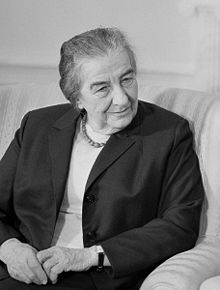
Jew of the Week: Golda Meir

Golda Meir

Golda Meir

Golda Mabovitch (1898-1978) was born in Ukraine and moved with her family to Milwaukee when she was 7 years old. A leader from her youth, she raised funds to pay for her classmates’ textbooks while in elementary school, and ran her parents’ grocery store in their absence. At 14, Golda rebelled against her mother’s wishes to abandon her studies and get married. Instead, she fled to Denver to live with her older sister. There she was first exposed to Zionism, and met her husband Morris Meyerson, from whom she took the last name, later shortening it to Golda Meir. She only married him with the promise that they would move to Israel. After working as a teacher for a few years, Meir finally made aliyah in 1921, joining a kibbutz where she worked on farms and chicken coops. Recognizing her leadership, the kibbutz appointed her their representative to the Histadrut (Federation of Labour). Meir rose through the ranks, eventually becoming head of the Jewish Agency and chief negotiator with the British Mandate. In 1948, she single-handedly raised $50 million for Israel to purchase arms in the wake of war. Ben-Gurion famously said that this was the money that “made the State possible”. She was one of 24 signatories of the Declaration of Independence, and the first person to carry an Israeli passport. Meir served as Labour Minister, and then Foreign Minister, until retiring in 1966 due to lymphoma. But she came back three years later, aged 72, to become Israel’s Prime Minister. She was Israel’s “iron lady” during the Yom Kippur War, maneuvering a victory against all odds. Nonetheless, she took the blame for the war and resigned. She succumbed to lymphoma shortly after. A winner of the Israel Prize, and voted to the list of greatest Israelis, her maxims are often quoted. Meir once said: “Pessimism is a luxury that a Jew can never allow himself.”

Words of the Week

Ten measures of speech were given to the world, and nine of them were granted to women.
– Talmud, Kiddushin 49b

Jew of the Week: Uriah P. Levy

America’s Commodore

Happy 4th of July!

Uriah Phillips Levy (1792-1862) was born in Philadelphia to parents descended from German and Portuguese Jews. At age 10, he left home to work as a cabin boy on a merchant ship. At 13, he returned home for his Bar Mitzvah (having already traveled the world!) He continued on the nautical path and became a sailor. Levy enlisted in the navy during the War of 1812, where he was captured and imprisoned for 16 months. After the war, he returned to the navy and rose through the ranks, participating in many conflicts (including the Barbary Wars) and eventually becoming commodore of the Mediterranean Fleet. This made him the first ever Jewish commodore – the highest naval rank at the time. Facing extreme anti-Semitism throughout his military career, he would defend his honour in some violent fights, for which he was court-martialed no less than 6 times! He became a champion of the lowly soldier, refusing to participate in flogging or any form of corporal punishment. For this he was dismissed from his post, but by 1850 was able to convince Congress to pass an anti-flogging bill, thus abolishing the practice. He then wrote a new manual for humane military discipline. Away from the army, Levy found success in real estate, and became a noted philanthropist. In 1834 he purchased Thomas Jefferson’s estate (Monticello) and paid for its restoration. For this he is considered by many to be the first (modern) person to restore a historical site. He donated Monticello to the U.S. government in 1862. He also commissioned a statue of Jefferson for the Capitol building, which remains to this day the only piece of artwork in the Capitol to be privately commissioned. Levy financed the Bnai Yeshurun Jewish seminary of New York and served as the first president of the Washington Hebrew Congregation. The destroyer ship USS Levy is named after him.

Words of the Week

Do not harden your heart nor shut your hand from your destitute brother.
– Deuteronomy 15:7.
It is forbidden to withhold charity and relief for the needy if we are aware of their desperate situation and have the means to assist them. This is one of the 613 commandments of the Torah.