Category Archives: Law, Politics & Military

Jews in the World of Law and Politics

Jews of the Week: Shushandukht and Bahram V

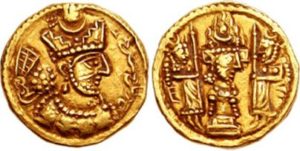
Gold Coins Depicting Iranian Shah Bahram V, often referred to as Bahramgur – “Bahram the Hunter”

Shushandukht (c. 380-430 CE) was born in Persia, the daughter of the Resh Galuta (Exilarch), a title reserved for the chief rabbi and official leader of the Jews in the diaspora during this time period. Little is known of her early life. She went on to marry the Sasanian king Yazdegerd I, and gave him two sons, Shapur IV and Bahram V (c. 406-438 CE). Yazdegerd and Shapur were assassinated, triggering a brief civil war that ended with Bahram successfully taking the throne. Bahram V went on to reign for nearly two decades as Iran’s Shah. In that time, he held off the advancing Eastern Roman Empire and conquered Armenia. Later, a massive invasion by the feared Huns nearly destroyed his empire. However, he caught the Huns unaware in a surprise night attack, decimating their force, and bringing peace to the entire region. Bahram presided over a period of great Persian wealth. Coins with Bahram’s portrait have been found across Asia. Not surprisingly, Bahram V became one of the most legendary kings in Asian history, and is an important figure not just in Iran, but in Uzbekistan, Pakistan, India, and even in Islamic literature (despite the fact that the Muslims tried pretty hard to erase pre-Islamic Iranian history). Bahram V is the hero of many ancient Persian legends. One of these was translated into English under the title The Three Princes of Serendip – giving rise to the word “serendipity”. In the famous Persian epic Shahnameh, he is the king that slays two lions with his bare hands. Meanwhile, his mother Shushandukht used her position to assist the Jews of Iran (where the vast majority of the world’s Jews lived at the time). She established large and prosperous Jewish neighbourhoods in Esfahan, Susa, Hamadan, and Shushtar. During this period, the Jewish Exilarch sat on the Shah’s court. Many scholars believe that the ‘Tomb of Esther and Mordechai’ in modern-day Iran is actually the tomb of Shushandukht.

Words of the Week

It is more important to know what sort of person has a disease than to know what sort of disease a person has.
– Hippocrates
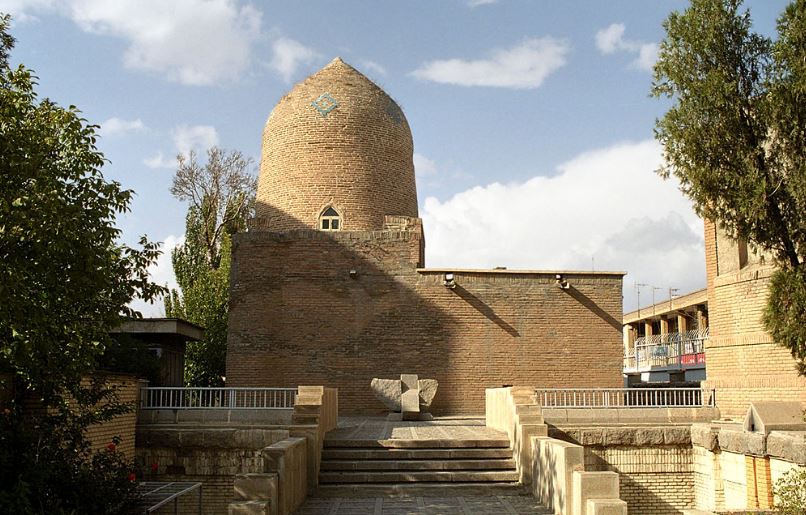
Tomb of Esther and Mordechai (or Shushandukht) in present-day Hamadan, Iran (Credit: Philippe Chavin)

Jew of the Week: Aletta Jacobs

A Great Pioneer for Women’s Rights

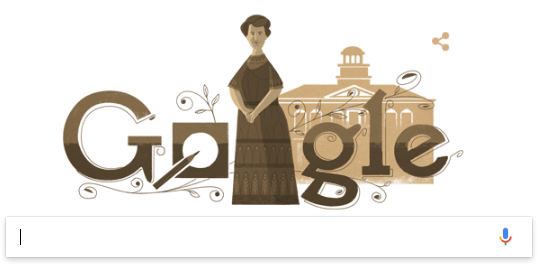
Aletta Jacobs

Aletta HenriĆ«tte Jacobs (1854-1929) was born in a small village in the Netherlands, the eighth of twelve children. Growing up, she often accompanied her doctor father to work and developed a passion for medicine. Unfortunately, medical school (as well as high school) was barred to women at the time. Undeterred, Jacobs studied on her own, and passed the exam to become a pharmacist. This made her quite famous, and in 1871 the Dutch Prime Minister personally granted her permission to attend the University of Groningen. Jacobs was the university’s first female student, and eight years later became the first female physician in the Netherlands. During a brief period of study in London, Jacobs joined a group of suffrage activists and became a noted feminist. She discovered the need for effective contraceptives for women, and back in Amsterdam, starting to work on a new type of diaphragm. Many credit her as a co-inventor of the device. Jacobs opened her own medical clinic, focused on serving the poor. She fought tirelessly to alleviate the terrible living conditions of Amsterdam’s impoverished neighbourhoods, campaigned for public housing, worker’s rights, and for an end to prostitution. By 1903, Jacobs left the field of medicine and devoted herself full time to women’s rights. She traveled around the world to speak about women’s issues, and inspired many along the way. She also wrote regularly for a Dutch newspaper. During World War I, she was a staunch peace activist, meeting with European leaders to stop the conflict. She even met with US President Woodrow Wilson in 1915 to try to convince him to mediate an end to the fighting. In 1919, Jacobs saw the fruits of her labour when the Netherlands finally granted women the right to vote. She continued her important work until the last days of her life. Jacobs is included in the official ‘Canon of Dutch History’, which is taught in all primary and secondary schools in the Netherlands.

Words of the Week

I will insist that the Hebrews have done more to civilize men than any other nation… They have given religion to three quarters of the globe and have influenced the affairs of mankind, more and more happily than any other nation, ancient or modern.
John Adams, 2nd President of the United States, in a letter to F.A Van der Kemp, 1809

On February 9th (her birthday), Aletta Jacobs was featured in a Google Doodle

Jew of the Week: Judith

Heroine of Chanukah

Judith displaying the head of Holofernes

Judith displaying the head of Holofernes

Yehudit bat Merari (c. 2nd century BCE) was a Jewish woman who lived in the town of Bethulia in Israel. Her husband, Menashe, fought and died with the Maccabees during the Chanukah wars against the Syrian-Greeks. When a massive Greek legion led by General Holofernes invaded her village, the local men were too frightened to fight back. Taking matters into her own hands, the young widow (together with her maid) crossed enemy lines and pretended to be a Greek spy. Slowly, she got closer to the Greek authorities and eventually made it to the tent of Holofernes. One night, Judith plied him with wine and fed him cheese until he was asleep. She then decapitated him with his own sword. Judith brought the head back to the fearful Israelites and roused them to attack the Greeks. Her inspirational words and wise military counsel led to a monumental Jewish victory. Jewish texts credit this event as the turning point of the war, leading to the recapture and re-dedication of the Holy Temple, the preservation of Judaism, and the ultimate collapse of the Syrian-Greek empire. Judith is often listed as one of the genuine prophetesses of Israel, and a great heroine like Esther, Deborah, Yael, and many others before her. (She was even canonized as a saint in Catholicism!) In honour of her feat, it is customary to eat dairy products during the 8-day festival of Chanukah, and for women to abstain from any work while the Chanukah lights are burning. Judith continued to lead the nation until her passing at the age of 105.

Chanukah Begins Saturday Night! Chag Sameach!

Words of the Week

The darkest time of the night is just before dawn.
Midrash Tehillim, Chapter 22